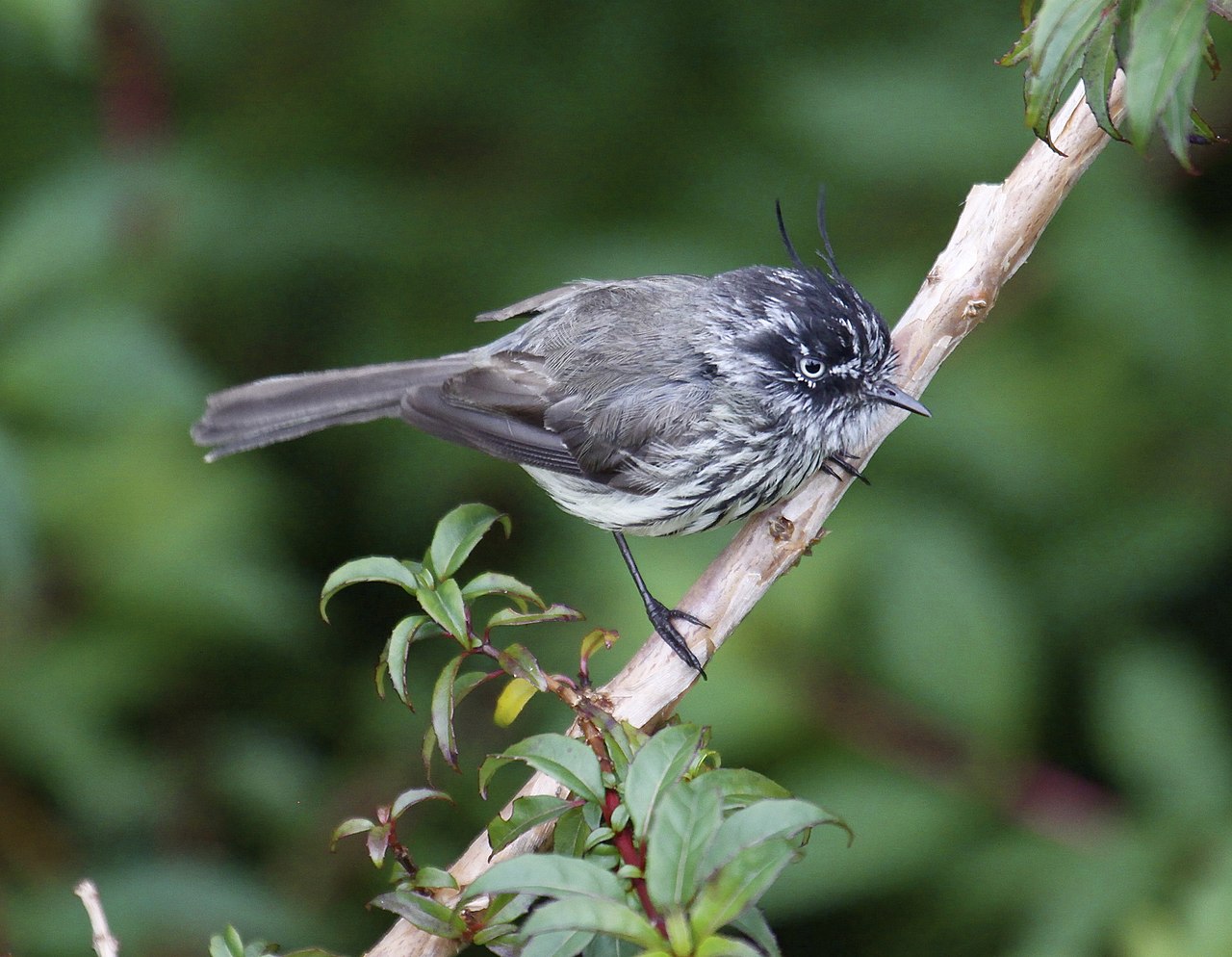
The tufted tit-tyrant is a species of bird in the tyrant flycatcher family Tyrannidae. This species is found in western South America; its range stretches from southern Colombia south along the Andes mountains to Tierra del Fuego. It prefers to live in upper montane forests and shrublands; however, it is a habitat generalist and can be found across a wide range of ecosystems. The tufted tit-tyrant has three subspecies, including the nominate subspecies Anairetes parulus parulus, A. p. aequatorialis, and A. p. patagonicus, and is very closely related to the Juan Fernández tit-tyrant. It is very small with a distinctive and conspicuous crest. The bird's head is black overall with white supraloral and postocular stripes. Its dull grayish-brown back contrasts with its white throat and breast that are covered with black streaks and pale, unmarked yellow underbelly. There are few noticeable differences in plumage between the subspecies. It is a vocal flycatcher with a broad repertoire of songs.
Region
Andes Mountains
Typical Environment
Occurs along the western spine of South America from southern Colombia through Ecuador, Peru, and Bolivia to Chile and Argentina, reaching Tierra del Fuego. It favors upper montane forests, Polylepis woodlands, matorral, and shrubby edges, but is a habitat generalist that also uses open country, hedgerows, and urban parks. In the far south it can occur near sea level, while in the central Andes it ranges into high-elevation scrub and forest edges. Frequently forages in second-growth and disturbed landscapes.
Altitude Range
Sea level to 4000 m
Climate Zone
Highland
Ease of Keeping
Beginner friendly: 1/5
This tiny tyrant flycatcher is named for its tit-like behavior—restless, crest-cocked, and constantly gleaning among twigs. It ranges from southern Colombia down the Andes to Tierra del Fuego and adapts well to a variety of shrubby and forest-edge habitats. It often joins mixed-species flocks and is closely related to the Juan Fernández tit-tyrant.


A tufted tit-tyrant, A. p. aequatorialis

A tufted tit-tyrant, A. p. aequatorialis

Porlieria chilensis in tufted tit-tyrant habitat
Temperament
social and active
Flight Pattern
short rapid wingbeats with agile hovering and darting sallies
Social Behavior
Usually seen in pairs or small family groups and commonly joins mixed-species flocks. Builds a small cup nest in shrubs or trees; pairs are likely monogamous during the breeding season. Highly territorial during nesting but tolerant in nonbreeding flocks.
Migratory Pattern
Partial migrant
Song Description
A lively series of thin, rapid trills, squeaky chips, and scolds delivered in quick bursts. Calls are high-pitched and penetrating, often given while actively foraging or when agitated.
Plumage
Small, crested flycatcher with dull grayish-brown upperparts, two pale wingbars, and a contrasting white throat and breast heavily streaked black. The head appears dark with bold white supraloral and postocular stripes; the underbelly is pale yellow to yellowish wash. Tail is fairly long and often cocked; crest is conspicuous.
Diet
Primarily small insects and other arthropods such as flies, beetles, caterpillars, and aphids. Captures prey by sallying from exposed perches, hover-gleaning from foliage, and picking from twigs. Occasionally takes small berries, especially in cooler seasons when insects are scarce.
Preferred Environment
Forages in shrublands, forest edges, second-growth, and hedgerows, from low shrubs to mid-canopy levels. Often utilizes scrubby patches and disturbed habitats near human settlements and along roadsides.