

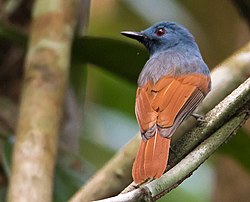
The rufous-winged philentoma is a bird species. They are now usually assigned to the Vangidae. It is found in Brunei, Indonesia, Malaysia, Myanmar, Thailand, and Vietnam. Its natural habitat is subtropical or tropical moist lowland forests.
Region
Southeast Asia
Typical Environment
Occurs in lowland and foothill evergreen forests across southern Myanmar, Thailand, Vietnam, Peninsular Malaysia, Brunei, and parts of Indonesia (including Borneo and Sumatra). Prefers primary and mature secondary forest, often along shaded edges and streams. Regular in peat swamp and heath (kerangas) forest where intact canopy and understory are present. Typically keeps to the lower to mid understory and midstory. Avoids open country and is scarce in heavily logged or highly fragmented habitats.
Altitude Range
Sea level to 1200 m
Climate Zone
Tropical
Ease of Keeping
Beginner friendly: 1/5
Once placed with monarch flycatchers, the rufous-winged philentoma is now usually assigned to the Vangidae based on morphology and genetics. It has a broad, slightly hooked bill adapted for sally-gleaning insects from the foliage. Often joins mixed-species flocks in the forest understory. Sensitive to extensive forest degradation and fragmentation.

Temperament
shy and unobtrusive
Flight Pattern
short rapid wingbeats
Social Behavior
Usually seen singly, in pairs, or small family groups, and frequently participates in mixed-species understory flocks. Forages by sally-gleaning from shaded perches, often returning to the same branch. Nests are neat cups placed low to mid-level in the understory; both parents likely share care duties.
Migratory Pattern
Resident
Song Description
Delivers soft, fluty whistles and mellow, rising phrases, interspersed with thin contact notes. Vocalizations are modest in volume and may go unnoticed unless at close range.
Plumage
Slate-gray to gray-brown upperparts with a distinct rufous panel in the wings and rufous tones in the tail; underparts pale gray to whitish. Feathers are smooth and close-fitting, giving a neat, compact appearance. The heavy, broad-based bill and subtle facial mask contribute to a distinctive profile.
Diet
Primarily takes insects such as beetles, orthopterans, caterpillars, and other arthropods; also snaps up spiders. Uses a sit-and-sally technique, gleaning prey from leaves and twigs and making short aerial sallies. May occasionally take small berries when insect prey is scarce.
Preferred Environment
Feeds in the shaded understory and midstory of mature lowland forest, often along streams, gullies, and dense thickets. Follows mixed-species flocks to exploit disturbed prey and foraging opportunities.


