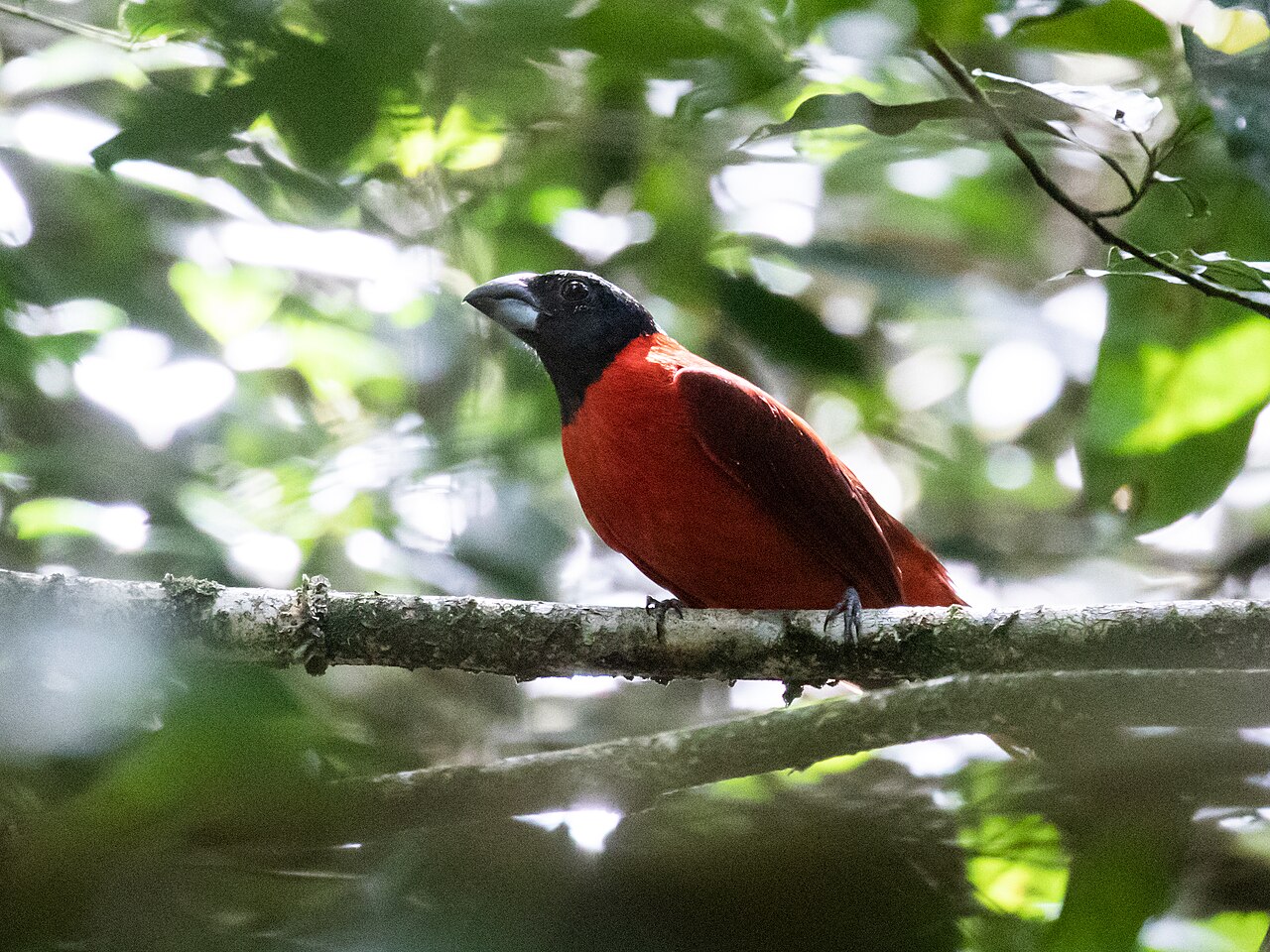
The red tanager is a medium-sized American songbird in the family Cardinalidae.
Region
North and Central America
Typical Environment
Breeds across the southern and central United States, especially in open woodlands, pine-oak habitats, riparian corridors, and edges. Migrates through Mexico to winter in Central America, the Caribbean, and northern South America. It favors sunny gaps and edges within forests where perches offer good views for flycatching. In the nonbreeding season, it uses second-growth, forest edges, and fruiting trees.
Altitude Range
Sea level to 2400 m
Climate Zone
Subtropical
Ease of Keeping
Beginner friendly: 1/5
The red tanager, better known as the Summer Tanager, is a medium-sized American songbird in the family Cardinalidae. Males are uniquely uniform red, while females are warm yellow-olive, helping distinguish them from similar species. It famously hunts bees and wasps and often rubs the stingers off before eating. During winter it shifts to more fruit in tropical forests.


Temperament
solitary and territorial
Flight Pattern
short rapid wingbeats
Social Behavior
Typically forms monogamous pairs during the breeding season and defends a territory. The female builds a shallow cup nest on a horizontal branch, often high in a deciduous tree. She incubates most of the time, while both parents feed the nestlings. Outside breeding, birds are usually solitary or loosely associated in mixed flocks on migration or wintering grounds.
Migratory Pattern
Seasonal migrant
Song Description
Song is a mellow, robin-like series of rich, slurred phrases delivered at a measured pace. The call is a distinctive pit-i-tuck or pik-i-tuk, sharp and carrying through the canopy. Males sing persistently from exposed perches during breeding.
Plumage
Males are uniformly rose-red with no wing bars; females are yellow to olive-yellow with duller olive upperparts and unbarred wings. Juveniles resemble females, with males gradually acquiring red feathers. Feathers are smooth with a sleek, even appearance.
Diet
Primarily hunts bees and wasps, often catching them on the wing and rubbing the stinger off before swallowing. Also takes other flying insects such as beetles, flies, and caterpillars, and occasionally small spiders. On the wintering grounds it consumes more fruit and berries from a variety of native trees and shrubs.
Preferred Environment
Feeds high in the canopy along forest edges, open woodlands, and riparian corridors where perches allow sallying for insects. In winter, frequents fruiting trees in second-growth and semi-open tropical forests.