
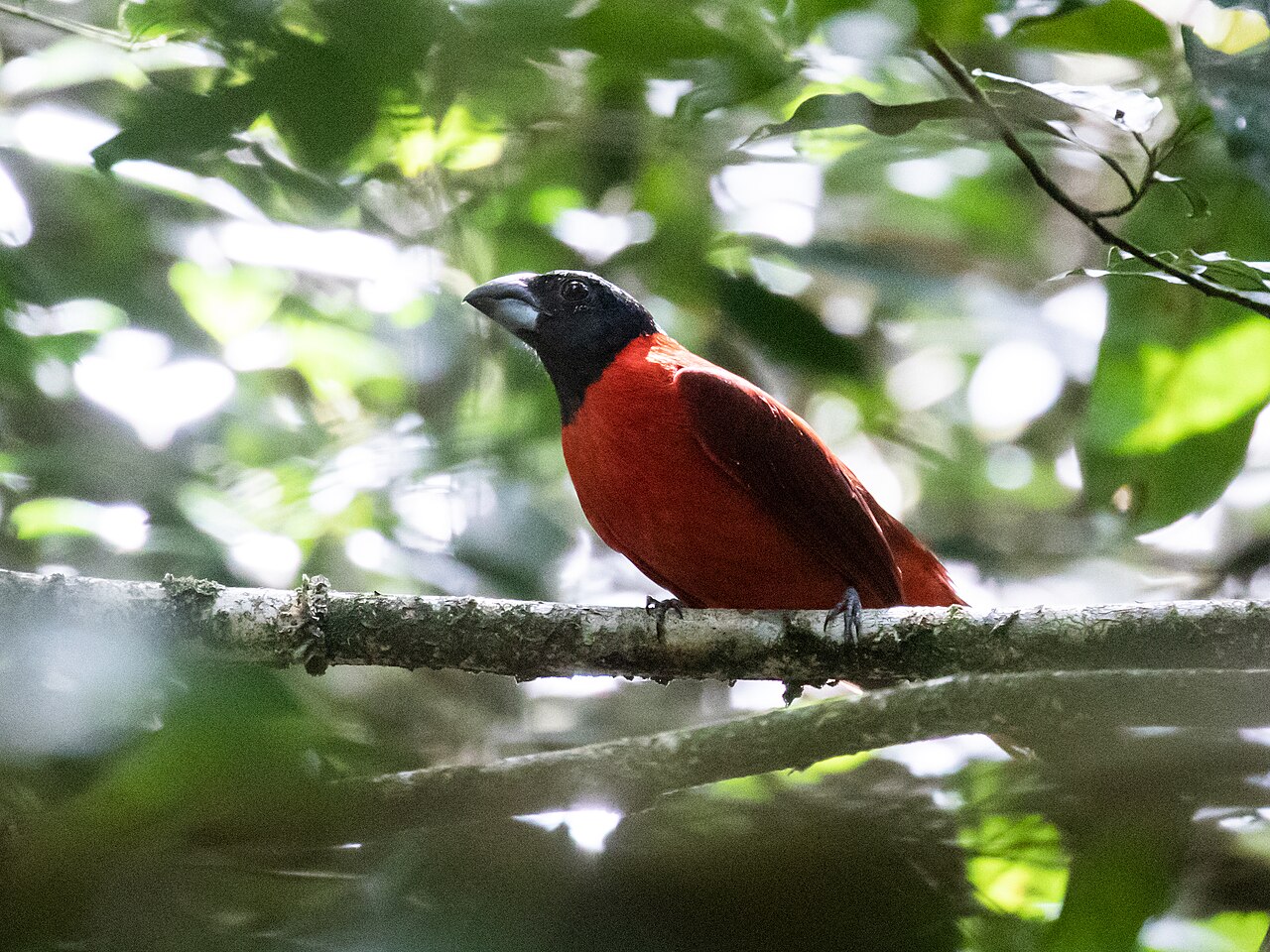
The red-and-black grosbeak is a species of bird in the family Cardinalidae, the cardinals or cardinal grosbeaks. It is found in Brazil, French Guiana, Guyana, Suriname, and Venezuela.
Region
Guiana Shield and northern Amazon Basin
Typical Environment
Occurs in northern South America, including Brazil, French Guiana, Guyana, Suriname, and southern Venezuela. Prefers mature lowland humid forest, especially terra firme and seasonally flooded várzea with dense understory. Often keeps to shaded thickets along streams, forest edges, and tall secondary growth. Generally forages at low to mid-levels, moving quietly through vine tangles and sapling layers.
Altitude Range
Sea level to 1000 m
Climate Zone
Tropical
Ease of Keeping
Beginner friendly: 1/5
Despite its striking coloration, the red-and-black grosbeak is a shy forest bird that keeps to dense understory, making it more often heard than seen. Its powerful conical bill allows it to crush hard seeds and husk fruits, and it also takes insects opportunistically. Pairs are usually discreet and maintain small territories within mature lowland rainforest. The species occurs across the Guiana Shield and northern Amazon Basin.


Temperament
solitary and secretive
Flight Pattern
short rapid wingbeats, low darting flights between cover
Social Behavior
Usually seen singly or in pairs within dense forest understory. Pairs maintain small territories and may accompany mixed-species flocks peripherally. Nesting is presumed to be a small cup placed low in dense vegetation; both sexes likely participate in parental care as in related cardinalids.
Migratory Pattern
Resident
Song Description
Song is a series of clear, mellow whistles delivered from concealed perches. Calls include sharp metallic tik notes and soft chup contact calls.
Plumage
Male shows bold contrast with rich scarlet-red head, breast, and belly, and black mantle, wings, and tail; glossy, cleanly demarcated colors. Female is duller with olive-brown upperparts and yellowish-ochre underparts, sometimes with a faint pale eyering; wings and tail darker. Juveniles resemble females but are even duller.
Diet
Feeds on a mix of fruits, seeds, and arthropods. Uses its strong bill to crush hard-coated seeds and to husk small fruits and berries. Also gleans insects and spiders from foliage and twigs, occasionally sallying short distances to snatch prey. Diet composition varies seasonally with fruit availability.
Preferred Environment
Forages in dense understory and midstory of primary and tall secondary forest. Often near fruiting shrubs, vine tangles, and along streamside thickets where cover is abundant.


