
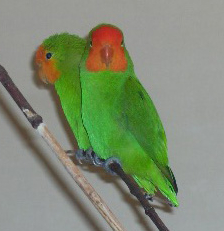
The red-headed lovebird, also known as the red-faced lovebird, is a member of the genus Agapornis, a group commonly known as lovebirds. Like other lovebirds it is native to Africa.
Region
West and Central Africa
Typical Environment
Occurs from Sierra Leone and Ghana east through Nigeria and Cameroon to the Congo Basin and western Uganda, with pockets south into northern Angola. Prefers lowland moist forests, forest–savanna mosaics, gallery forests, and wooded farmlands. Often forages along edges and in secondary growth where seeding grasses and fruiting trees are abundant. Nests are typically placed in arboreal or ground termite mounds within these habitats.
Altitude Range
0–1500 m
Climate Zone
Tropical
Ease of Keeping
Beginner friendly: 2/5
Also called the red-faced lovebird, this small African parrot shows clear sexual dimorphism: males have a vivid red face, while females are more orange-red. Unusually for parrots, it nests inside active termite mounds, where the stable microclimate protects eggs and chicks. It is considered tricky to breed in captivity because it often requires termite-mound-like conditions. Shy and fast-flying, it is more often heard than seen along forest edges.


3D scan of skeleton
Temperament
shy but social
Flight Pattern
short rapid wingbeats
Social Behavior
Usually found in pairs or small, loose flocks that keep contact with frequent calls. Strong pair bonds form during the breeding season, and pairs search for suitable termite mounds together. The female carries nesting material tucked in her rump feathers to line the chamber inside the mound.
Migratory Pattern
Resident
Song Description
High-pitched, rapid twittering interspersed with sharp, metallic chits used as contact calls in flight. Vocalizations are brief and repetitive, often carrying over forest edges and clearings.
Plumage
Compact, predominantly green plumage with darker wings and a bluish rump; short, rounded tail and swift-winged profile.
Diet
Feeds mainly on grass seeds, millet-like grains, and the seeds of herbaceous plants. Also consumes fruits, berries, and fig-like drupes when available. Buds and blossoms are taken seasonally, especially at forest edges and in secondary growth. It may visit cultivated fields to glean spilled grain.
Preferred Environment
Forages in canopy edges, tall shrubs, and seeding grasses along forest margins, woodland clearings, and agricultural mosaics. Often descends to the ground or low shrubs to pick seeds, then returns to perches to husk them.


