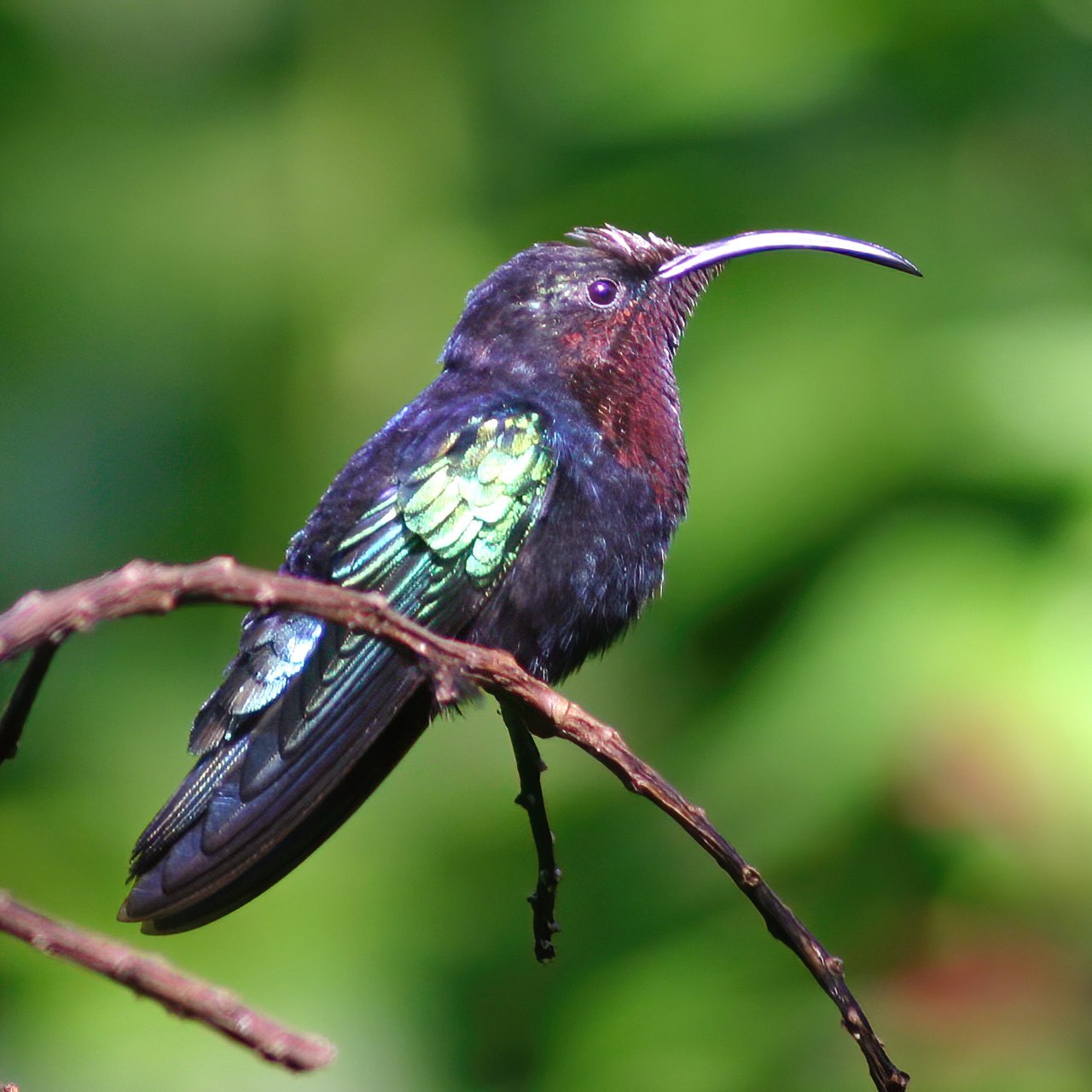
The purple-headed starling, also known as the purple-headed glossy-starling, is a species of starling in the family Sturnidae.
Region
Central African Rainforest
Typical Environment
Occurs across the Congo Basin and adjoining forests from southeastern Nigeria and Cameroon through Gabon, the Republic of the Congo, and the Democratic Republic of the Congo to western Uganda and adjacent regions. It favors lowland evergreen forests, forest edges, and clearings with scattered tall trees. The species also uses secondary growth, riverine forest, and forest–savanna mosaics. It is most often encountered in the mid- to upper canopy, sometimes visiting plantations and village fruit trees.
Altitude Range
Sea level to 1700 m
Climate Zone
Tropical
Ease of Keeping
Beginner friendly: 2/5
Also called the purple-headed glossy-starling, it is a striking forest starling of Central Africa noted for its iridescent violet head. It forages high in the canopy, often following fruiting trees and joining mixed-species flocks. Like many starlings, it nests in tree cavities and adapts to secondary forest and edges.

Temperament
social and active
Flight Pattern
strong direct flight with short rapid wingbeats
Social Behavior
Typically seen in pairs or small, loose flocks, sometimes joining mixed-species parties in the canopy. Nests are usually in natural cavities or old woodpecker holes in trees. Both sexes likely share in nest defense and provisioning. Outside breeding, it forms feeding groups at fruiting trees.
Migratory Pattern
Resident
Song Description
A series of clear whistles, metallic chinks, and chatters delivered from high perches. Vocal repertoire includes contact calls used to keep flock members coordinated in the canopy.
Plumage
Glossy, iridescent plumage with a deep violet to purple sheen on the head contrasting with metallic greenish-blue upperparts and darker wings and tail.
Diet
Consumes a mix of fruits and invertebrates, including figs, berries, beetles, caterpillars, and other arthropods. It often gleans prey from foliage and branches and will sally out to catch flying insects. Fruit becomes especially important when trees are in season, and it may travel widely between fruiting sites.
Preferred Environment
Primarily forages in the mid- to upper canopy of mature and secondary forest. Frequently visits forest edges, clearings, and plantations with fruiting trees. Occasionally descends to lower levels to exploit termites or fallen fruit.