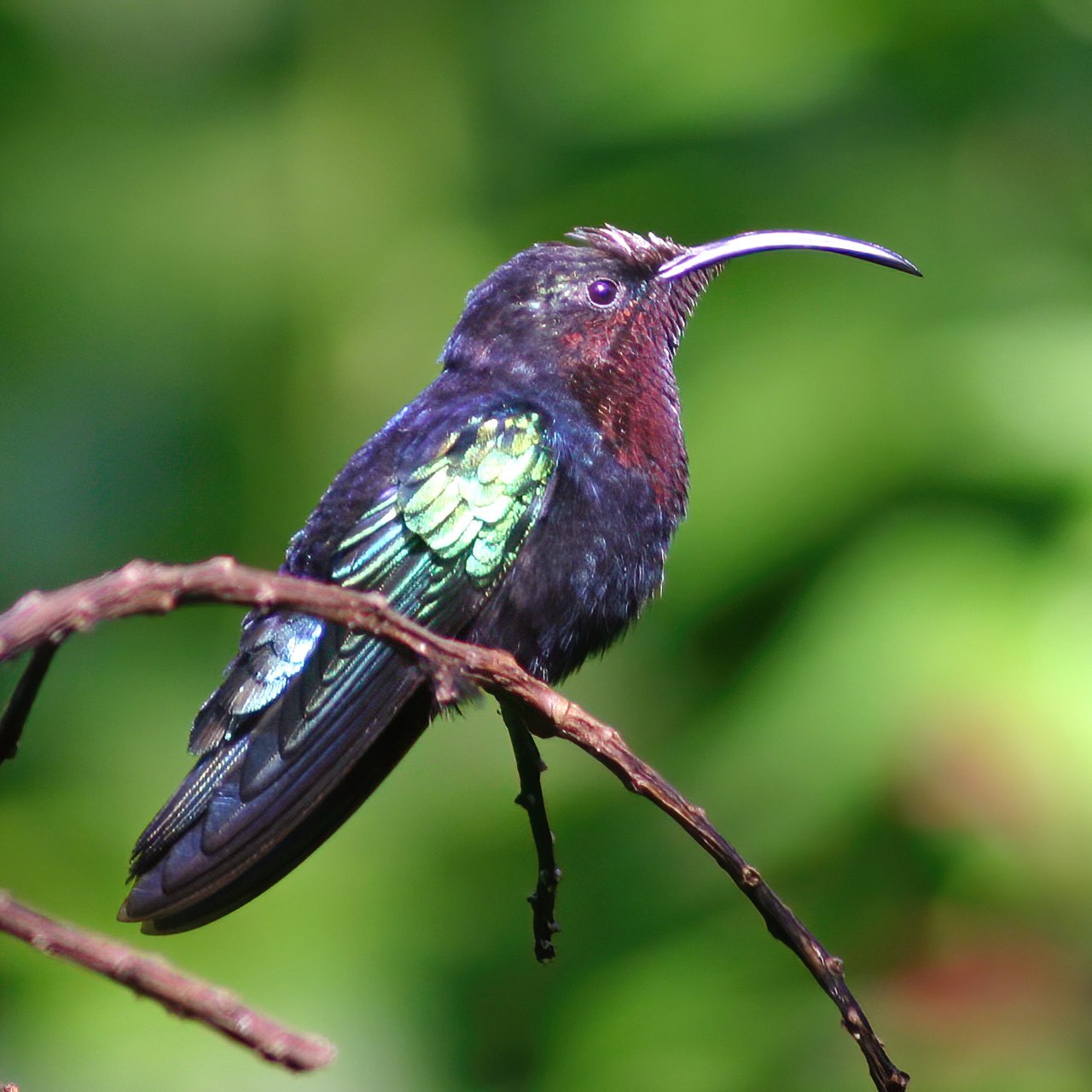
The purple-rumped sunbird is a sunbird endemic to the Indian Subcontinent. Like other sunbirds, they are small in size, feeding mainly on nectar but sometimes take insects, particularly when feeding young. They can hover for short durations but usually perch to lap nectar from flowers. They build a hanging pouch nest made up of cobwebs, lichens and plant material. Males are contrastingly coloured but females are olive above and yellow to buff below. Males are easily distinguished from the purple sunbird by the light coloured underside while females can be told apart from males by their whitish throats.
Region
South Asia
Typical Environment
Common across peninsular India and Sri Lanka in urban gardens, villages, forest edges, scrub, and plantations. It favors areas with abundant flowering shrubs and trees, including ornamental species. It avoids dense closed-canopy forest interiors and very arid zones. Often found near human habitation where nectar sources are available year-round.
Altitude Range
Sea level to 1800 m
Climate Zone
Tropical
Ease of Keeping
Beginner friendly: 1/5
A tiny, energetic sunbird of gardens and edges, it feeds mainly on nectar but also takes small insects, especially for chicks. It can hover briefly but usually perches to probe flowers, and sometimes pierces corollas to access nectar. The species builds a distinctive hanging pouch nest bound with cobwebs and decorated with lichens and plant fibers. Males are vividly iridescent with a purple rump, while females are olive above and yellow below.


Temperament
active and territorial
Flight Pattern
short rapid wingbeats with brief hovering
Social Behavior
Typically seen singly or in pairs, with males defending rich nectar sources. Pairs construct a pendant pouch nest of cobwebs, lichens, bark fibers, and plant down, often suspended from a twig or eave with a side entrance. Both adults provision the young with insects and some nectar.
Migratory Pattern
Resident
Song Description
High, thin, metallic chips and short buzzy trills given in rapid sequences. Calls are repeated frequently while foraging and during territorial chases.
Plumage
Male with glossy maroon upperparts, metallic green crown, violet-purple rump and shoulder gloss, bright yellow underparts, and a contrasting whitish throat patch with a dark breast band; female olive-brown above with a whitish throat and yellow underparts.
Diet
Primarily nectar from a wide variety of native and ornamental flowers, which it laps with a brush-tipped tongue. Also gleans small insects and spiders from foliage, an important protein source for nestlings. Occasionally pierces tough flower bases to access nectar, acting as a nectar robber.
Preferred Environment
Feeds in gardens, hedgerows, forest edges, and light woodland where flowering plants are abundant. Often works the mid-canopy and shrub layer, visiting flowering trees and creepers.