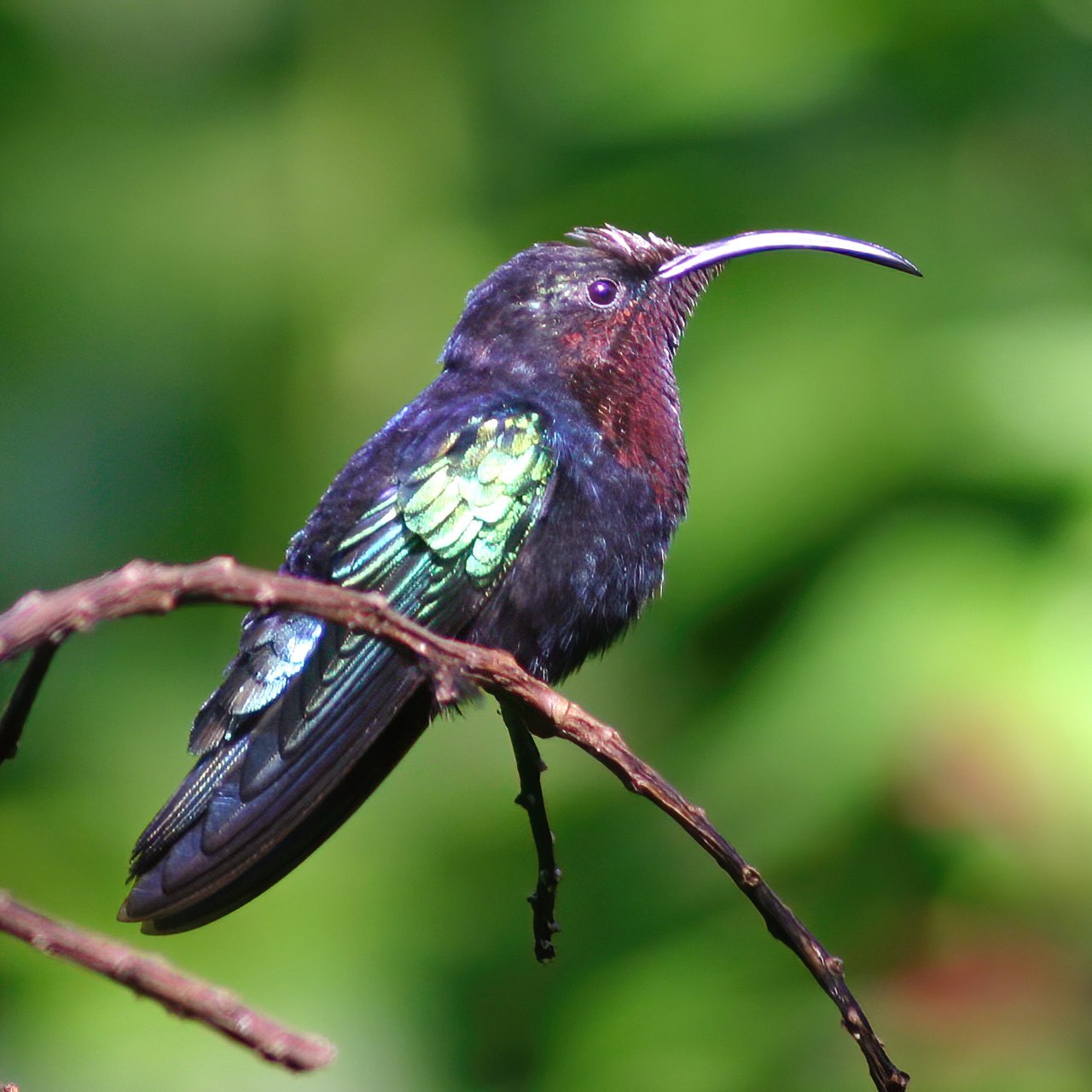
The purple-naped lory is a species of parrot in the family Psittaculidae. It is forest-dwelling endemic to the islands of Seram, Ambon, and perhaps also Haruku and Saparua, South Maluku, Indonesia. It is considered endangered, the main threat being from trapping for the cage-bird trade.
Region
Maluku Islands (South Maluku), Indonesia
Typical Environment
Occupies lowland and hill tropical forests, favoring primary forest but also using secondary growth, forest edges, and wooded gardens. Frequently visits flowering trees in coconut groves and village orchards, especially where native forest persists nearby. Often forages high in the canopy but will descend to mid-story when trees are in bloom. Roosts communally in tall trees near feeding sites.
Altitude Range
0–1200 m
Climate Zone
Tropical
Ease of Keeping
Beginner friendly: 2/5
This striking red lory has a distinctive purple patch on the nape and a dark bluish belly, with green in the wings. Like other lories, it has a brush-tipped tongue specialized for sipping nectar and pollen. It is threatened primarily by trapping for the cage-bird trade and by habitat loss on its limited island range.


On the Banda Islands, Indonesia

Blue-thighed lory (Lorius tibialis), which was either an extinct species or just an aberrant form of Lorius domicella
Temperament
social and active
Flight Pattern
strong flier with swift, direct flight
Social Behavior
Usually seen in pairs or small, noisy groups, especially at flowering trees. Likely monogamous, nesting in natural tree cavities with a small clutch (typically two eggs). Pairs maintain contact calls while foraging and may join mixed-species feeding aggregations at abundant blooms.
Migratory Pattern
Resident
Song Description
Vocalizations are loud, harsh screeches interspersed with metallic chattering. In flight they give sharp contact calls; at feeding trees they produce continuous chatter and rasping notes.
Plumage
Predominantly bright red with a vivid purple patch on the nape, dark bluish belly, and green in the wings; tail darker with reddish tones.
Diet
Feeds primarily on nectar and pollen, using a brush-tipped tongue to extract food from blossoms. Also takes soft fruits such as figs and other native fruits when available. Will opportunistically consume seeds and small invertebrates, especially when feeding young. Diet varies seasonally with flowering and fruiting cycles.
Preferred Environment
Forages mainly in the upper canopy at flowering trees, including native forest species and cultivated coconut and Syzygium. Regularly uses forest edges, secondary growth, and village gardens where nectar sources are concentrated.