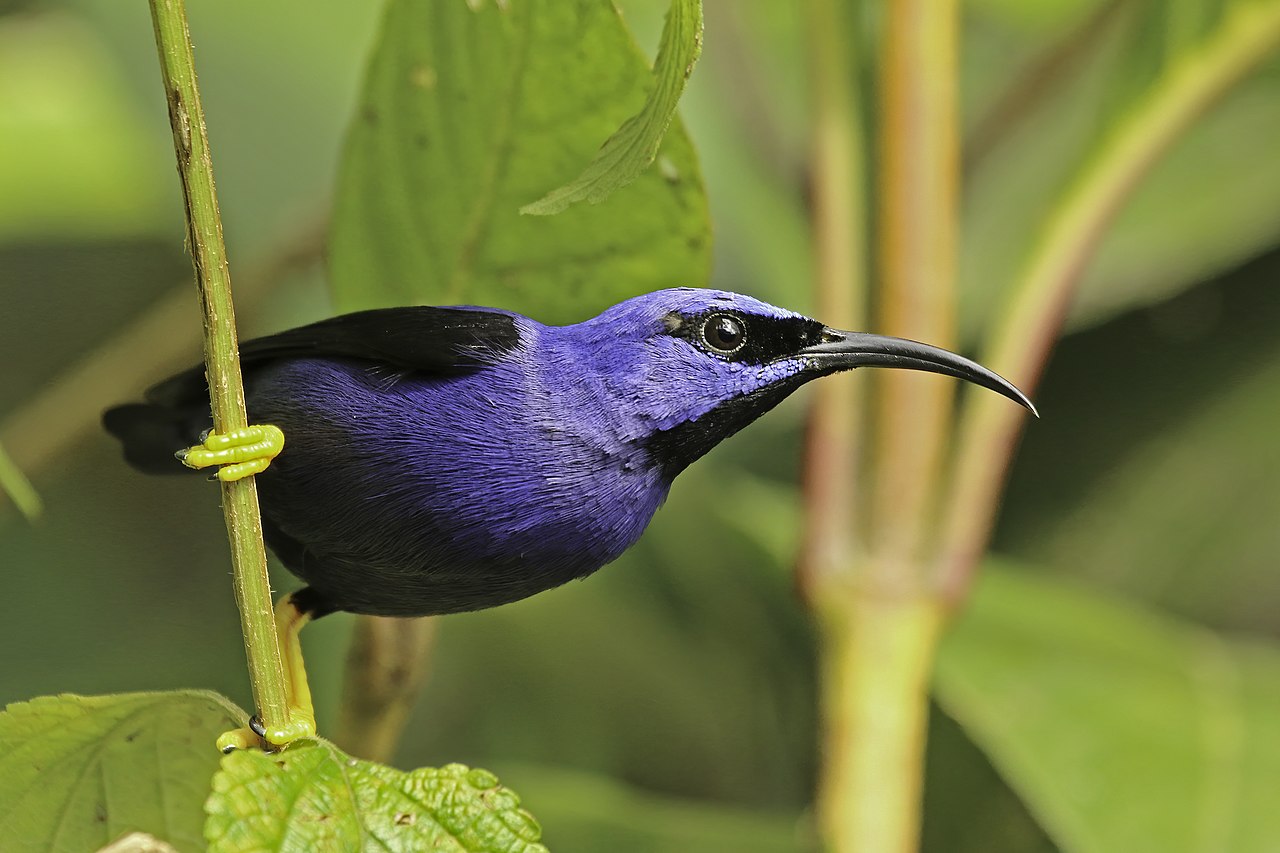
The purple cochoa is a brightly coloured bird found in the temperate forests of Asia. It is a quiet and elusive bird species that has been considered to be related to the thrushes of family Turdidae or the related Muscicapidae. They are found in dark forested areas and is found in the canopy, where it often sits motionless.
Region
Himalayas and Southeast Asia
Typical Environment
Occurs from the central and eastern Himalayas (Nepal, Bhutan, northeast India) through northern Myanmar and south China (Yunnan) to Thailand, Laos, and Vietnam. It inhabits evergreen and mixed broadleaf montane forests, often with oak, laurel, and rhododendron. Birds favor dark, mossy ravines and forest along shaded streams. They keep mainly to the mid- to upper-canopy and are most conspicuous when moving between fruiting trees. Seasonal or altitudinal movements bring them to lower elevations outside the breeding season.
Altitude Range
1000–2800 m
Climate Zone
Subtropical
Ease of Keeping
Beginner friendly: 1/5
A secretive canopy-dweller of Asian montane forests, the purple cochoa often sits motionless in shaded boughs and can be surprisingly hard to spot. Its taxonomy has long puzzled ornithologists, historically placed with thrushes (Turdidae) but now usually treated within Muscicapidae. Males show striking purplish tones with sky-blue panels, while females are more olive and camouflaged. It makes quiet, thin whistles that blend into the forest soundscape.


An artist's illustration of both male and female.
Temperament
quiet, secretive, and unobtrusive
Flight Pattern
short rapid wingbeats between canopy perches with brief glides
Social Behavior
Typically solitary or in pairs, especially during the breeding season. Nests are neat cup structures placed on horizontal branches over ravines or near streams. Both adults participate in care of the young, and family groups may remain loosely associated after fledging.
Migratory Pattern
Partial migrant
Song Description
Song is a series of soft, thin whistles and high, fluty notes delivered from concealed perches. Calls include faint seee and tsi notes that can be easily overlooked in forest ambience.
Plumage
Male is velvety purplish with contrasting blackish head and bright sky-blue patches on the wings and tail corners; female is olive-brown with subtle mottling and bluish wing and tail highlights. Both sexes have smooth, thrush-like feathering suited to shaded canopy life.
Diet
Takes a mix of insects and other small arthropods gleaned from foliage and bark, supplemented by berries and small fruits such as figs and laurels. It often employs short sallies to snatch prey and hover-gleans among dense leaves. Fruit becomes more important when seasonally abundant. Foraging is deliberate and methodical, with long pauses between movements.
Preferred Environment
Feeds mainly in the mid- to upper-canopy of moist montane forest, especially along shaded streams and in mossy ravines. Frequently visits fruiting trees at forest edges or gaps but retreats quickly into cover.