
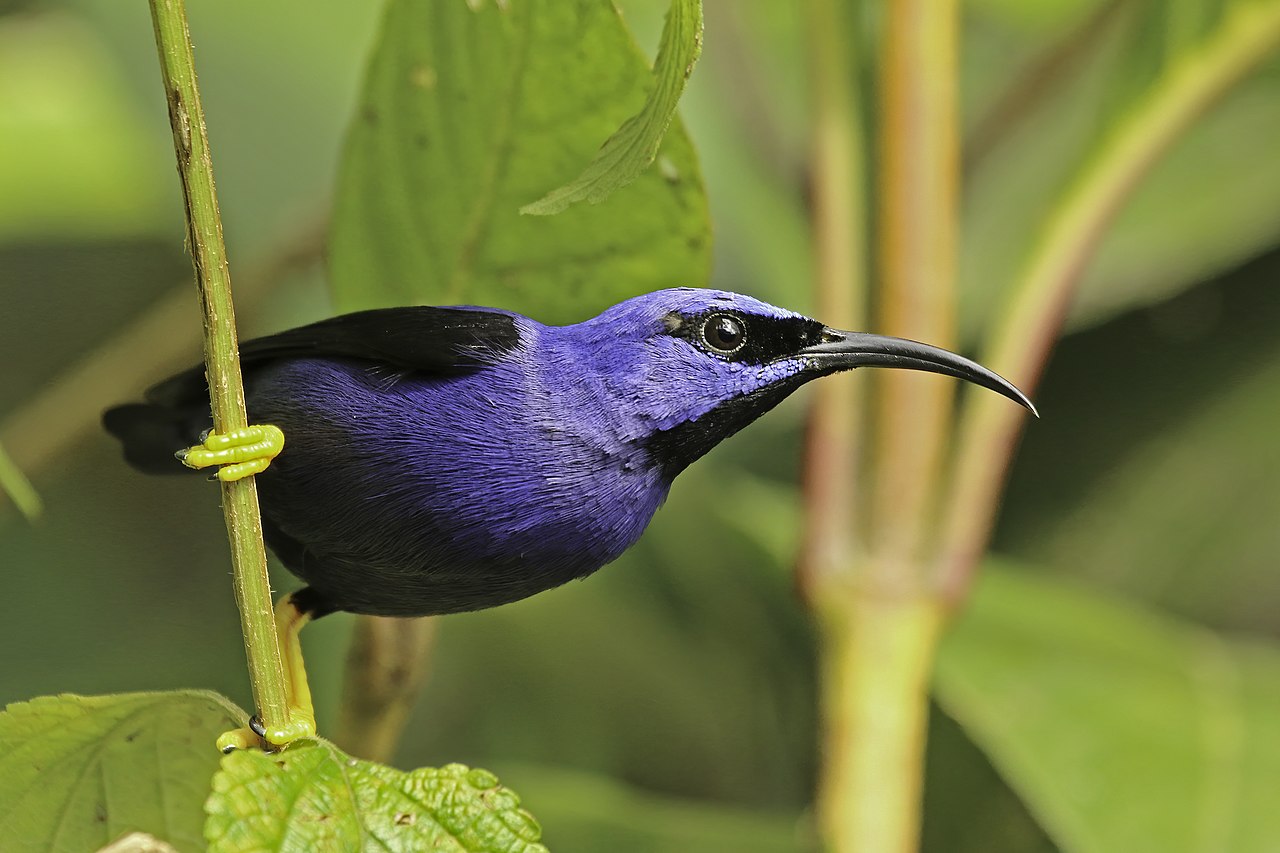
The purple honeycreeper is a small Neotropical bird in the tanager family Thraupidae. It is found in the tropical New World from Colombia and Venezuela south to Brazil, and on Trinidad. A few, possibly introduced, birds have been recorded on Tobago.
Region
Northern South America and Trinidad
Typical Environment
Occurs from Colombia and Venezuela through the Guianas and northern Brazil, and on Trinidad; a few records exist on Tobago. It inhabits tropical lowland forests, forest edges, second growth, plantations, and gardens with flowering trees. Most activity is in the canopy and midstory, but it will descend to forage at fruiting shrubs or feeders. It adapts well to disturbed habitats where nectar sources are abundant.
Altitude Range
Sea level to 1200 m
Climate Zone
Tropical
Ease of Keeping
Beginner friendly: 1/5
The purple honeycreeper shows striking sexual dimorphism: males are vivid violet-blue with black accents, while females are greenish and streaked. It often joins mixed-species flocks in the forest canopy and readily visits flowering trees and garden feeders. Its slightly decurved bill and brush-tipped tongue are adapted for sipping nectar, but it also takes small arthropods.


Temperament
social and active
Flight Pattern
short rapid wingbeats
Social Behavior
Often travels in pairs or small groups and frequently joins mixed-species flocks in the canopy. Nests are small cups placed in foliage; the female primarily builds and incubates while the male helps defend the territory. Courtship involves active chasing and soft calls around flowering trees.
Migratory Pattern
Resident
Song Description
Vocalizations are high, thin, sibilant notes and short, buzzy chips delivered rapidly. Songs are simple, with brief, squeaky phrases interspersed with sharp call notes, often given while foraging.
Plumage
Male is vivid purple-blue with black wings, tail, and mask; female is green above with streaked paler underparts and a faint supercilium. Both sexes have fine, sleek plumage suited to canopy life.
Diet
Feeds mainly on nectar from a variety of flowers, using a slightly decurved bill and brush-tipped tongue. Also takes small arthropods gleaned from foliage and bark, and supplements diet with small fruits and berries. It may hawk tiny insects on short sallies from perches in the midstory.
Preferred Environment
Forages primarily in the canopy and midstory of forests, edges, and second growth where flowering trees are abundant. Common at flowering Inga and other nectar sources, and will visit garden feeders with sugar water in some areas.


