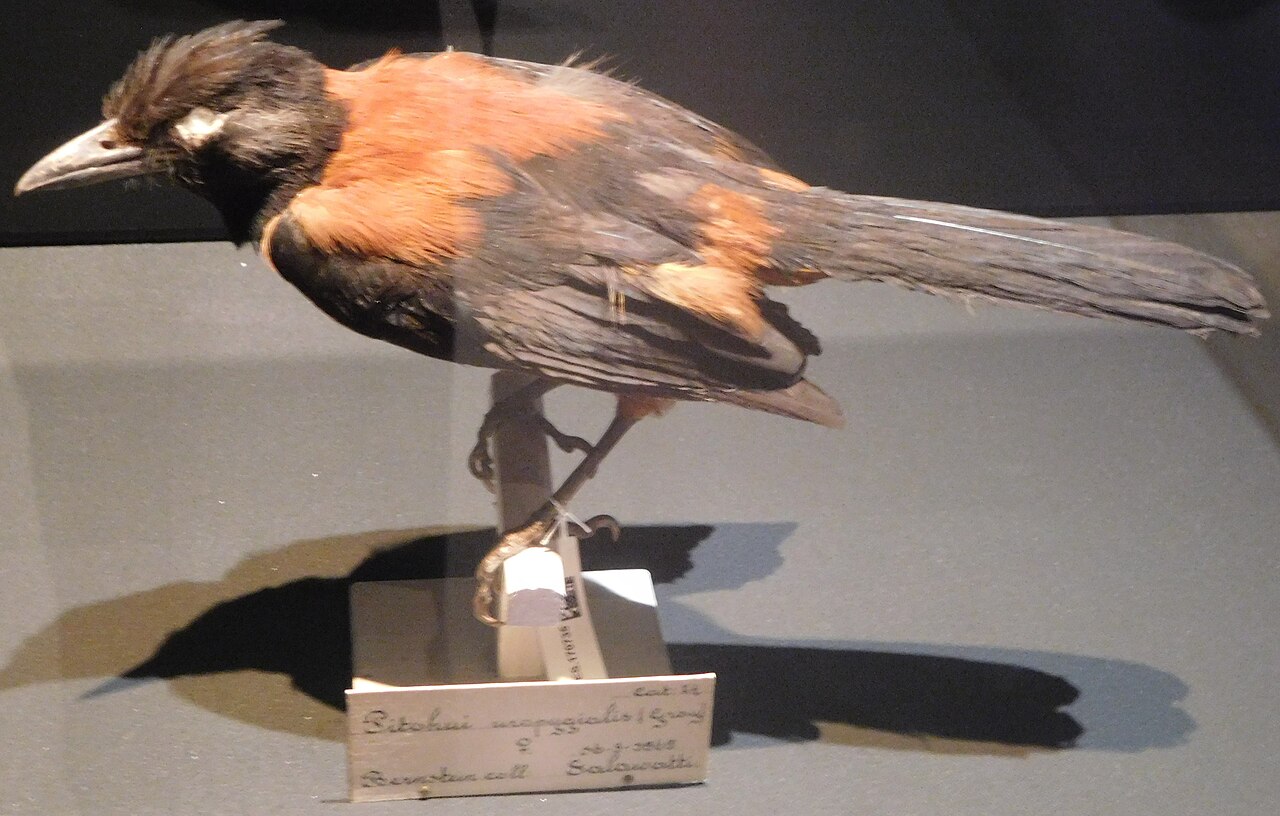
The northern sooty woodpecker is a species of bird in the family Picidae. It is endemic to Luzon, Marinduque, Catanduanes and the Polillo Islands in the Philippines. Its natural habitats are tropical moist lowland forests and tropical moist montane forests.
Region
Northern Philippines
Typical Environment
Occurs in primary and older secondary tropical moist lowland and lower montane forests, most frequently in extensive tracts of dipterocarp forest. It forages from mid-canopy to the upper canopy on large trunks and major limbs, occasionally descending to the understory or visiting forest edges. The species is patchy where forest has been fragmented and is most reliable in protected or remote areas. It requires large-diameter trees for nesting cavities and is less common in heavily logged landscapes.
Altitude Range
Sea level to 1800 m
Climate Zone
Tropical
Ease of Keeping
Beginner friendly: 1/5
A large, uniformly dark woodpecker, the northern sooty woodpecker depends heavily on mature lowland and montane forest with large trees for foraging and nesting. It excavates deep cavities in dead or diseased trunks, where both sexes share nesting duties. Its loud drumming and harsh rattling calls carry far through the forest. Ongoing deforestation on Luzon and nearby islands is the primary threat to this species.


Temperament
solitary and territorial
Flight Pattern
undulating flight with strong wingbeats
Social Behavior
Usually seen singly or in pairs, sometimes with a dependent juvenile after breeding. Pairs excavate nest cavities high in large trunks and share incubation and chick-rearing. Breeding is timed to local seasonal rains, with small clutches typical of large woodpeckers.
Migratory Pattern
Resident
Song Description
Vocalizations are harsh rattles and grating notes delivered from exposed perches. Drumming is loud, rapid, and resonant, used for territorial advertisement and pair communication.
Plumage
Uniform sooty-brown to blackish plumage with a slightly paler belly; feathers appear matte with minimal barring or spotting.
Diet
Feeds primarily on wood-boring beetle larvae, ants, and termites extracted from dead or decaying wood. Uses powerful blows to scale bark and chisel into galleries, probing with a long tongue. Will occasionally take other insects and their larvae and may sample fruits opportunistically.
Preferred Environment
Forages on large trunks and major limbs in mid to upper canopy, especially in old-growth or mature secondary forest. Also works along edges, gaps, and near fallen snags within intact forest blocks.