

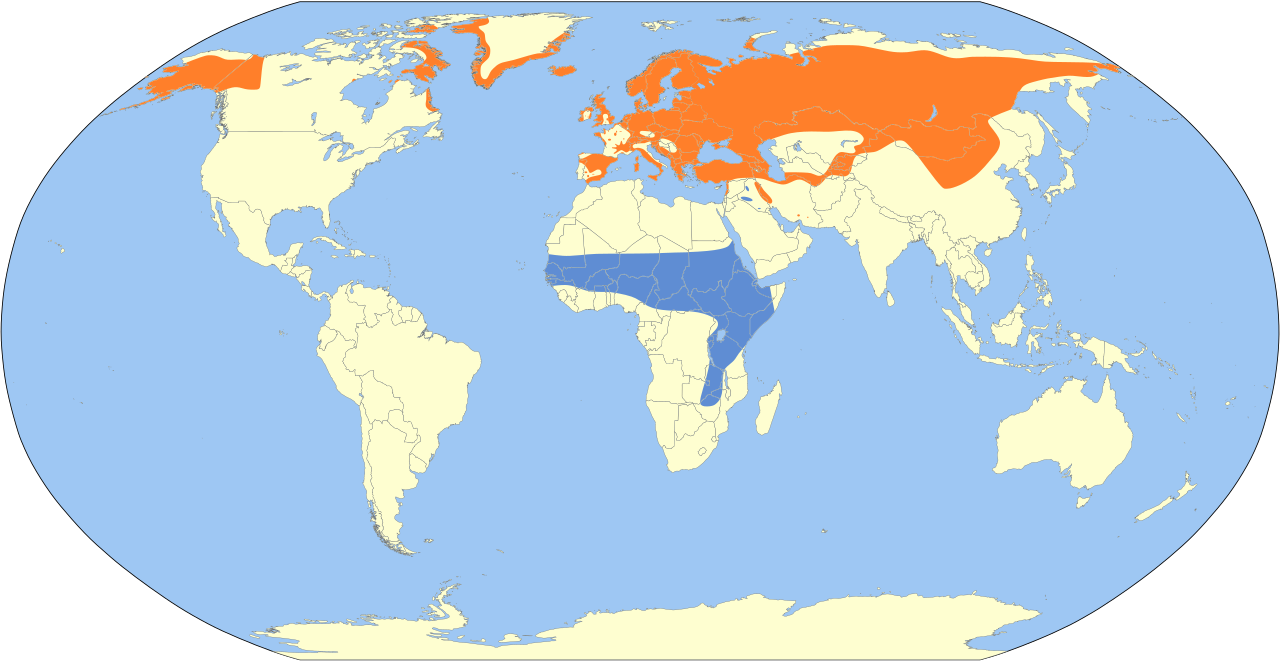
The northern wheatear or wheatear is a small passerine bird in the Old World flycatcher family. It is the most widespread member of the wheatear genus Oenanthe in Europe and North and Central Asia. The northern wheatear is a migratory insectivorous species breeding in open stony country in Europe and east across the Palearctic with footholds in northeastern Canada and Greenland as well as in northwestern Canada and Alaska. It nests in rock crevices and rabbit burrows. All birds spend most of their winter in Africa.
Region
Palearctic (breeding) and sub-Saharan Africa (wintering)
Typical Environment
Breeds across open, stony habitats from western Europe through North and Central Asia, with outposts in Greenland, northeastern Canada, and Alaska. Prefers short turf, tundra, upland moors, coastal slopes, scree, and human-altered sites like quarries and pastures. In winter it occupies Sahelian and savanna zones, semi-arid scrub, fallow fields, and burned areas with sparse cover. It readily uses cavities or crevices for nesting and benefits from traditional grazing that maintains low vegetation.
Altitude Range
Sea level to 3000 m
Climate Zone
Other
Ease of Keeping
Beginner friendly: 1/5
The northern wheatear undertakes one of the longest migrations of any small songbird, with Alaskan and Greenland birds traveling to sub-Saharan Africa via Eurasia. Its name derives from an old phrase meaning 'white rump,' a nod to the striking white rump and black 'T'-patterned tail. It often nests in rock crevices, stone walls, and rabbit burrows and uses tail-flicking and ground-hopping to flush prey.



Northern wheatear juvenile

Eggs, Collection Museum Wiesbaden
Temperament
alert and territorial in breeding season
Flight Pattern
short rapid wingbeats with low, bounding flights
Social Behavior
Breeds in solitary pairs, defending territories with song and display flights. Nests in cavities such as rock crevices, rabbit burrows, and stone walls, lining the nest with grasses and hair. Clutches typically contain 4–7 eggs, and both parents feed the young.
Migratory Pattern
Seasonal migrant
Song Description
Song is a bright, varied warble of short phrases with trills and mimicry, delivered from low perches or in display flights. Calls include a sharp 'chak' or 'tac' and a soft, whistled contact note.
Plumage
Upright, chat-like bird with clean, contrasting plumage; males in breeding season have grey upperparts, black mask and wings, and pale underparts; females are warmer brown and less contrasting. Both sexes show a white rump and tail with an inverted black 'T' pattern. Non-breeding plumage is duller and buffier but the tail pattern remains distinctive.
Diet
Feeds mainly on insects and other invertebrates including beetles, ants, caterpillars, spiders, and small snails and worms. Will take small berries and seeds opportunistically, especially in late summer and during migration. Hunts by running and pausing on the ground, sallying after prey, and flipping stones or probing crevices.
Preferred Environment
Forages on short turf, rocky ground, coastal headlands, and open tundra where prey is visible and accessible. In winter it uses sparsely vegetated fields, burnt patches, and scrub edges, often near scattered rocks or termite mounds.


