

The long-tailed minivet is a species of bird in the family Campephagidae. It is found in southern and south-eastern Asia where it occurs in Afghanistan, Bangladesh, Bhutan, China, India, Laos, Myanmar, Nepal, Pakistan, Thailand, and Vietnam. Its natural habitats are subtropical or tropical moist lowland forest and subtropical or tropical moist montane forest.
Region
South and Southeast Asia
Typical Environment
Found from the Himalayan foothills through northeastern India, Bhutan, Nepal, and into southern China and northern Indochina. Occupies subtropical and tropical moist lowland and montane forests, as well as forest edges and secondary growth. Frequently uses tall trees along ridges, clearings, and plantations near forest. Often descends to lower elevations outside the breeding season and can tolerate moderately disturbed habitats.
Altitude Range
200–3000 m
Climate Zone
Subtropical
Ease of Keeping
Beginner friendly: 1/5
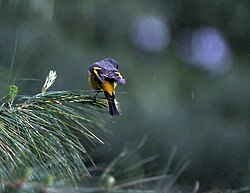
Long-tailed minivets are active canopy foragers that often travel in mixed-species flocks, making them a conspicuous presence in forest edges and clearings. Their nests are neat, camouflaged cups bound with spider silk and decorated with lichen high on horizontal branches. Males are strikingly red-and-black, while females are yellow-and-grey, a vivid example of sexual dimorphism.


Temperament
social and active
Flight Pattern
short rapid wingbeats with brief glides
Social Behavior
Often forages in small groups or joins mixed-species flocks in the mid- to upper canopy. Breeds in pairs, constructing a small, well-camouflaged cup nest on exposed branches high in trees. Clutch size is typically 2–4 eggs, and both parents participate in care.
Migratory Pattern
Partial migrant
Song Description
Calls are thin, clear whistles and sweet, piping notes delivered in short phrases. Song is simple but bright, often a series of high, ringing whistles repeated from canopy perches.
Plumage
Male with glossy black upperparts contrasted by bright scarlet to orange-red underparts, rump, and wing panels; very long, narrow tail. Female is grey to olive-grey above with yellow underparts and a yellow wing panel, also long-tailed but duller overall. Both sexes show clean, crisp color blocks and a slim, compact build.
Diet
Primarily hunts insects such as caterpillars, beetles, flies, and small orthopterans gleaned from foliage and twigs. Uses quick sallies to snatch airborne prey and deftly picks items from leaves and bark. Occasionally takes small berries, but animal prey dominates.
Preferred Environment
Feeds mostly in the mid- to upper canopy of forests, edges, and tall secondary growth. Also forages along ridgelines, in clearings with scattered tall trees, and in lightly wooded plantations.


