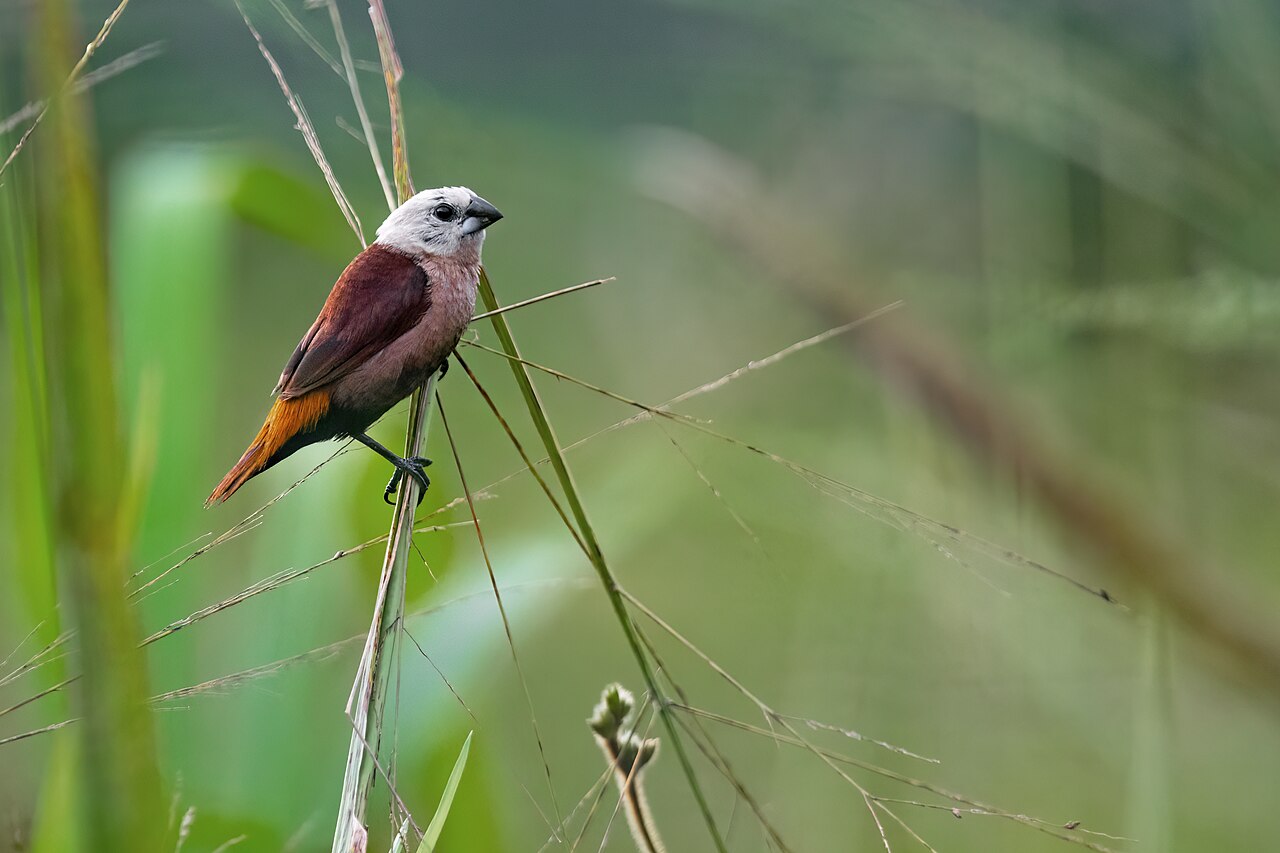
The grey-headed imperial pigeon is a species of bird in the family Columbidae. It is endemic to Sulawesi in Indonesia. Its natural habitats are subtropical or tropical moist lowland forests and subtropical or tropical moist montane forests.
Region
Sulawesi and satellite islands (Wallacea)
Typical Environment
Found in primary and mature secondary evergreen forest from lowlands into montane zones. It frequents forest edges, riverine corridors, and ridgelines where fruiting canopy trees are abundant. The species occasionally visits gardens or cultivated fruit trees near forest margins. It is mostly arboreal, moving through the upper canopy and occasionally perching on emergent trees to survey for fruiting sources.
Altitude Range
Sea level to 1800 m
Climate Zone
Tropical
Ease of Keeping
Beginner friendly: 1/5
This large fruit-dove is confined to the island of Sulawesi and nearby islets, where it plays a key role in dispersing the seeds of forest trees, especially figs. It spends most of its time high in the canopy and can be surprisingly hard to see despite its size. Pairs or small groups often commute long distances between fruiting trees, giving deep, booming calls that carry through the forest.
Temperament
shy and canopy-dwelling
Flight Pattern
strong flier with direct, rapid wingbeats
Social Behavior
Typically seen singly, in pairs, or in small groups moving between fruiting trees. It nests high in trees on a simple platform of sticks, usually laying a single egg typical of pigeons. Pairs maintain close contact calls while foraging and during nesting.
Migratory Pattern
Resident
Song Description
A series of deep, resonant coos and booming notes that carry far through the forest. Calls are often given from high perches at dawn and late afternoon.
Plumage
Smooth grey head and neck contrasting with glossy olive-green mantle and wings; underparts paler grey with buffy to whitish belly. Tail is dark with a pale terminal band, and wings show a subtle metallic sheen in good light.
Diet
Primarily frugivorous, feeding on figs (Ficus) and a variety of drupes and berries. It swallows fruits whole and later regurgitates or passes seeds, aiding long-distance seed dispersal. When trees are in heavy fruit, several birds may gather quietly to feed. It occasionally supplements diet with other soft plant material.
Preferred Environment
Forages almost entirely in the upper to mid canopy of tall humid forest. It also uses fruiting trees along forest edges and in secondary growth, and may visit orchards adjacent to intact forest.