

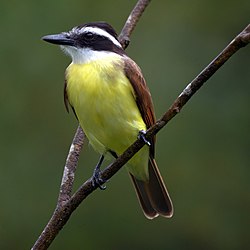
The great kiskadee, called bem-te-vi in Brazil, pitogue in Paraguay, benteveo or bichofeo in Argentina and Uruguay, and luis bienteveo, pitabil, luis grande or chilera in Mexico, is a passerine bird in the tyrant flycatcher family Tyrannidae. It is the only member of the genus Pitangus.
Region
Neotropics
Typical Environment
Widespread from southern Texas and Mexico through Central America to much of South America, including Trinidad and Tobago and northern Argentina. It favors open and semi-open habitats such as savannas, pastures, forest edges, riparian corridors, and urban parks. Common around human settlements, it readily uses fences, wires, and rooftops as perches. It avoids the interior of dense, unbroken forests but occupies gallery forests and mangroves along edges.
Altitude Range
0–2500 m
Climate Zone
Tropical
Ease of Keeping
Beginner friendly: 2/5
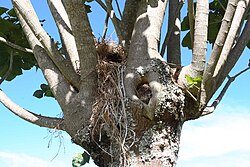
The great kiskadee is the only member of the genus Pitangus and is named for its loud, onomatopoeic call, often rendered as 'kis-ka-dee.' Bold and adaptable, it thrives in human-dominated landscapes and may snatch pet food or small fish from garden ponds. It sometimes builds a domed nest near wasp nests, likely gaining protection from predators.


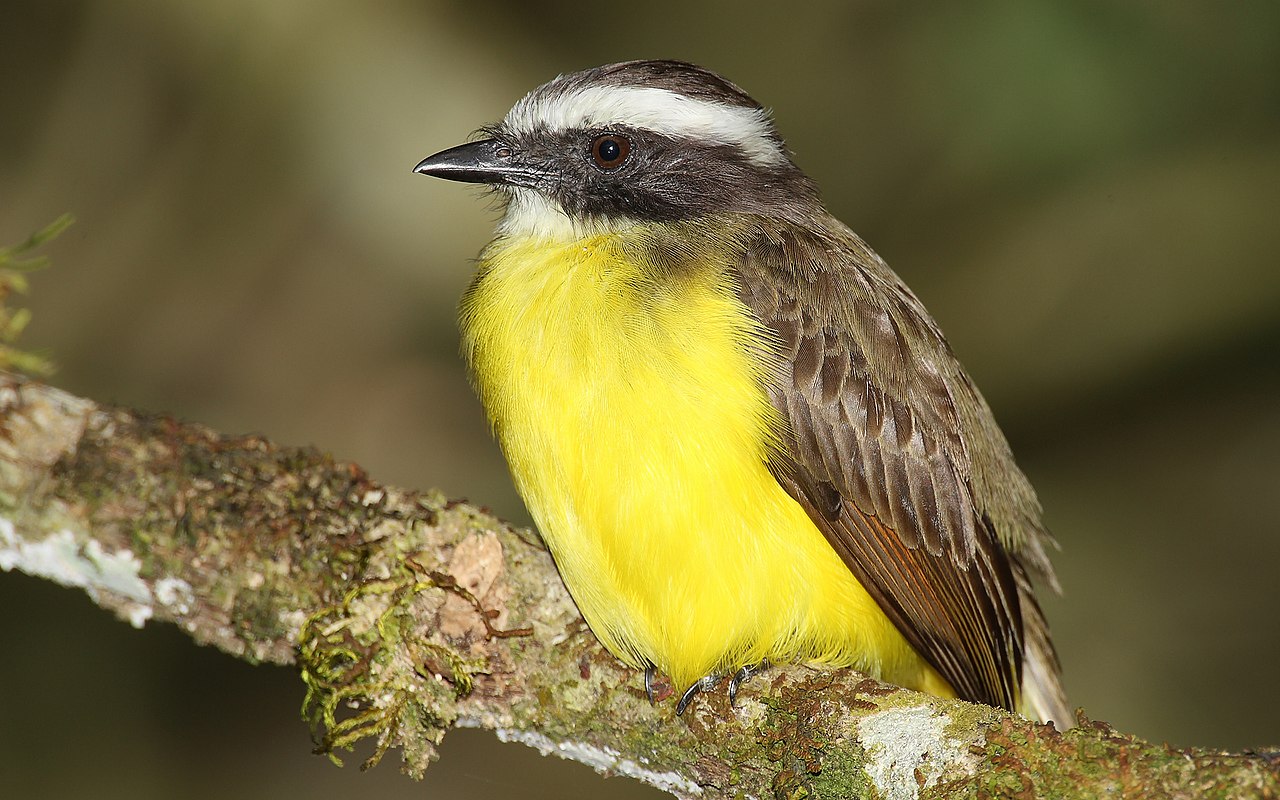
One of the diverse tyrant flycatchers resembling the great kiskadee in color is the aptly named Myiozetetes similis





Temperament
bold and active
Flight Pattern
direct flight with short rapid wingbeats
Social Behavior
Usually seen in pairs or small family groups and strongly territorial around nest sites. Builds a bulky, domed nest with a side entrance in trees, on poles, or human structures. Both sexes participate in nest building and vigorously mob predators.
Migratory Pattern
Resident
Song Description
Vocal and conspicuous, giving loud, ringing calls rendered as 'kis-ka-dee' or 'benteveo.' Also produces sharp scolds and chatters in social interactions, often calling from exposed perches.
Plumage
Bright yellow underparts with a brown back and rufous-tinged wings; white throat and supercilium contrasting with a black mask and crown. Often shows a concealed orange to cinnamon crown patch when excited.
Diet
An opportunistic omnivore that takes flying insects by sallies, gleans arthropods from foliage, and picks prey from the ground. It eats fruits and berries regularly, especially in the non-breeding season. It will capture small vertebrates such as lizards, tadpoles, and occasionally small fish by shallow plunges at the water’s edge. It may also raid nests for eggs and nestlings when available.
Preferred Environment
Feeds along forest edges, riparian zones, pastures, gardens, and urban parks where perches and open spaces are abundant. Often forages near water and around human dwellings, using fences, wires, and rooftops as vantage points.


