The great auk, also known as the penguin or garefowl, is an extinct species of flightless alcid that first appeared around 400,000 years ago and became extinct in the mid-19th century. It was the only modern species in the genus Pinguinus. It was not closely related to the penguins of the Southern Hemisphere, which were named for their resemblance to this species.
Region
North Atlantic
Typical Environment
The great auk bred on remote, rocky islands and sea stacks across the North Atlantic, including sites off Newfoundland, Iceland, the Faroe Islands, Scotland, Ireland, and coastal Norway. Outside the breeding season it ranged widely over cold offshore waters, often far from land. It favored islands with easy sea access and minimal terrestrial predators. Colonies were densely packed on flat or gently sloping shores where landing from the water was straightforward. Historical records suggest regular use of a limited number of safe breeding islands, making it vulnerable to human exploitation.
Altitude Range
Sea level to 100 m
Climate Zone
Temperate
Ease of Keeping
Beginner friendly: 1/5
The great auk was a large, flightless seabird of the North Atlantic and the only modern member of the genus Pinguinus. Despite its name and appearance, it was not closely related to southern penguins. Overharvesting for meat, eggs, and specimens led to its extinction in the mid-19th century, with the last confirmed birds killed in 1844. It was a superb swimmer and diver, using its short, flipper-like wings to pursue fish underwater.


Fossil humerus of the Early Pliocene relative Pinguinus alfrednewtoni
![The "Great Auk, Northern Penguin, or Gair-Fowl", wood engraving by Thomas Bewick in A History of British Birds, 1804[a]](https://upload.wikimedia.org/wikipedia/commons/thumb/6/6b/Great_Auk_Thomas_Bewick_1804.jpg/1280px-Great_Auk_Thomas_Bewick_1804.jpg)
The "Great Auk, Northern Penguin, or Gair-Fowl", wood engraving by Thomas Bewick in A History of British Birds, 1804[a]
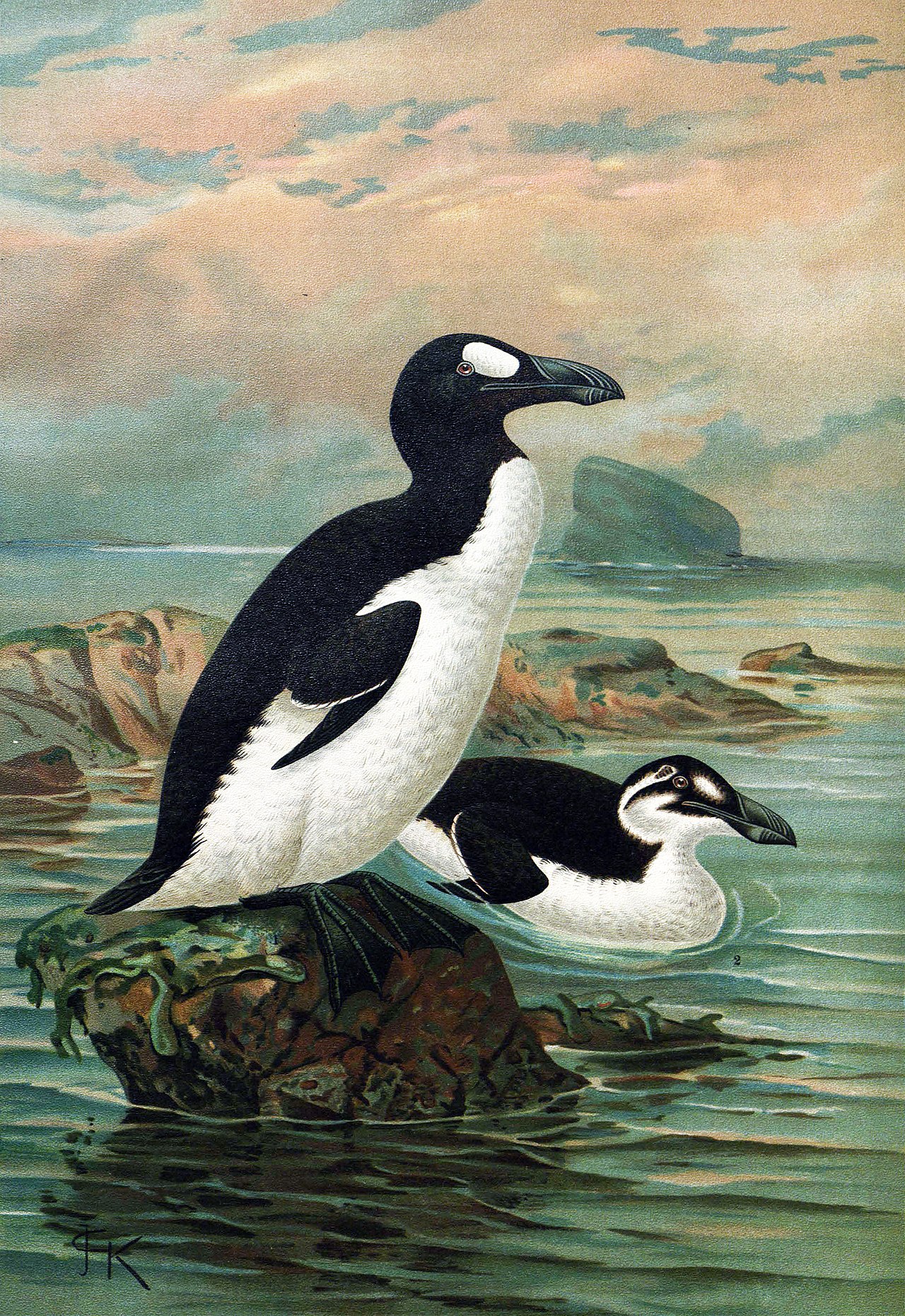
Summer (standing) and winter (swimming) plumage, by John Gerrard Keulemans

Paintings showing variation in egg markings, as well as seasonal and ontogenic differences in plumage

Stac an Armin, St. Kilda, Scotland, one locality where the great auk used to breed

Great Auks by John James Audubon, from The Birds of America (1827–1838)

Great auk eating a fish, by John Gould

Nesting ground with juveniles and eggs, by Keulemans

Eggs in Muséum national d'histoire naturelle

Illustration of two humeri (1) and two tibiae (2), bones of the great auk uncovered by archaeologists in an ancient kitchen midden in Caithness

The only known illustration of a great auk drawn from life, Ole Worm's pet, received from the Faroe Islands, 1655

Eldey, last refuge of the great auk

Specimen No. 3 in the Royal Belgian Institute of Natural Sciences, one of the two last birds killed on Eldey in 1844

Specimen No. 39, skeleton, and replica egg at Senckenberg Museum

Great auk in winter plumage (No. 24, one of four in existence) and the internal organs of the last two great auks, Natural History Museum of Denmark


Temperament
social and colonial but wary
Flight Pattern
flightless; powerful swimmer and diver
Social Behavior
Great auks nested in dense colonies on a few traditional islands, laying a single large, boldly marked egg on bare rock. Pairs formed strong seasonal bonds and defended small territories around the nesting site. They were gregarious at sea as well, often foraging in loose groups.
Migratory Pattern
Seasonal migrant
Song Description
Vocalizations were low grunts, croaks, and rasping calls, especially at colonies. Sounds carried over surf noise and were likely used for mate contact and territorial displays.
Plumage
Smooth, dense, penguin-like plumage with glossy black upperparts and clean white underparts.
Diet
Primarily small schooling fishes such as capelin and sand lance, supplemented by other small fish and occasional crustaceans. It pursued prey underwater using rapid wing-propelled strokes. Foraging dives were short to moderate in duration, repeated in bouts near prey schools. Prey was swallowed whole at the surface or underwater.
Preferred Environment
Cold coastal waters, tidal rips, and offshore banks where baitfish concentrate. It foraged near breeding islands and over productive shelves, often in areas with strong currents.