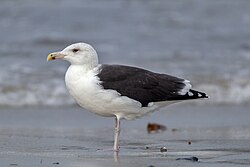
The great black-backed gull, sometimes referred to as greater black-backed gull, is the largest species of seabird in the gull and tern family Laridae. It is a very aggressive hunter, pirate and scavenger which breeds on the North Atlantic coasts and islands of northern Europe and northeastern North America. Southern populations are generally sedentary, while those breeding in the far north migrate farther south in winter. A few also move inland to large lakes and reservoirs. The adult has a white head, neck and underparts, dark blackish-grey wings and back, pink legs and the bill yellow with a red spot.
Region
North Atlantic
Typical Environment
Breeds along rocky coasts, islands, and estuaries of northern Europe and northeastern North America, and ranges widely across the North Atlantic. Outside the breeding season it disperses along coasts and into large inland lakes and reservoirs. It frequents harbors, fish-processing areas, beaches, mudflats, and urban landfills. Nesting typically occurs on predator-free islands, rooftops, or remote shorelines with open views. Juveniles may wander far from natal sites and can occur well inland during winter.
Altitude Range
Sea level to 1200 m
Climate Zone
Temperate
Ease of Keeping
Beginner friendly: 1/5
The great black-backed gull is the largest gull in the world, often dominating other seabirds at feeding sites. It is a bold predator and scavenger, taking fish, carrion, and even the chicks of other birds, and is also a notorious kleptoparasite that steals food from other seabirds. Adults show a striking contrast of white and blackish slate plumage, with a heavy yellow bill marked by a red spot. They can live for decades, with some banded individuals recorded at over 30 years.


Adult Larus marinus with fish, Sandy Hook, New Jersey, United States



Great black-backed gull grabs an eider duckling

Great black-backed gulls nesting in Sweden

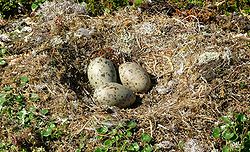
Eggs, Collection Museum Wiesbaden

Female great black-backed gull, with chicks

Juvenile walking alongside a human at Ogunquit Beach




Temperament
dominant and assertive
Flight Pattern
strong flier with steady wingbeats and soaring glides
Social Behavior
Breeds in loose colonies or dispersed pairs, often on coastal islands with open terrain. Pairs are typically monogamous within a season and defend nest territories vigorously. Nests are shallow scrapes lined with vegetation; both sexes incubate and feed young. Outside breeding, they form flocks at rich food sources and may engage in kleptoparasitism.
Migratory Pattern
Partial migrant
Song Description
Vocalizations include loud, ringing calls and deep laughing yelps, lower and rougher than many other large gulls. Alarm and aggression are conveyed with harsh 'kak' notes and long-calls delivered with head-tossing. Juveniles give plaintive begging calls near adults and at colonies.
Plumage
Adult with white head, neck, and underparts; very dark blackish-slate back and upperwings with white wing mirrors; pink legs and a heavy yellow bill with a red gonys spot. Immatures are mottled brown with a pale base to the bill, gradually attaining adult plumage over several years.
Diet
An opportunistic feeder taking fish, crustaceans, mollusks, marine worms, and carrion. It preys on eggs and chicks of other seabirds and will seize small birds or rodents when available. Frequently scavenges at fishing ports, follows boats for discards, and forages at landfills and beaches. It also practices kleptoparasitism, stealing prey from other birds.
Preferred Environment
Forages along shorelines, intertidal zones, harbors, and estuaries, as well as on offshore waters near fishing vessels. Inland, it uses lakes, reservoirs, fields, and refuse sites, exploiting human-associated food sources.