The great barbet is an Asian barbet native to the Indian sub-continent and Southeast Asia, where it inhabits forests up to 3,000 m (9,800 ft) altitude. It has been listed as Least Concern on the IUCN Red List since 2004 because of its wide distribution.
Region
Himalayas and Southeast Asia
Typical Environment
Occupies subtropical to temperate montane broadleaf and mixed forests, often with oak, rhododendron, and pine. It favors mature fruiting trees such as figs and laurels and also visits forest edges, secondary growth, and orchards. The species typically forages in the upper canopy, descending to the mid-storey when fruit is plentiful. In winter it may move downslope to lower elevations along forested valleys while remaining within wooded habitats.
Altitude Range
200–3000 m
Climate Zone
Highland
Ease of Keeping
Beginner friendly: 1/5
The great barbet is the largest barbet in Asia, and its booming, repetitive calls carry for long distances through mountain forests. It is a cavity nester, excavating its own nest holes in decaying trunks and large branches. Highly frugivorous, it plays an important role in seed dispersal, especially of figs. It typically keeps to the high canopy but can descend to orchards and village groves when fruiting is abundant.

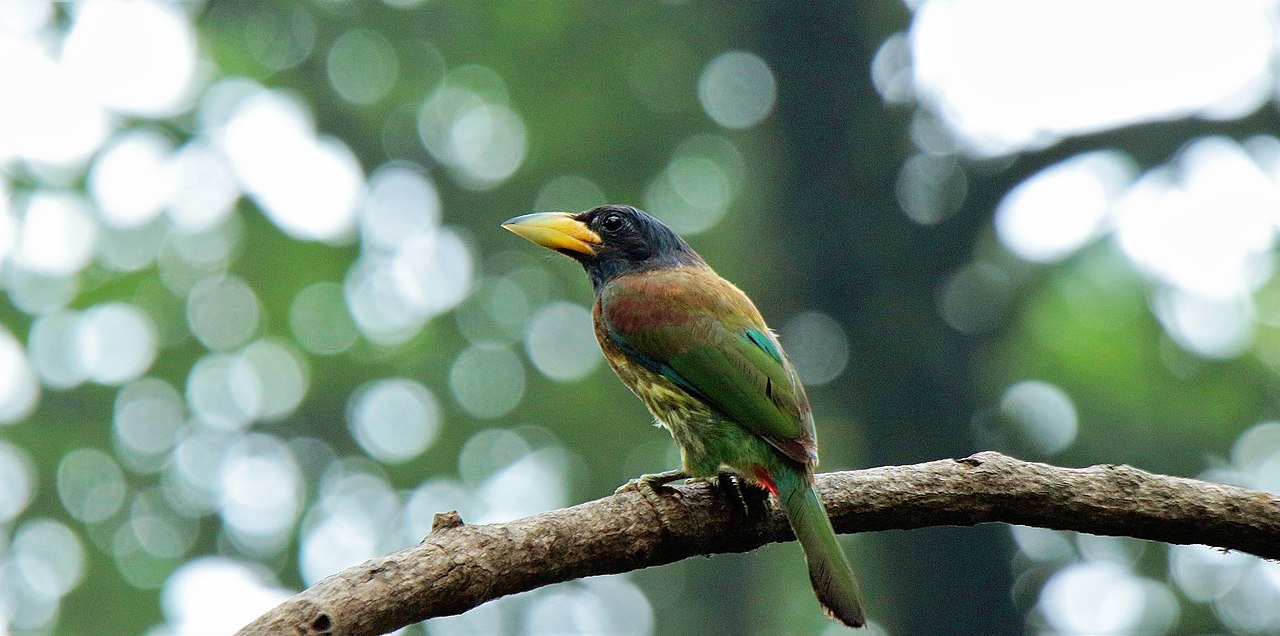
Great barbet in Ba Bể National Park

Great barbet in Himachal Pradesh

Great barbet in Himachal Pradesh

Great barbet at Sarahan
Temperament
shy but vocal, usually keeping to the canopy
Flight Pattern
undulating flight with short, rapid wingbeats
Social Behavior
Commonly seen singly, in pairs, or small family parties. Pairs are territorial in the breeding season and excavate nest cavities in soft or decaying wood. Both sexes share incubation and chick-rearing duties.
Migratory Pattern
Resident
Song Description
A loud, far-carrying, repetitive series of hollow notes, often rendered as piu-piu or ku-koo, delivered at measured intervals. Calls can continue for long periods, especially at dawn. It also gives harsh rattles and clucks when agitated.
Plumage
Large, heavy-bodied barbet with green upperparts, mottled greenish underparts, and a dark brown head contrasting with a bright blue throat and face. Feathers appear slightly scaly on the breast and flanks due to pale edging. The bill is thick and prominently yellow.
Diet
Primarily eats fruit, especially figs, berries, and drupes, swallowing many items whole and later dispersing the seeds. Supplements its diet with insects such as beetles, caterpillars, and cicadas gleaned from bark and foliage. Occasionally takes nectar or buds during lean fruit periods.
Preferred Environment
Forages high in the canopy of mature forests and fruiting trees. It readily visits forest edges, clearings with large fruiting trees, and village orchards.