
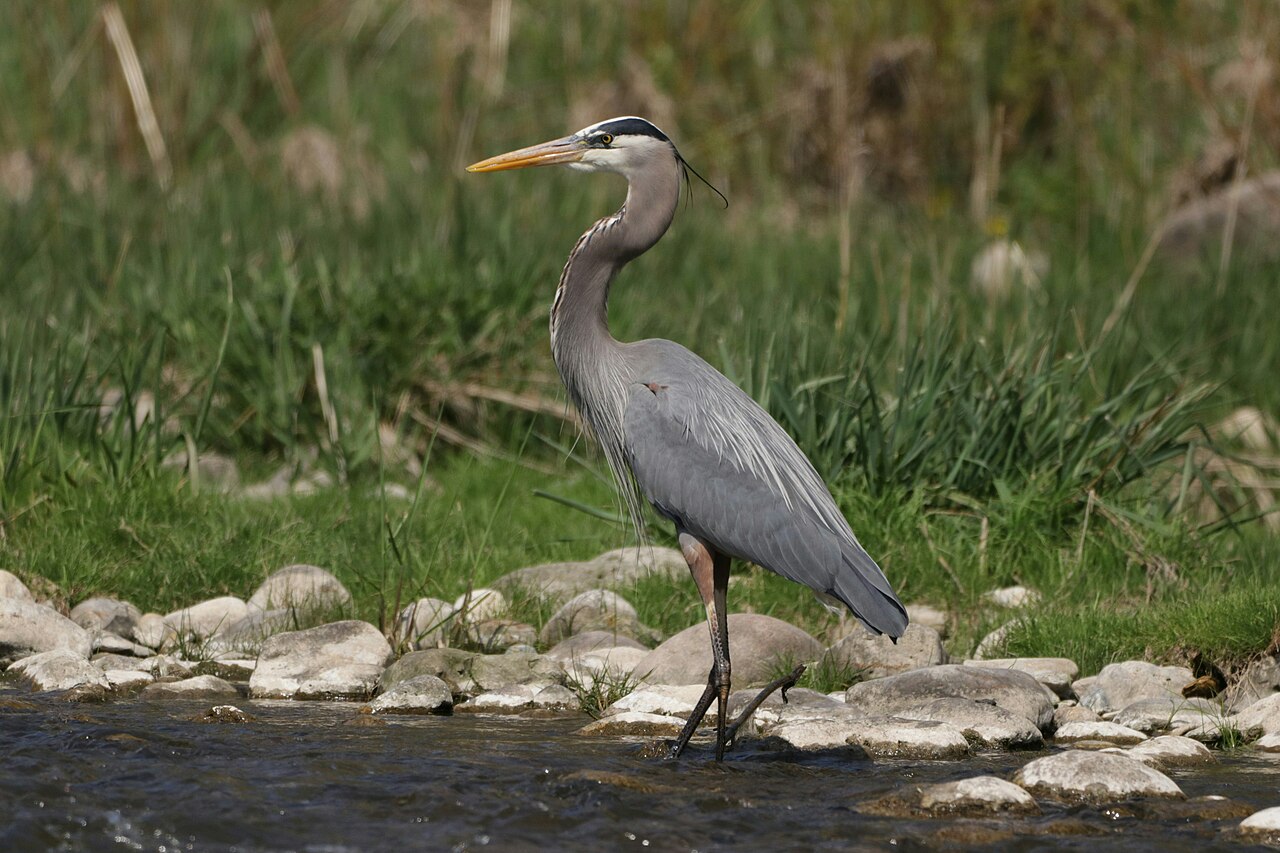
The great blue heron is a large wading bird in the heron family Ardeidae, common near the shores of open water and in wetlands over most of North and Central America, as well as far northwestern South America, the Caribbean and the Galápagos Islands. It is occasionally found in the Azores and is a rare vagrant to Europe. An all-white population found in south Florida and the Florida Keys is known as the great white heron. Debate exists about whether these white birds are a color morph of the great blue heron, a subspecies of it, or an entirely separate species.
Region
North and Central America and the Caribbean
Typical Environment
Common around lakes, rivers, marshes, mangroves, estuaries, and coastal shorelines from Alaska and Canada through the United States into Mexico, Central America, the Caribbean, and the Galápagos Islands. It frequents both freshwater and brackish habitats, from quiet backwaters to tidal flats. Nests are typically in tall trees near water, but it may also use shrubs or ground sites on predator-free islands. Urban and suburban ponds and park wetlands are also used where disturbance is limited.
Altitude Range
Sea level to 2000 m
Climate Zone
Other
Ease of Keeping
Beginner friendly: 1/5
The great blue heron is North America’s largest heron, hunting by standing motionless and striking prey with a rapid thrust of its dagger-like bill. An all-white population in south Florida and the Florida Keys, often called the great white heron, has long been debated as a color morph, subspecies, or separate species. It flies with slow, deep wingbeats and its neck curled in an S-shape, a classic heron silhouette. Colonies (rookeries) can persist for years where tall nesting trees stand near water.


Neck fully extended, while swallowing a brown water snake

Sunning, in the delta wing posture.

Würdemann's heron (A. h. occidentalis × wardi), in Mexico

A. h. occidentalis, in Florida

A. h. occidentalis flying in the Florida Everglades.

Perched in Green-Wood Cemetery, New York City

Eating a bowfin. Displaying glottis exposure.


With nesting material in Illinois

Chicks at a nest, in San Francisco

A. h. fannini heronry at Stanley Park (B.C.)

Juvenile, in Georgia
Temperament
solitary and territorial
Flight Pattern
slow deep wingbeats with neck tucked
Social Behavior
Forages mostly alone but nests colonially in large rookeries, often with dozens to hundreds of pairs. Pairs are seasonally monogamous, building bulky stick nests high in trees or occasionally on the ground on safe islands. Courtship includes bill clattering, stretching displays, and presentation of nesting sticks.
Migratory Pattern
Partial migrant
Song Description
Vocalizations are harsh and guttural, including loud croaks and a deep 'fraunk' call, especially in flight or alarm. At nests, adults and young give softer clucks, grunts, and hisses. The species is not known for melodious song.
Plumage
Slate-blue to blue-gray overall with long shaggy plumes on the breast and back; whitish face and crown with a bold black supercilium extending into long head plumes; rufous-brown thighs and a dark shoulder patch.
Diet
Primarily fishes, but also amphibians, crustaceans, aquatic insects, reptiles, and small mammals, and occasionally small birds. It hunts by standing motionless or stalking slowly in shallow water, then spearing or grasping prey with a rapid thrust. It may also forage in fields and along shorelines, taking rodents or other small terrestrial prey.
Preferred Environment
Shallow edges of ponds, lakes, rivers, marshes, tidal flats, and mangroves where prey is visible and accessible. It uses perches or wades quietly along shorelines, docks, and channels, including human-modified habitats such as marina edges and urban ponds.


