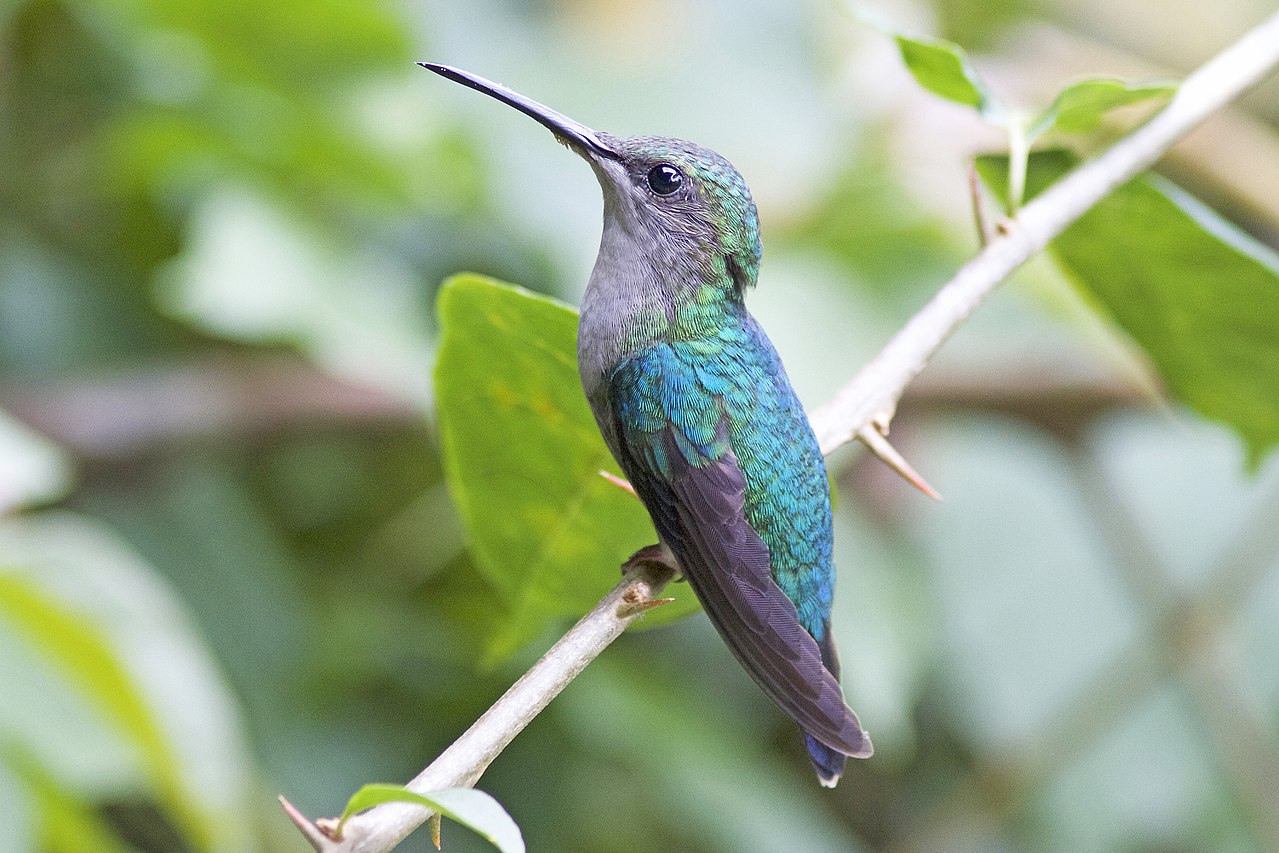
The crowned woodnymph or violet-crowned woodnymph, is a species of hummingbird in the "emeralds", tribe Trochilini of subfamily Trochilinae. It is found from Belize and Guatemala to far-northern Peru.
Region
Central America and northwestern South America
Typical Environment
Occurs from Belize and Guatemala through Honduras, Nicaragua, Costa Rica, and Panama into western Colombia and northwestern Ecuador, reaching the foothills of far-northern Peru. It inhabits humid lowland and foothill forests, especially edges, clearings, secondary growth, and riparian corridors. The species also uses shaded plantations and flower-rich gardens adjacent to forest. It typically forages in the understory and midstory but will ascend to the canopy when flowers are abundant.
Altitude Range
Sea level to 1500 m
Climate Zone
Tropical
Ease of Keeping
Beginner friendly: 1/5
This dazzling hummingbird shows strong sexual dimorphism: males flash a violet crown with glittering green and blue underparts, while females are green above with pale, speckled underparts. It frequents forest edges, clearings, and gardens, and readily visits feeders. Males can be fiercely territorial at rich flower patches, and the species is an important pollinator of many tropical plants.


Temperament
active and territorial
Flight Pattern
short rapid wingbeats with agile hovering and darting chases
Social Behavior
Generally solitary outside of breeding, with males defending rich flower patches against rivals and other hummingbirds. Courtship involves display flights; the female alone builds a tiny cup nest of plant down and spider silk and cares for the young. Nests are placed on horizontal branches or sheltered forks in the understory.
Migratory Pattern
Resident
Song Description
Vocalizations are high, thin chips and short buzzy trills given during foraging and territorial interactions. Males often emit sharp, metallic notes during chases and display flights.
Plumage
Male with iridescent violet crown, glittering green throat and breast, and deep blue belly; wings dark with a slightly forked dark tail. Female green above with grayish-white underparts washed with green spots on the flanks and a tail with prominent white tips. Both sexes show a straight, slender bill adapted for nectar feeding and rapid hovering flight.
Diet
Feeds primarily on nectar from a wide variety of tubular flowers, including native understory plants and epiphytes. It supplements nectar with small arthropods, gleaned from foliage or hawked in short sallies, providing essential protein. The species is an effective pollinator, transferring pollen between flowers as it probes repeatedly.
Preferred Environment
Forages along forest edges, in clearings, secondary growth, and shaded plantations such as coffee or cacao. Often visits flowering shrubs in gardens near forest and along streams where blooms are concentrated.