
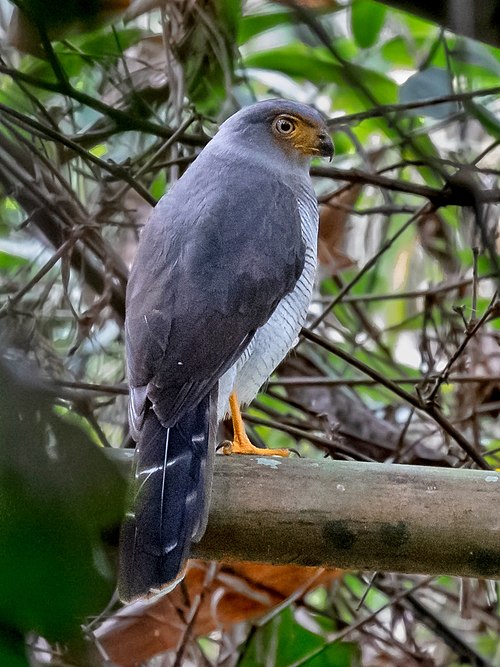
The cryptic forest falcon is a species of bird of prey in the family Falconidae. It is found in the southeastern Amazon rainforest in Brazil and Bolivia. While uncommon in its Amazonian range, it remains widespread and is therefore rated as least concern by BirdLife International and IUCN. Unlike the lined forest falcon, with which it has long been confused in a cryptic species complex, adult cryptic forest falcons only have a single white tail-band.
Region
Southeastern Amazon Basin
Typical Environment
Occurs in the lowland rainforests south and southeast of the Amazon River in Brazil and into northeastern Bolivia. Prefers terra firme forest but also uses seasonally flooded forest, secondary growth, and tall forest edges. Typically keeps to dense understory and midstory where it hunts from concealed perches. It tolerates light selective logging but declines with extensive fragmentation and deforestation.
Altitude Range
0–800 m
Climate Zone
Tropical
Ease of Keeping
Beginner friendly: 1/5
This elusive raptor of the Amazon understory was only formally described in 2002 after long being confused with the lined forest falcon. Adults show a single bold white tail band, a key field mark separating it from similar Micrastur species. It is most vocal at dawn and dusk, giving mournful, whistled notes that carry far through dense forest. Although uncommon locally, it remains widespread across parts of southeastern Amazonia.


Temperament
secretive and territorial
Flight Pattern
short rapid wingbeats with swift dashes through understory
Social Behavior
Predominantly solitary outside of the breeding season. Nests in large tree cavities, often using natural hollows or old woodpecker holes. Pairs defend territories and communicate with far-carrying whistles, especially in the early morning.
Migratory Pattern
Resident
Song Description
Gives a series of clear, mournful, whistled notes, often rising or slightly descending in pitch. Vocal activity peaks at dawn and dusk, carrying over long distances in dense forest.
Plumage
Upperparts dark slaty to brownish with a contrastingly banded tail; underparts buffy to whitish with fine gray barring on the breast and flanks. Throat paler, often whitish, with a darker malar stripe. Flight feathers darker with subtle barring; tail shows one broad white band and a pale tip.
Diet
An opportunistic predator that takes small birds, reptiles, frogs, large insects, and small mammals. Hunts by sit-and-wait from shaded perches, then dashes rapidly to seize prey on the ground or in low vegetation. Will occasionally attend mixed-species bird flocks and may hunt near army-ant swarms to ambush flushed prey.
Preferred Environment
Forages in dense understory and midstory of mature terra firme and transitional forests, as well as semi-open edges. Often hunts along trails, stream margins, and light gaps where prey is more easily ambushed.


