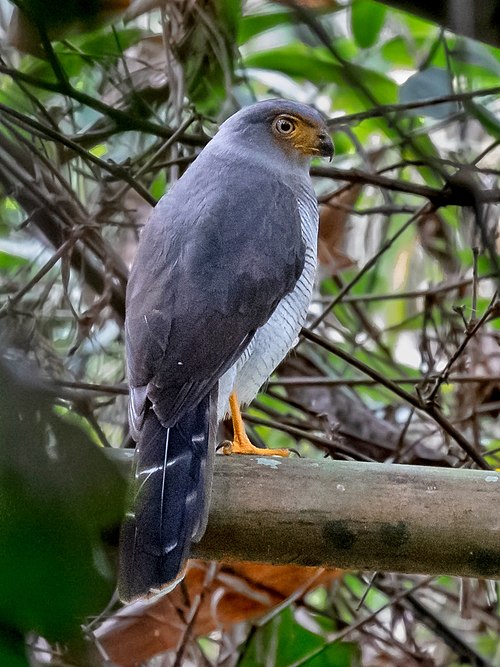
The cryptic becard is a species of bird in the family Tityridae. It is found in Ecuador and Peru. Its natural habitats are subtropical or tropical dry forests and subtropical or tropical moist montane forests.
Region
Northern Andes
Typical Environment
Occurs from southern Ecuador into northern Peru, mainly in subtropical foothill and moist montane forests, forest edges, and tall second growth. It also uses semi-open habitats with scattered trees and riparian corridors. In parts of its range it can be found in drier intermontane forest patches, but it most often favors humid foothill zones. It forages from the midstory to canopy and sometimes along forest edges and clearings.
Altitude Range
500–2000 m
Climate Zone
Tropical
Ease of Keeping
Beginner friendly: 1/5
The Cryptic Becard is a recently recognized species in the becard group that was long confused with the Slaty Becard. It inhabits foothill and montane forests of Ecuador and northern Peru, where males are mostly slaty gray and females are warm brown with buffy underparts. Its identity is best confirmed by voice, which differs subtly from similar becards. Like others in its family (Tityridae), it builds a globular, hanging nest.

Temperament
solitary and territorial
Flight Pattern
short rapid wingbeats with brief sallies
Social Behavior
Usually encountered singly or in pairs, sometimes joining mixed-species flocks while foraging. Pairs defend small territories during breeding. The nest is typically a globular, hanging structure suspended from a branch with a side entrance. Both sexes likely participate in nest-building, as in related becards.
Migratory Pattern
Resident
Song Description
Gives soft, clear whistles and short phrases repeated at intervals, with a slightly plaintive quality. Calls are subtle but distinctive to experienced listeners, aiding separation from similar species. Vocal activity is strongest at dawn and early morning.
Plumage
Male largely uniform slaty-gray with slightly darker cap and subtly paler throat; female brownish-olive above and buffy to cinnamon below with a softer, washed appearance.
Diet
Feeds mainly on arthropods such as beetles, caterpillars, and spiders, taken by gleaning and short sallies from perches. Also consumes small fruits and berries, especially when insect prey is less abundant. Occasional hover-gleaning is used to pick prey from foliage.
Preferred Environment
Forages in the midstory to canopy of humid foothill and montane forests, edges, and tall secondary growth. Often works along vine tangles, outer foliage, and forest gaps, and may accompany mixed-species flocks.