

The crowned sandgrouse is a species of bird in the sandgrouse family, the Pteroclidae from North Africa and the Middle East.
Region
North Africa and the Middle East
Typical Environment
Occurs across the Sahara and surrounding deserts from Morocco and Western Sahara through Algeria, Tunisia, Libya, and Egypt, east into the Sinai, Levant, and the Arabian Peninsula, reaching parts of Iraq and Iran. It favors open, arid landscapes such as gravel and stony deserts (hamada), dune margins, and sparsely vegetated plains. The species also uses dry wadis and steppe-like semidesert where seed-bearing plants persist after rains. Highly mobile within its range, it undertakes local nomadic movements tracking recent rainfall and seed availability. Regular visits to waterholes are essential, especially in the breeding season.
Altitude Range
0–2500 m
Climate Zone
Arid
Ease of Keeping
Beginner friendly: 1/5
Crowned sandgrouse are desert specialists that often fly long distances at dawn and dusk to reach scarce water sources. Adults can carry water in their specially adapted belly feathers to give to their downy chicks at the nest. Their cryptic, sandy plumage blends perfectly with stony desert plains, making them hard to spot. They often gather in sizable flocks when drinking.


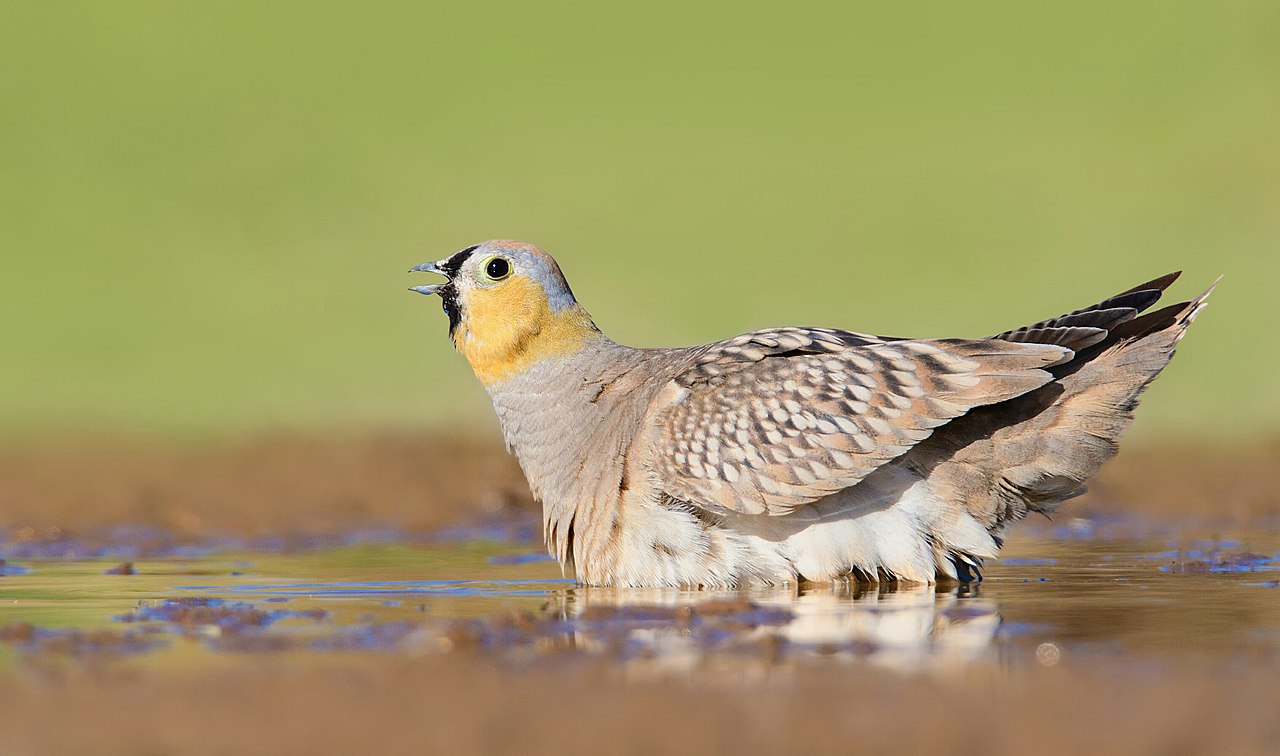
Crowned sandgrouse
Temperament
wary and alert, gregarious at waterholes
Flight Pattern
fast, direct flight with rapid, whirring wingbeats; strong long-distance flier
Social Behavior
Often forms small to large flocks when commuting to water or feeding. Pairs are typically monogamous, nesting on a simple ground scrape with minimal lining. Clutches are usually two eggs, with both sexes sharing incubation and brood care. Adults transport water to chicks using specialized absorbent belly feathers.
Migratory Pattern
Resident
Song Description
Vocalizations are carrying, nasal and rolling calls, often heard as flocks approach water: a repeated kek-kek-kek or kirr-rru. Calls serve to coordinate group movements and maintain contact in flight. At rest, they give softer, chattering notes.
Plumage
Sandy-buff to pale brown upperparts with fine barring and speckling that match stony desert ground; long, pointed wings and short tail. Males show a neat, grey-toned head and crown with cleaner, less barred underparts and a darker belly patch; females are more heavily barred and overall duller.
Diet
Primarily granivorous, taking dry seeds of desert grasses and herbs, including saltbush and other ephemeral plants that sprout after rains. It also pecks green shoots and leaves when available, with occasional small invertebrates taken incidentally. Foraging is mostly on the ground, picking seeds singly and moving steadily across open flats.
Preferred Environment
Feeds in open stony or gravel deserts, sparse steppe, and along wadis where seed-bearing plants concentrate. Often forages near routes to traditional waterholes, using flat, unobstructed terrain that allows early detection of predators.


