

The chimney swift is a bird belonging to the swift family Apodidae. A member of the genus Chaetura, it is closely related to both Vaux's swift and Chapman's swift; in the past, the three were sometimes considered to be conspecific. It has no subspecies. The chimney swift is a medium-sized, sooty gray bird with very long, slender wings and very short legs. Like all swifts, it is incapable of perching on flat surfaces, and can only perch on vertical surfaces. Many fly around all day and only come down at night when roosting.
Region
Eastern North America and Western Amazon Basin
Typical Environment
Breeds across eastern Canada and the eastern United States, especially in towns, cities, and forested regions with suitable chimneys or hollow trees. Winters primarily in the western Amazon Basin of South America. Commonly forages over lakes, rivers, fields, and urban areas where aerial insects are abundant. Uses large communal roosts in chimneys outside the breeding season. Frequently seen swooping and circling high overhead in warm, calm weather.
Altitude Range
Sea level to 2500 m
Climate Zone
Other
Ease of Keeping
Beginner friendly: 1/5
Chimney swifts are fast, aerial insectivores that spend almost all daylight hours on the wing and can cling only to vertical surfaces. Historically they nested in hollow trees, but now commonly use chimneys and similar structures, gluing a small twig nest to walls with saliva. They migrate long distances between eastern North American breeding grounds and the western Amazon Basin. Their stiff, spiny tail tips help them brace against vertical surfaces while roosting.


Chimney swifts, like these in a chimney in Missouri, United States, roost communally when not breeding.

Egg, Collection Museum Wiesbaden
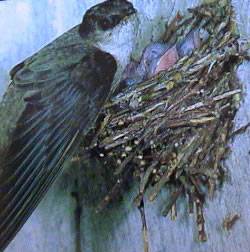
The nest is made of small, short twigs glued together with saliva.


Purpose-built towers can provide nesting and roosting locations.
Temperament
social and active
Flight Pattern
rapid, bat-like flight with stiff, quick wingbeats; agile aerialist
Social Behavior
Forms large communal roosts, especially in chimneys outside the breeding season. Monogamous pairs build a small twig nest glued to vertical surfaces with saliva. Strong site fidelity to traditional roosts and nest structures. Non-breeding birds often gather in sizable flocks during migration.
Migratory Pattern
Seasonal migrant
Song Description
Gives high, rapid chittering and twittering notes while in flight. Vocalizations are persistent over feeding areas and near roosts, with sharper chips exchanged between mates at nest sites.
Plumage
Uniform sooty gray-brown with a slightly paler throat; sleek, cigar-shaped body with very long, narrow wings.
Diet
Consumes flying insects such as flies, mosquitoes, beetles, winged ants, termites, and small wasps. Captures prey exclusively on the wing, often at varying heights depending on weather and insect swarms. Will range widely over water bodies and open areas where emergent insects are concentrated. Feeds opportunistically around storm fronts and thermal updrafts.
Preferred Environment
Forages over urban and suburban neighborhoods, open fields, lakes, rivers, and forest edges. Frequently concentrates near large roost chimneys and above streets or parking lots that produce heat plumes attracting insects.


