The Chinese bamboo partridge is a small Galliform bird. It is one of three species in the genus Bambusicola, along with the mountain bamboo partridge of the Himalayas, and the Taiwan bamboo partridge of Taiwan. Chinese bamboo partridge is a monotypic species.
Region
East and Southeast Asia
Typical Environment
Native to central and southern China and extending into parts of northern Indochina, favoring foothills and low mountains with extensive bamboo, scrub, and secondary forest. It thrives in forest edges, thickets, tea plantations, orchards, and agricultural mosaics where dense cover is available. It avoids the dark interior of mature forest but readily uses regenerating and disturbed habitats. Introduced populations are established in Japan and on several Hawaiian islands, especially in shrubby uplands and leeward slopes.
Altitude Range
Sea level to 2000 m
Climate Zone
Subtropical
Ease of Keeping
Beginner friendly: 2/5
Named for its preference for bamboo thickets, this partridge is often heard before it is seen, delivering a loud accelerating whistle from dense cover. It is one of three species in the genus Bambusicola, alongside the mountain and Taiwan bamboo partridges. Widely introduced beyond its native range, it has established feral populations in Japan and parts of Hawaii. Sexes look similar, with males slightly larger.

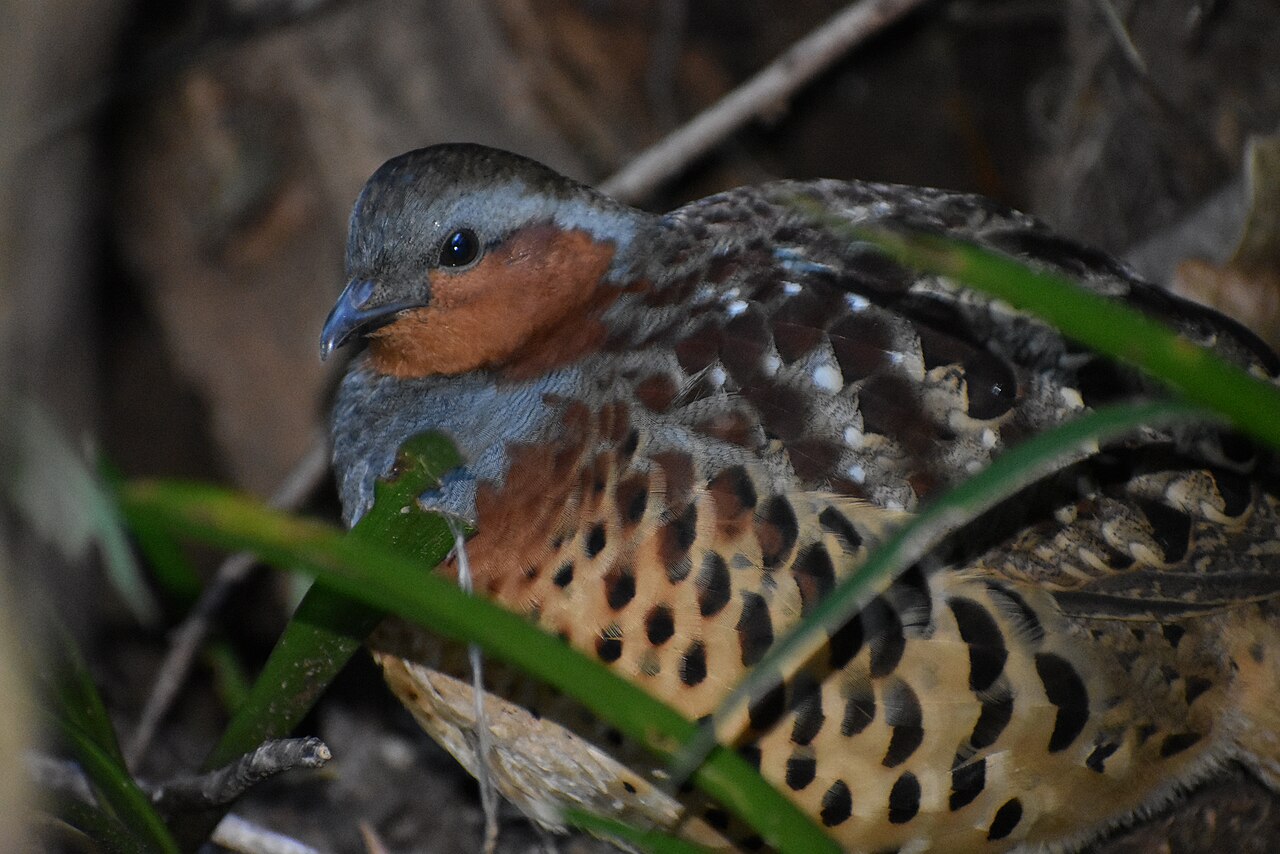
A close-up of a Chinese Bamboo Partridge, Mount Takao, Japan.

Two Chinese Bamboo Partridges foraging at the base of Mount Takao, Japan.

Chinese bamboo partridge chick two days old
Temperament
wary and secretive
Flight Pattern
explosive flush with short rapid wingbeats into nearby cover
Social Behavior
Outside the breeding season it forms small coveys that forage and roost together on or near the ground. During breeding, pairs or small family groups dominate, with ground nests hidden under dense vegetation. The nest is a shallow scrape lined with leaves, and clutches typically contain several eggs.
Migratory Pattern
Resident
Song Description
A loud, ringing series that accelerates, often rendered as repeated whistled notes carrying far through thickets. Calls include sharp chuk and chatter used for contact within coveys, with peak vocal activity at dawn and dusk.
Plumage
Overall mottled and scaly appearance with rufous-brown upperparts, bold black and buff spotting, and finely barred tail; underparts show greyish to buff tones with dark spotting on breast and flanks.
Diet
Feeds on a mix of seeds, grains, and green plant matter such as bamboo shoots and tender leaves. Supplements this with berries and small invertebrates including ants, beetles, and other insects, especially in the breeding season. Forages by scratching through leaf litter and soil on the ground.
Preferred Environment
Most often feeds along forest edges, in bamboo stands, dense scrub, and in farmland adjacent to cover. It readily uses tea gardens, orchards, and hedgerows where it can quickly retreat into thick vegetation.