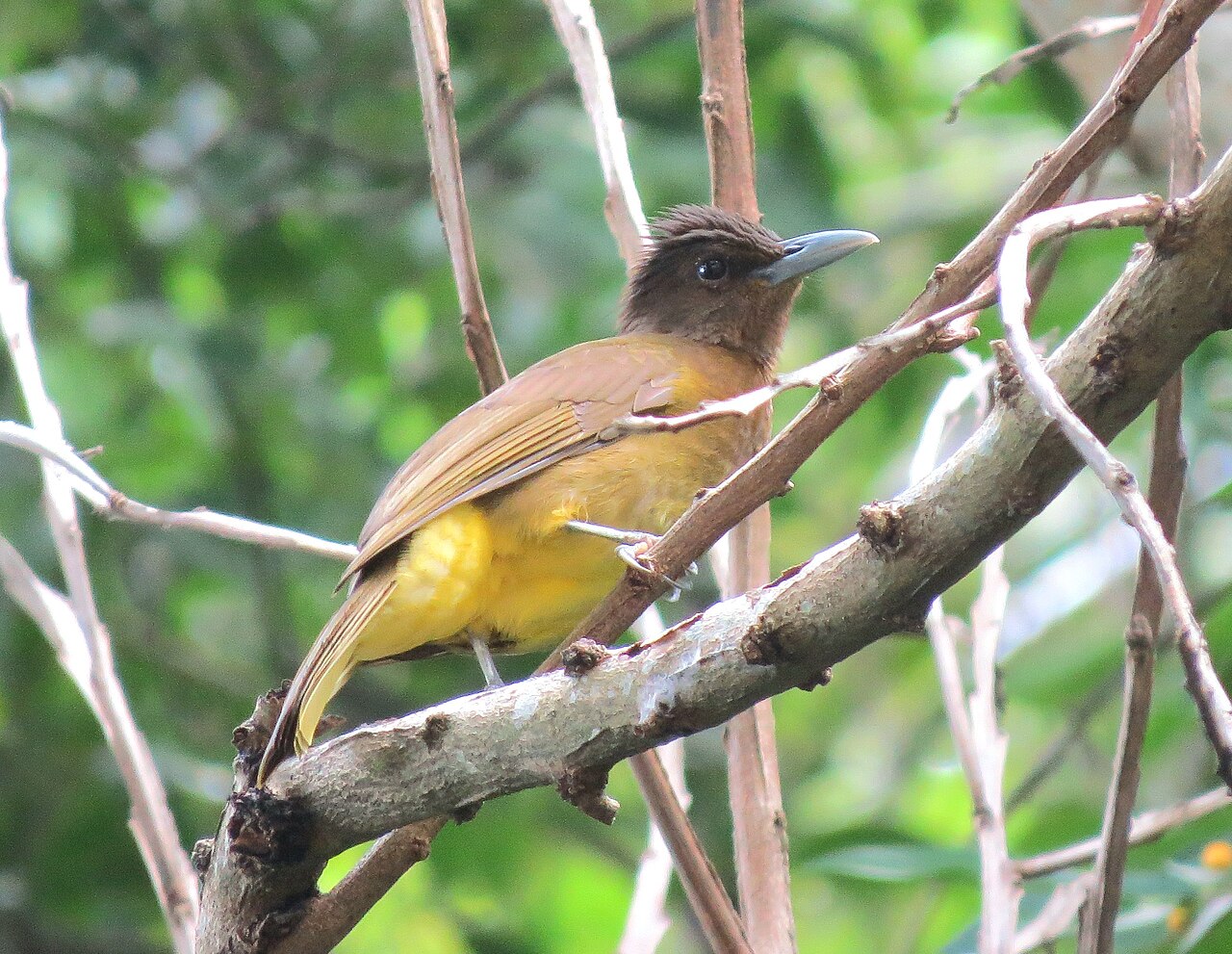
The Cameroon olive greenbul, is a species of songbird in the bulbul family, Pycnonotidae.
Region
West-Central Africa (Cameroon Line and Gulf of Guinea)
Typical Environment
Found in humid evergreen and secondary forests, forest edges, and dense thickets from lowlands into foothills. Prefers shaded understorey and mid-storey layers where it forages among leaves and vine tangles. Occurs on the mainland in southwestern Cameroon and adjacent areas and on Bioko Island. Tolerates moderately disturbed habitats but declines with extensive forest clearance.
Altitude Range
Sea level to 2000 m
Climate Zone
Tropical
Ease of Keeping
Beginner friendly: 2/5
The Cameroon olive greenbul is a quietly skulking songbird of the understorey, most often detected by its soft, fluty calls rather than seen. It inhabits humid forests along the Cameroon Line, including Bioko Island. By gleaning insects and taking small fruits, it helps control herbivorous insects and contributes to seed dispersal. Its subtle plumage makes voice and behavior especially useful for identification.
Temperament
shy and skulking
Flight Pattern
short rapid wingbeats through dense cover
Social Behavior
Usually seen singly, in pairs, or small family groups, and often joins mixed-species foraging flocks. Likely monogamous, nesting in a small cup concealed in dense vegetation close to the ground or in the understorey. Territorial during breeding, with soft contact calls between pair members.
Migratory Pattern
Resident
Song Description
Song consists of soft, fluty whistles and short, repeated phrases delivered from concealed perches. Calls include thin chips and mellow notes used to keep contact while moving through foliage.
Plumage
Mostly olive-green upperparts with slightly paler, grayish-olive underparts and a subtly paler throat. Plumage is plain and soft-textured with minimal contrast, aiding camouflage in dense foliage.
Diet
Takes a variety of small invertebrates such as caterpillars, beetles, and spiders, gleaned from leaves and twigs. Also consumes small fruits and berries, especially when insect prey is less abundant. Occasionally hawks short distances for flying insects and may pick small seeds.
Preferred Environment
Forages in the shaded understorey and mid-storey of humid forests, along edges, and in dense second growth. Frequently searches vine tangles, saplings, and leaf clusters where prey is concentrated.