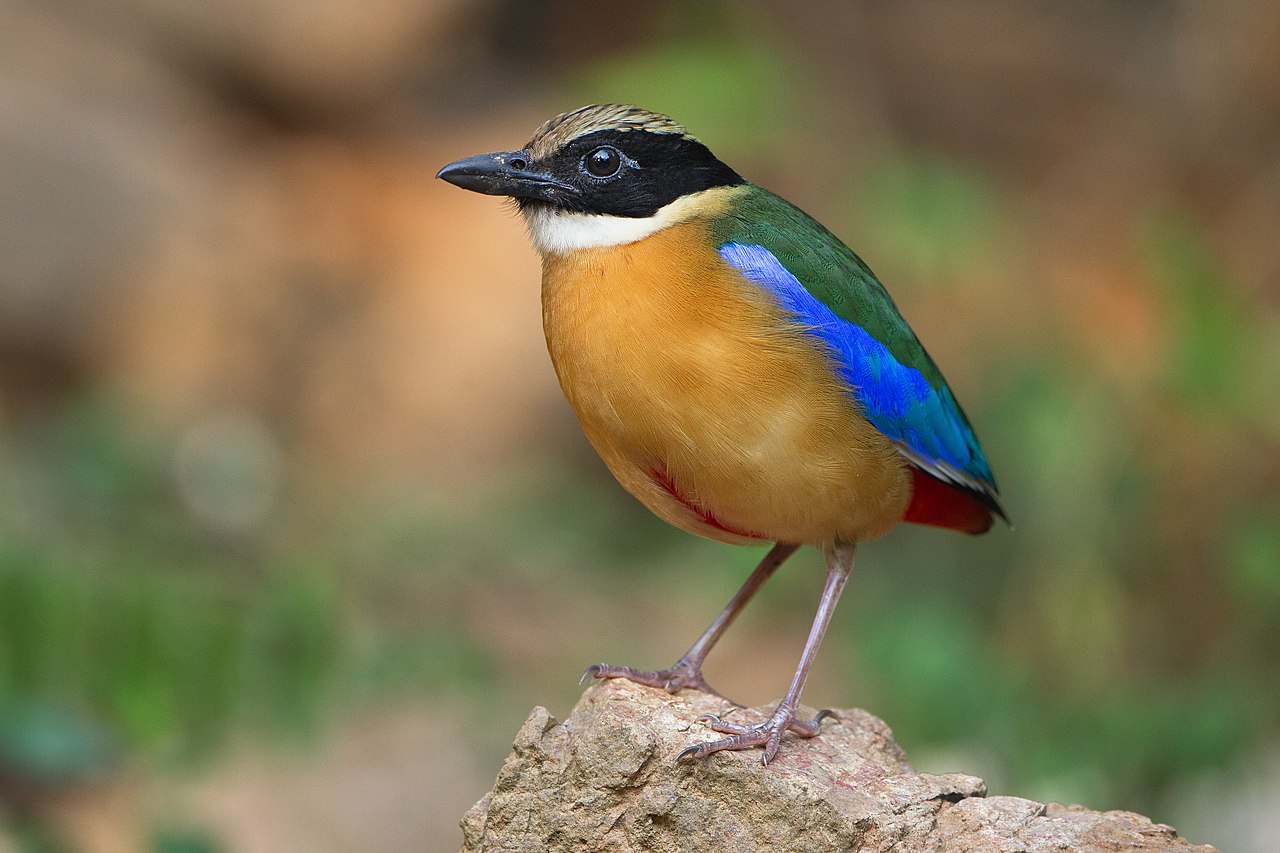
The blue-winged leafbird is a species of leafbird found in forest and second growth throughout Southeast Asia as far east as Borneo and as far south as southern Sumatra. It previously included Jerdon's leafbird from the Indian Subcontinent, and the Bornean leafbird from northern Borneo as subspecies, but differs from both in measurements and morphology, with Jerdon's lacking any blue to the flight feathers, and Bornean having a distinctive male-like female plumage. The Javan leafbird, which is endemic to Java, was also formerly grouped with the species, but more recent phylogenetic studies have split both. The distribution of the blue-winged and the Bornean leafbird are known to approach each other, but there is no evidence of intergradation.
Region
Southeast Asia
Typical Environment
Occurs from southern Myanmar and Thailand through Laos, Cambodia, and Vietnam, south into the Malay Peninsula, and onto Sumatra and Borneo. It inhabits lowland and foothill evergreen forest, forest edge, and well-wooded secondary growth. The species readily visits flowering trees, orchards, and gardens near forest. It is mostly non-migratory, moving locally in response to food availability. Where ranges approach the Bornean leafbird, there is no evidence of intergradation.
Altitude Range
0–1500 m
Climate Zone
Tropical
Ease of Keeping
Beginner friendly: 2/5
Blue-winged leafbirds are canopy specialists noted for their vivid leaf-green plumage and the male’s black facial mask. They can mimic the calls of other birds and often visit flowering trees for nectar, aiding pollination. This species formerly included Jerdon’s, Bornean, and Javan leafbirds, which are now treated as separate species based on morphology and genetics. Trapping for the cage-bird trade affects some populations locally.


C. c. viridinucha
Temperament
active and territorial
Flight Pattern
short rapid wingbeats; agile canopy flier
Social Behavior
Usually seen singly, in pairs, or small family groups; often joins mixed-species flocks at fruiting or flowering trees. Pairs defend feeding and nesting areas vigorously. The nest is a small, well-hidden cup placed high in foliage, and both parents assist in care.
Migratory Pattern
Resident
Song Description
A rich, varied warble interspersed with whistles and chattering notes. Skilled mimicry is common, with phrases borrowed from other forest birds, delivered from high perches.
Plumage
Bright leaf-green body with blue suffusion in the flight feathers; males show a glossy black mask and throat edged yellow, females lack the mask and are paler below. Both sexes display conspicuous blue on the wings and a subtle blue moustachial line.
Diet
Takes nectar from blossoms using a brush-tipped tongue, and also consumes soft fruits such as figs and berries. Insects and other small arthropods are gleaned from leaves and twigs or snapped up in short sallies. The mixed diet provides both energy from sugars and protein for breeding and molt.
Preferred Environment
Feeds mainly in the mid- to upper canopy at flowering and fruiting trees. Frequently visits forest edges, secondary growth, orchards, and gardens where nectar and fruit are abundant.