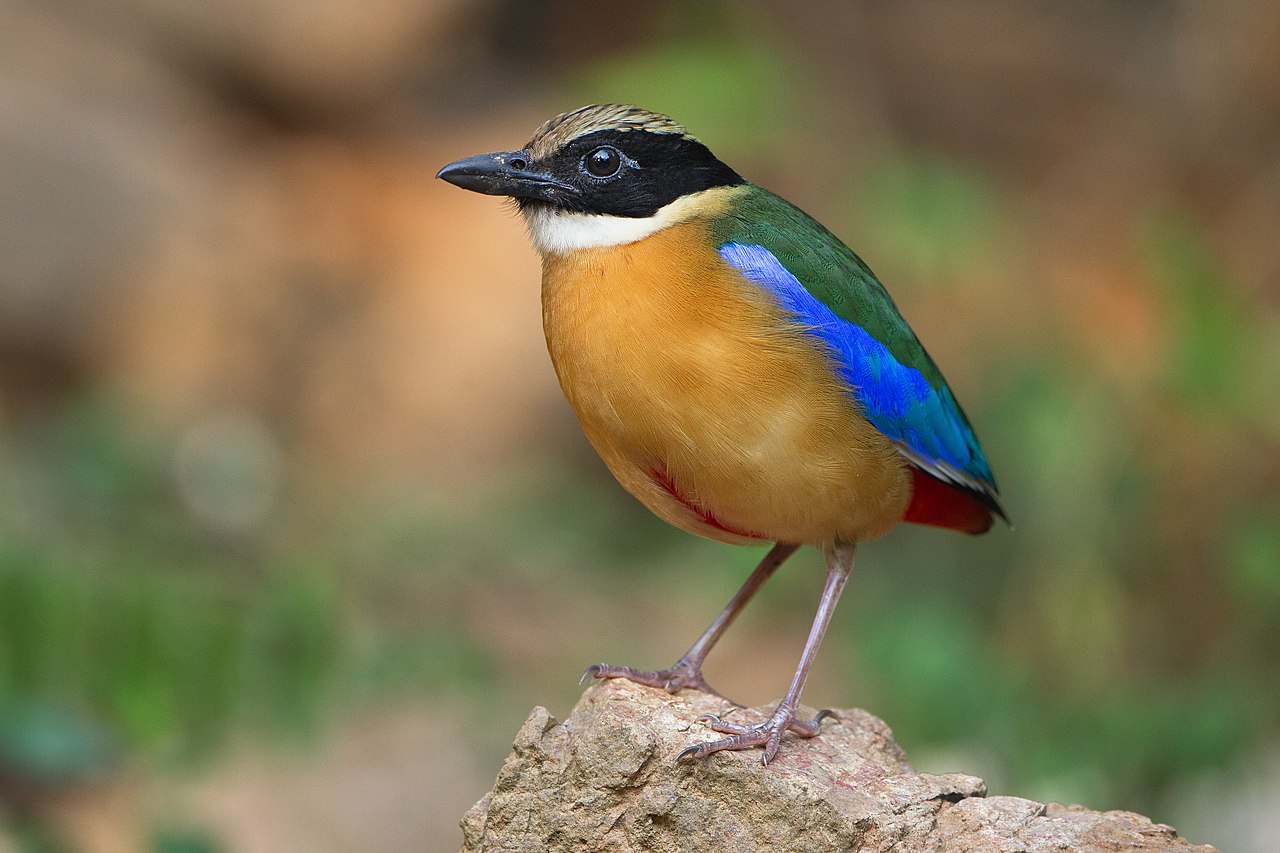
The blue-winged parakeet, also known as the Malabar parakeet, is a species of parakeet endemic to the Western Ghats of southern India. Found in small flocks, they fly rapidly in forest clearings while making screeching calls that differ from those of other parakeet species within their distribution range. Their long blue tails tipped in yellow and the dark wings with blue contrast with the dull grey of their head and body. Adult males and females can be easily told apart from the colour of their beak.
Region
Western Ghats, southern India
Typical Environment
Occupies evergreen and moist-deciduous forests, forest edges, and wooded valleys, often spilling into shade-coffee and cardamom plantations adjacent to forest. Frequently forages in the mid to upper canopy but descends to fruiting trees in clearings and along riparian corridors. Uses tall, mature trees for communal roosting and nesting cavities. Often seen commuting in swift, noisy flights between roosts and feeding sites across forested hillsides.
Altitude Range
Sea level to 1800 m
Climate Zone
Tropical
Ease of Keeping
Beginner friendly: 2/5
Also called the Malabar parakeet, it is confined to the Western Ghats of southern India. Males have a red bill while females have an all-black bill, a key field mark at a distance. They often roost communally and regularly commute in noisy flocks between forest and nearby plantations.

Temperament
social and active
Flight Pattern
strong, direct flight with rapid wingbeats
Social Behavior
Usually found in small, noisy flocks and pairs during the breeding season. Nests in natural cavities high in large trees, likely re-using suitable holes across years. Pairs are monogamous and maintain contact calls while foraging. Communal roosts form outside the breeding season.
Migratory Pattern
Resident
Song Description
Vocalizations are loud, ringing screeches and chattering notes that carry over forest clearings. In flight they give sharp, repetitive contact calls; perched birds add softer twitters and chatter within the flock.
Plumage
Bluish-grey head and body with contrasting dark wings that show bright blue panels; long blue tail tipped yellow.
Diet
Feeds on a variety of wild fruits, figs, berries, seeds, and flower buds. Also takes cultivated fruits such as mango, guava, and jackfruit when available, and may visit spice and coffee plantations. Uses its strong bill to husk seeds and manipulate food while perched. Forages quietly between bouts of loud contact calls when moving between trees.
Preferred Environment
Primarily forages in the mid to upper canopy of evergreen and moist-deciduous forests. Frequently visits forest edges, orchards, and shade plantations near intact woodland.