
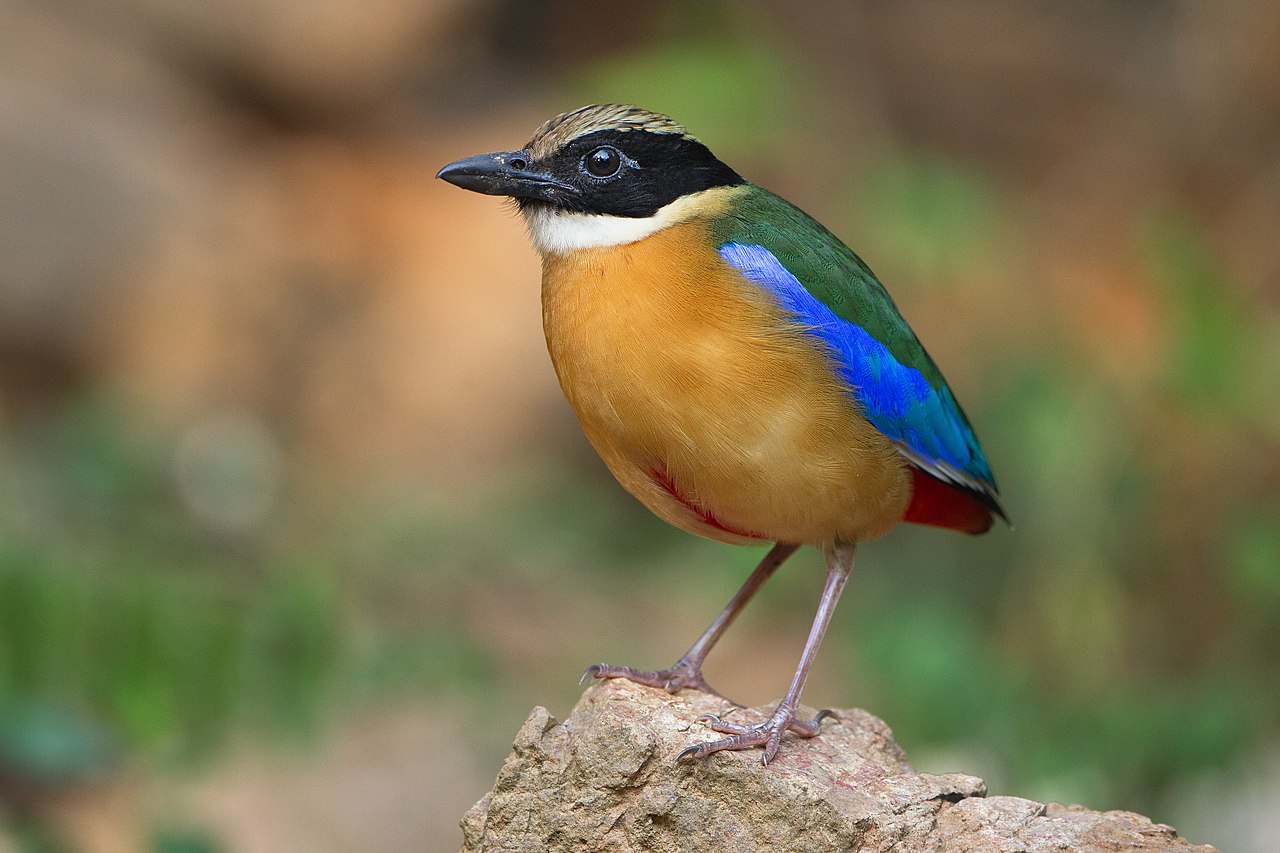
The blue-winged pitta is a passerine bird in the family Pittidae. It forms a superspecies with three other pittas, the Indian pitta, the fairy pitta and the mangrove pitta. A colourful bird, it has a black head with a buff stripe above the eye, a white collar, greenish upper parts, blue wings, buff underparts and a reddish vent area. Its range extends from India to Malaysia, Indonesia, southern China and the Philippines. Its habitat is moist woodland, parks and gardens and it avoids dense forest. It feeds mainly on insects and worms. It breeds in the spring, building an untidy spherical nest on the ground, often near water and between tree roots. A clutch of about five eggs is laid and incubated by both parents, hatching after about sixteen days.
Region
Southeast Asia
Typical Environment
Occurs from the Indian subcontinent through Indochina and the Malay Peninsula to parts of Indonesia, with seasonal movements across this range. Prefers moist woodland, secondary forest, forest edges, bamboo thickets, and overgrown parks and gardens, usually avoiding dense primary forest. Often found near water or in damp gullies where leaf litter is abundant. Uses patches of scrub and plantations during migration and in wintering areas. Urban green spaces with dense understory can also host this species during passage.
Altitude Range
0–1200 m
Climate Zone
Tropical
Ease of Keeping
Beginner friendly: 1/5
The blue-winged pitta is a vividly colored ground-dwelling bird that favors damp, semi-open woodland and forest edges. It builds a domed, spherical nest on or near the ground, often at the base of tree roots. Both parents incubate and care for the young. It is known to crack snail shells against hard surfaces to access the meat.


Sunning with spread wings
Temperament
shy and skulking
Flight Pattern
short rapid wingbeats, low to the ground
Social Behavior
Usually solitary or in pairs, foraging quietly on the forest floor among leaf litter. Nests are domed and placed on or near the ground, often among roots or dense undergrowth. Both sexes participate in nest building, incubation, and feeding of the young.
Migratory Pattern
Seasonal migrant
Song Description
Loud, whistled phrases often delivered from a perch slightly above ground, typically a clear two- or three-note call. The song carries far through woodland and is repeated at intervals, especially at dawn and dusk.
Plumage
Strikingly patterned with green upperparts, a vivid blue wing panel, buff underparts, and a bright reddish vent; head black with a buff supercilium and a narrow white collar.
Diet
Primarily consumes earthworms, beetles, ants, termites, and other terrestrial invertebrates. Also takes snails, using a hard surface as an anvil to break shells. Occasionally eats small frogs or other soft-bodied prey when available. Forages by hopping and probing in moist leaf litter.
Preferred Environment
Feeds on the forest floor in damp, shaded areas with deep leaf litter and fallen branches. Forest edges, thickets, and lightly disturbed secondary growth are favored. During migration, it also forages in gardens, parks, and plantations with dense understory.


