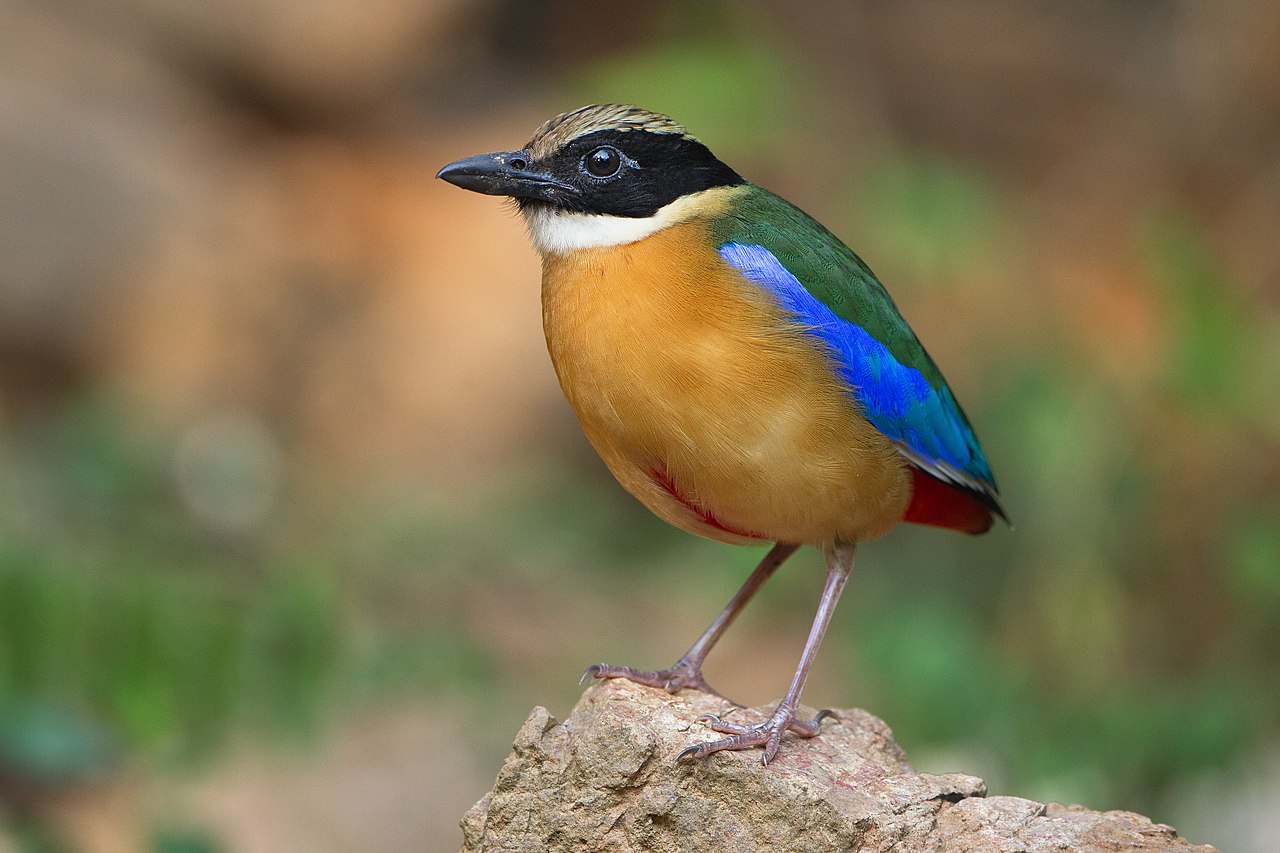
The blue-winged parrot, also known as the blue-banded parakeet or blue-banded grass-parakeet, is a small parrot found in Tasmania and southeast mainland Australia. It is partly migratory, with populations of blue-winged parrots travelling to Tasmania for the summer. The parrot is sexually dimorphic – the males have more blue on the wings and a two-toned blue frontal band on the head, while females are duller and have more green on the wings and a wingbar. Both sexes have predominantly olive-green plumage. Predominantly a feeder on the ground, the blue-winged parrot mainly eats seeds of grasses. It adapts readily to captivity.
Region
Tasmania and southeastern Australia
Typical Environment
Occurs in open grassy habitats, lightly timbered eucalypt woodland with a grassy understory, coastal heath and saltmarsh, and modified farmlands and pastures. Frequently uses roadside verges, stubble fields, and open paddocks where seeding grasses are abundant. Breeding commonly takes place in Tasmania and nearby islands, with non-breeding movements to the southeastern mainland. It avoids dense forest and prefers mosaic landscapes with scattered trees and extensive ground cover of grasses.
Altitude Range
Sea level to 1000 m
Climate Zone
Temperate
Ease of Keeping
Beginner friendly: 4/5
Also called the blue-banded parakeet, this small grass-parrot is native to southeastern Australia and Tasmania. It is partly migratory, with many birds moving to Tasmania to breed in spring–summer and returning to the mainland in autumn–winter. It is predominantly a ground-feeder that specializes on grass seeds and adapts readily to captivity. Males show a distinctive two-toned blue frontal band, while females are duller with a pale wingbar.

Temperament
social and active
Flight Pattern
short rapid wingbeats with low, direct flight
Social Behavior
Outside the breeding season they gather in small flocks that forage together on open ground. Pairs are monogamous during the breeding season and nest in tree hollows, typically in eucalypts. They are wary when feeding and flush readily, often flying low to nearby cover.
Migratory Pattern
Partial migrant
Song Description
Calls are soft, tinkling twitters and thin, high-pitched whistles, often given in flight. The song is simple and subdued, with brief trills and chirps used to maintain contact within flocks.
Plumage
Predominantly olive-green with a bright blue shoulder/wing patch and yellowish underparts; tail long and narrow with bluish hues. Males show more extensive blue on the wings and a two-toned blue frontal band. Females are duller green with a paler, often visible wingbar and reduced blue on the head and wings.
Diet
Feeds mainly on seeds of native and introduced grasses and herbs, taken from the ground or directly from seeding heads. Also consumes seeds of saltmarsh plants and sedges where available. Occasionally nibbles buds and flowers, especially when seeds are scarce.
Preferred Environment
Forages in open pastures, grassy woodlands, coastal saltmarsh edges, and farm stubble. Often seen along road verges and in lightly grazed paddocks where seeding grasses are dense.