

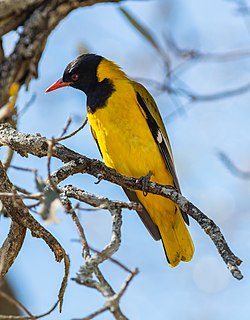
The black-headed oriole is a species of bird in the family Oriolidae. It is found in Africa and has a very striking appearance with a bright yellow body, contrasting black head and flesh-coloured beak.
Region
Eastern and Southern Africa
Typical Environment
Occurs widely from East Africa southward through savannas, open and riverine woodlands, and forest edges, extending into suburban parks and large gardens. It favors areas with mature trees and a well-developed canopy, including acacia and miombo woodlands. Often associates with fruiting trees and flowering shrubs. Less common in dense closed forest or very open treeless habitats.
Altitude Range
Sea level to 2000 m
Climate Zone
Tropical
Ease of Keeping
Beginner friendly: 2/5
This striking oriole shows a bright yellow body with a contrasting black head and a pinkish, flesh‑colored bill. It spends much of its time high in the canopy, where its mellow, fluty whistles often reveal its presence before the bird is seen. Juveniles are duller with some mottling and a darker bill. Pairs weave a neat, hanging cup nest slung in a forked branch.


Temperament
alert and somewhat secretive
Flight Pattern
strong direct flight with short rapid wingbeats and brief glides
Social Behavior
Usually seen singly, in pairs, or in small family groups, moving through mid to upper canopy. Monogamous pairs build a neatly woven, suspended cup nest in a forked branch. Both parents tend the nest and feed the young. Often joins mixed-species flocks when foraging.
Migratory Pattern
Resident
Song Description
Rich, fluty whistles and liquid phrases, often delivered from concealed perches. Calls include mellow, far-carrying notes and chattering scolds. Capable of varied phrases that can resemble other orioles’ songs.
Plumage
Bright yellow body with an olive-tinged back and wings; glossy black head and throat; narrow pale edging on wing feathers.
Diet
Feeds extensively on fruit such as figs and berries, supplementing with insects like caterpillars, beetles, and mantids. Also takes nectar from flowering trees and occasionally small invertebrates hidden among foliage. Forages methodically among leaves and twigs and may sally to snatch insects in flight. Will visit fruiting and flowering garden trees.
Preferred Environment
Mid to upper canopy of woodlands, forest edges, and riverine trees. Frequently forages in fruiting trees and along edges where sunlight promotes flowering and fruiting. In suburban areas, uses tall shade trees and orchards.


