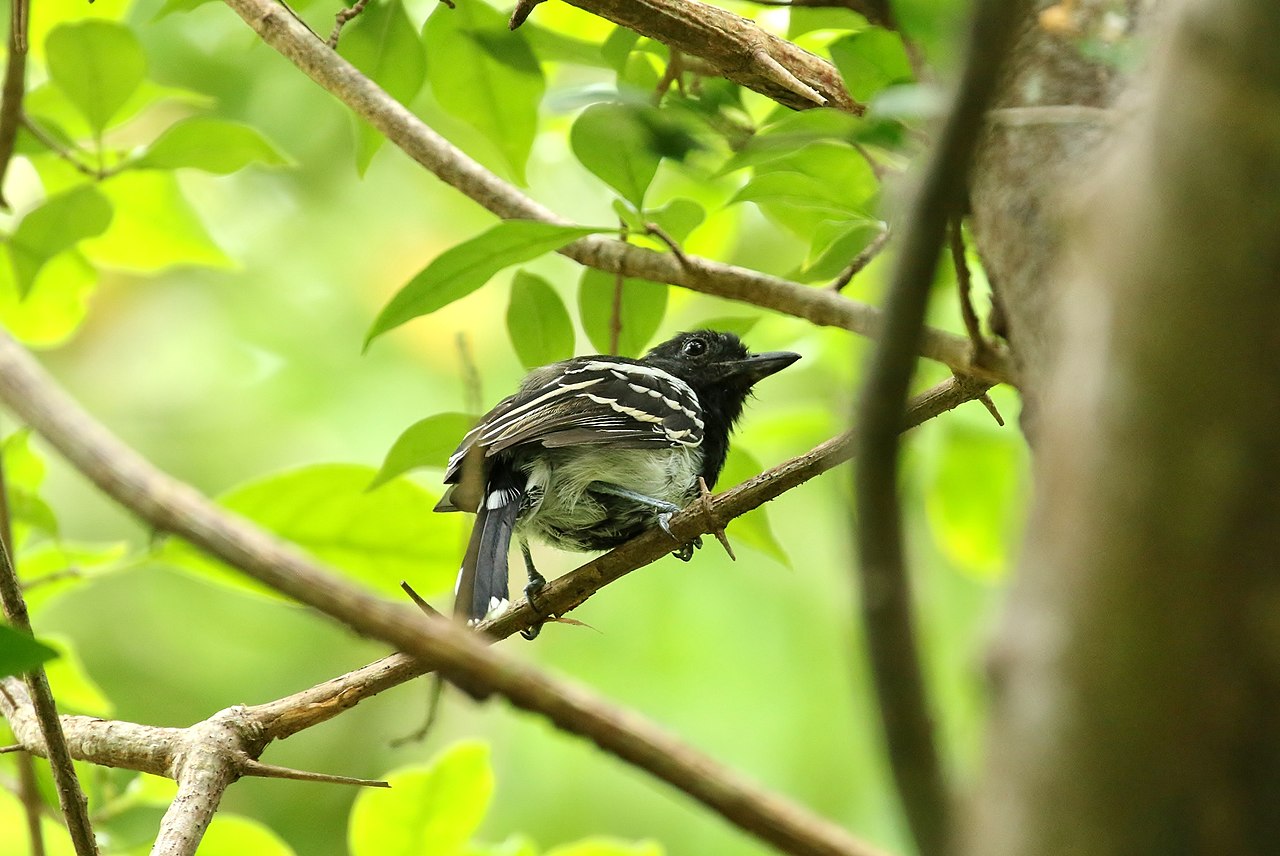
The black-and-yellow broadbill is a species of bird in the typical broadbill family Eurylaimidae. A small, distinctive species, it has a black head, breastband, and upperparts, a white neckband, yellow streaking on the back and wings, and vinous-pink underparts that turn yellow towards the belly. The beak is bright blue, with a green tip to the upper mandible and black edges. It shows some sexual dimorphism, with the black breastband being incomplete in females.
Region
Sundaland, Southeast Asia
Typical Environment
Occurs in the Malay Peninsula (southern Thailand to Peninsular Malaysia and Singapore), Sumatra, Borneo, and nearby smaller islands. Prefers primary and well-structured secondary lowland evergreen rainforest, peat swamp forest, and riverine forest. Often found along forest edges and clearings but relies on dense canopy or midstory cover for foraging. Common near streams where it also places its hanging nests. Becomes scarce in heavily logged or fragmented habitats.
Altitude Range
Sea level to 1000 m
Climate Zone
Tropical
Ease of Keeping
Beginner friendly: 1/5
This striking broadbill of the Sundaic lowlands is easily recognized by its bright blue bill, pinkish underparts, and bold black-and-yellow upperparts. It builds a large, pear-shaped hanging nest often suspended over streams, with both sexes sharing nesting duties. The species is sensitive to forest loss and fragmentation, favoring intact lowland rainforest. It frequently joins mixed-species flocks while foraging in the midstory.


Male, showing tail spot


Female adult and juvenile

Black-and-yellow broadbill at nest
Temperament
social and active
Flight Pattern
short rapid wingbeats with undulating, fluttery flights under the canopy
Social Behavior
Usually seen in pairs or small family groups and often joins mixed-species flocks in the midstory. Monogamous pairs build a large, pendant, pear-shaped nest suspended from a branch, frequently over water. Both sexes incubate and feed the young, and adults maintain small territories around nest sites.
Migratory Pattern
Resident
Song Description
Gives a series of thin, high-pitched wheezy whistles that rise and fall, often delivered in brief bursts. Calls carry surprisingly well through dense forest and are a key cue to its presence. Also produces soft contact notes while moving with mixed flocks.
Plumage
Glossy black head and upperparts with a crisp white nuchal collar, bold black breastband, and yellow-streaked mantle and wings. Underparts are vinous-pink fading to yellow on the belly. Feathers appear smooth and sleek with a neat, sharply defined pattern.
Diet
Primarily hunts insects, including beetles, mantises, moths, orthopterans, and spiders, taken by sallying or gleaning from foliage. Occasionally takes small fruits or other small invertebrates. Forages methodically, making short sallies from perches to snatch prey from leaves or in the air.
Preferred Environment
Feeds in the midstory and lower canopy of humid lowland rainforest, along forest edges, and near streams. Often forages within mixed-species flocks and favors areas with dense foliage and shaded perches.