
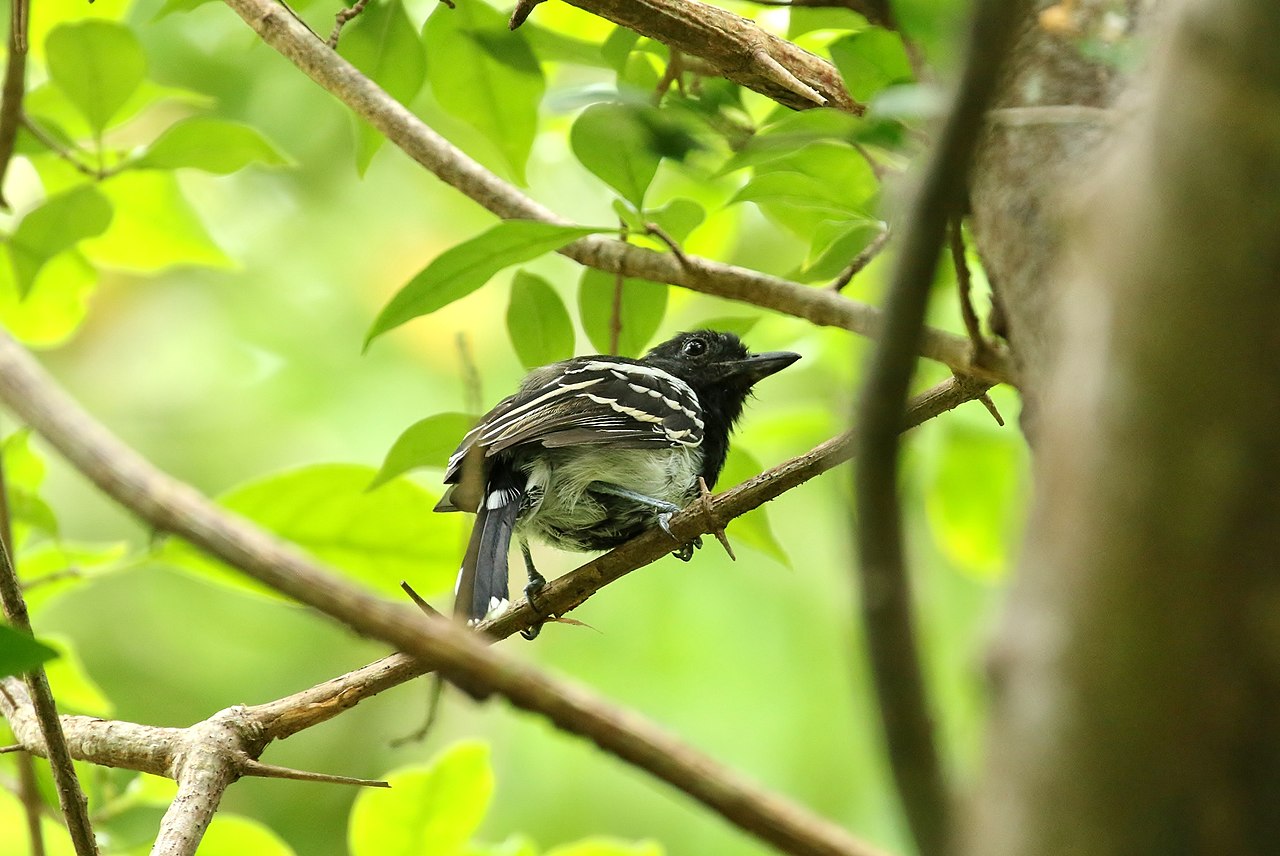
The black-backed antshrike is a species of bird in subfamily Thamnophilinae of family Thamnophilidae, the "typical antbirds". It is found in Colombia and Venezuela.
Region
Northern South America
Typical Environment
Occurs in northern Colombia and northwestern Venezuela, mainly in lowland and foothill forests. Prefers dense understory of humid and semi-humid forest, gallery forests along rivers, and overgrown second growth. Common along forest edges, thickets, and vine tangles, and may enter shaded plantations and scrubby woodlands. Usually stays within a few meters of the ground, moving through tangled vegetation.
Altitude Range
Sea level to 1200 m
Climate Zone
Tropical
Ease of Keeping
Beginner friendly: 1/5
This antshrike is a skulking understory bird that is most often detected by its distinctive duet between males and females. It forages methodically in dense thickets and is sometimes seen near army-ant swarms to snatch flushed insects. The species tolerates secondary growth and edge habitats, which helps keep its populations stable. Males and females look quite different, aiding quick field identification.


Black-backed antshrike

Temperament
solitary and territorial
Flight Pattern
short rapid wingbeats
Social Behavior
Typically found in pairs that maintain year-round territories. Nests are open cups placed low in dense vegetation. Pairs often keep contact with soft calls and may join mixed-species flocks along forest edges. Courtship and territorial defense often involve coordinated duets.
Migratory Pattern
Resident
Song Description
Song is a series of sharp, whistled notes that may accelerate or rise slightly in pitch. Males and females perform responsive duets, with the female’s part slightly softer and higher. Calls include dry scolds and ticking notes given from cover.
Plumage
Male is largely black above with contrasting pale spotting on the wings and faint barring in tail; underparts are dark slate to blackish. Female is warm rufous to cinnamon above with paler buffy underparts and subtle barring in the tail. Both sexes have a sturdy, slightly hooked bill typical of antshrikes.
Diet
Primarily hunts insects and other arthropods, including beetles, caterpillars, spiders, and orthopterans. Forages by gleaning from leaves, twigs, and vine tangles, and will make short sallies to seize prey. Occasionally attends army-ant swarms to capture flushed invertebrates. Rarely, it may take small vertebrates or berries opportunistically.
Preferred Environment
Feeds in dense understory and edge thickets, especially in viney second growth and along forested waterways. Often remains 0.5–4 meters above ground, using perches to scan and then making short pounces into cover.


