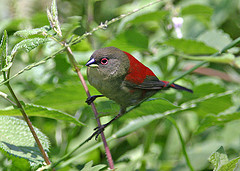
The Abyssinian catbird, also known as the juniper babbler, is a small passerine in the family Sylviidae, endemic to the highland forests and scrub of Ethiopia. Despite its name, it is unrelated to other birds called "catbirds." It is mostly grey, with black lores, a whitish forehead, and a chestnut vent.
Region
Horn of Africa
Typical Environment
Found in moist and mixed montane forests and scrub of the Ethiopian Highlands, especially where Juniperus procera, Hagenia abyssinica, Hypericum, and Erica thickets occur. It uses forest edges, clearings, ravines, and secondary growth with dense understory. The species prefers tangled shrubs and mid-story cover for foraging and nesting. It is generally sedentary within suitable habitat but may move locally following fruiting shrubs.
Altitude Range
1800–3500 m
Climate Zone
Highland
Ease of Keeping
Beginner friendly: 1/5
Also called the juniper babbler, it is the only species in the genus Parophasma and is endemic to the Ethiopian Highlands. Its vocalizations include a distinctive cat-like mew and rich duets between pairs. It favors juniper and Hagenia forests and dense montane scrub, where it is more often heard than seen.
Temperament
secretive in dense cover yet vocal
Flight Pattern
short rapid wingbeats with low, fluttering dashes between shrubs
Social Behavior
Usually seen in pairs or small family parties that keep close contact in thickets. Likely monogamous, with duetting common between mates. Nests are placed low in dense shrubbery where cover is thick.
Migratory Pattern
Resident
Song Description
A varied song featuring rich whistles, chatters, and a distinctive cat-like mew. Pairs often perform coordinated duets that carry through montane scrub.
Plumage
Mostly smooth grey with darker face, whitish forehead and throat, and a warm chestnut vent; tail and wings slightly duskier.
Diet
Takes insects and other small arthropods by gleaning from leaves and twigs. Also consumes berries and small fruits, including juniper and Hypericum when available. Will occasionally hop to the ground to pick prey from leaf litter and may sally short distances for flushed insects.
Preferred Environment
Forages within dense montane shrubs, forest edges, and mid-story tangles. Often works along ravines, clearings, and secondary growth where fruiting shrubs are abundant.