
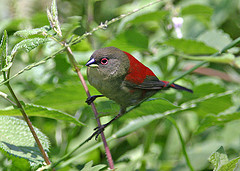
The Abyssinian crimsonwing, also known as the Ethiopian crimsonwing, Salvadori's crimsonwing or crimson-backed forest finch, is a common species of estrildid finch found in eastern Africa. It has an estimated global extent of occurrence of 190,000 km2 (73,000 sq mi).
Region
Horn of Africa (Ethiopia and Eritrea)
Typical Environment
The Abyssinian crimsonwing inhabits moist montane forests, forest edges, bamboo thickets, and dense secondary growth. It favors tangled understorey near streams and clearings where seed availability is high. Birds often keep low, moving through leaf litter and low shrubs, and will venture to forest margins when seeding grasses are abundant. Local movements may track seeding bamboo or grasses but the species is largely sedentary within its highland range.
Altitude Range
1500–3300 m
Climate Zone
Highland
Ease of Keeping
Beginner friendly: 2/5
Also called the Ethiopian or Salvadori’s crimsonwing, this small estrildid finch is a shy, forest-dwelling species of the Ethiopian Highlands. It keeps to dense thickets and bamboo, making it more often heard than seen. Its vivid crimson back contrasts with greenish wings and muted underparts, helping it blend in dappled montane forest light.

Temperament
shy and skulking
Flight Pattern
short rapid wingbeats, low dashes between cover
Social Behavior
Usually seen singly, in pairs, or in small family groups within dense undergrowth. Pairs are monogamous and nest low in thick vegetation, constructing a neat grass nest. They are secretive at the nest and often follow narrow runways through the understorey.
Migratory Pattern
Resident
Song Description
Soft, high, thin notes and delicate twittering contact calls given from cover. Song is a quiet, brief series of tinkling phrases, easily missed in flowing stream noise or rustling leaves.
Plumage
Male shows a bright crimson back and rump with olive-green wings and darker head; underparts are grey-olive and relatively plain. Female is duller, with more olive-brown upperparts and a reduced or muted crimson on the rump and back. Both sexes have a short, stout finch bill.
Diet
Feeds primarily on small seeds, including those of grasses and bamboo, often taken from the ground or low seed heads. It supplements with small insects and other invertebrates, especially during breeding. Berries and soft plant material may be taken opportunistically. Foraging is deliberate and close to cover, with frequent pauses to scan.
Preferred Environment
Forages in dense understorey, bamboo patches, forest edges, and along paths or stream sides where seeds accumulate. Often uses shaded leaf litter and low shrubs to remain concealed while feeding.


