
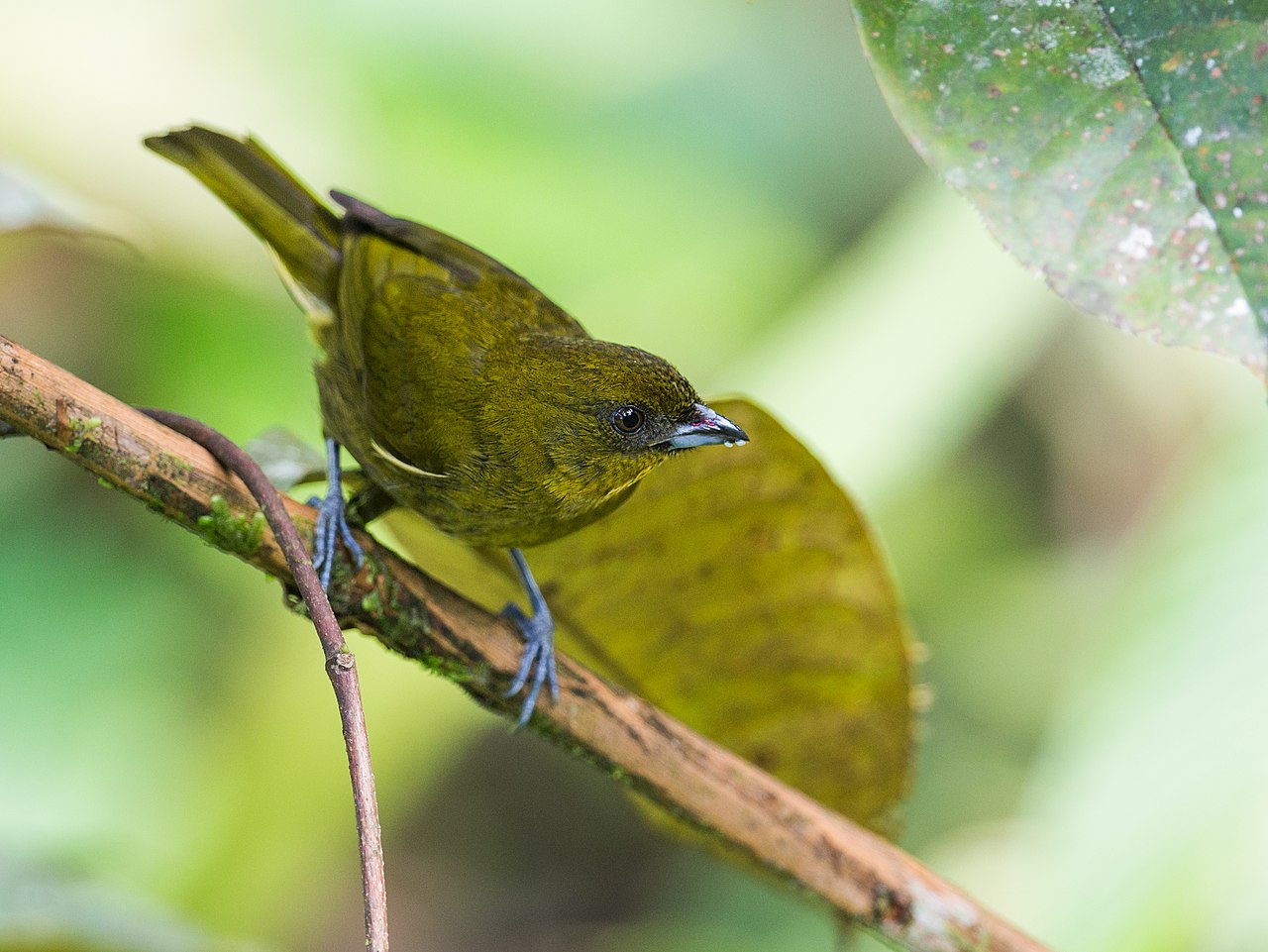
The yellow-green tanager is a species of bird in the family Thraupidae. It was formerly known as the yellow-green bush tanager or yellow-green chlorospingus as it used to be placed in the genus Chlorospingus with other bush tanagers. Chlorospingus as a whole was formerly placed in the tanager family Thraupidae, but was transferred to the New World sparrows when genetic analysis of two Chlorospingus species revealed they were embedded within the latter family. However, more recently, molecular analysis of additional Chlorospingus species found that the yellow-green tanager is not a member of Chlorospingus but a true tanager after all, most closely related to the blue-and-gold tanager, so the species was returned to Thraupidae and placed in the genus Bangsia.
Region
Andes Mountains
Typical Environment
Occurs in humid montane and cloud forests on the western Andean slopes, especially within the Chocó biogeographic region of northwestern Colombia. It favors mature forest but will use well-developed secondary growth and forest edges near fruiting trees. Most activity is in the shaded midstory, where it forages deliberately among mossy branches. The species is scarce to local and is sensitive to heavy fragmentation. It is largely absent from heavily degraded or open areas.
Altitude Range
900–2200 m
Climate Zone
Highland
Ease of Keeping
Beginner friendly: 1/5
This cloud-forest tanager was long treated as a bush-tanager in Chlorospingus, but genetic studies restored it to the true tanagers (Thraupidae) and placed it in Bangsia, where it is closely related to the blue-and-gold tanager. It keeps to the midstory of humid montane forests and often joins mixed-species flocks. Habitat loss in the Chocó–Andean region poses the main threat to the species. Its overall yellow-green plumage provides excellent camouflage in mossy, epiphyte-laden foliage.


Temperament
social and active
Flight Pattern
short rapid wingbeats
Social Behavior
Often encountered in pairs or small groups, frequently participating in mixed-species flocks with other midstory insectivores and frugivores. During breeding, pairs become more focused on dense cover where a cup nest is placed in shrubs or saplings. Both parents are believed to contribute to provisioning. Outside breeding, it forages cooperatively and remains relatively inconspicuous.
Migratory Pattern
Resident
Song Description
A soft, high-pitched series of thin sibilant notes interspersed with tinkling twitters. Contact calls are sharp, delicate chips given while moving through foliage.
Plumage
Predominantly yellow-green with brighter yellow underparts and olive-green upperparts; wings and tail are slightly darker with yellowish edging. Plumage appears uniform at a distance, lacking bold wingbars. Bill is short and stout; overall feathering is soft and mossy-toned to match cloud-forest foliage.
Diet
Takes small fruits and berries, especially from melastomes, along with a variety of arthropods gleaned from leaves and mossy branches. Will sally short distances to snatch flying insects and probe clusters of epiphytes for hidden prey. Fruit consumption increases when trees and shrubs are in heavy crop. Occasionally follows army ants peripherally to capture flushed insects.
Preferred Environment
Feeds mainly in the shaded midstory to lower canopy of humid forest and along forest edges with fruiting shrubs. Frequently forages along mossy limbs, vine tangles, and epiphyte-laden branches. Joins mixed-species flocks that move along ridgelines and stream gullies.


