

The yellow-headed caracara is new-world bird of prey in the family Falconidae, of the Falconiformes order. It is found as far north as Nicaragua, south to Costa Rica and Panamá, every mainland South American country, and on the Caribbean islands of Aruba, Bonaire, Curaçao, and Trinidad and Tobago.
Region
Neotropics
Typical Environment
Occurs from southern Central America (Nicaragua south through Costa Rica and Panama) across most of tropical South America, including Colombia, Venezuela, the Guianas, Ecuador, Peru, Bolivia, much of Brazil, and parts of Paraguay, with populations on Aruba, Bonaire, Curaçao, and Trinidad and Tobago. It favors open and semi-open habitats such as savannas, pastures, forest edges, and wetlands, as well as urban parks and agricultural lands. Frequently associated with human activity, it is common around ranches and villages. It is less typical of dense interior forest but readily uses riparian corridors and clearings.
Altitude Range
Sea level to 1800 m
Climate Zone
Tropical
Ease of Keeping
Beginner friendly: 2/5
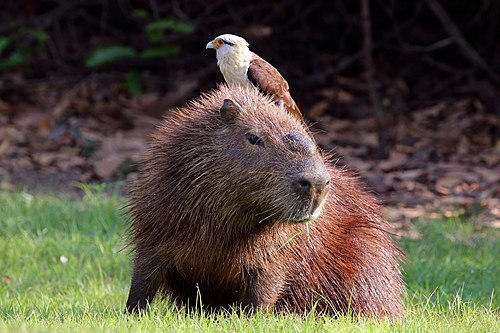
This adaptable caracara often follows livestock to pick off ticks and insects, and will scavenge along roads and shorelines. It frequently perches on cattle or capybaras and also patrols the edges of grass fires to catch fleeing prey. Pairs are commonly seen, and it thrives in human-modified landscapes. On islands like Aruba and Trinidad, it is a familiar raptor in open country.


Juvenile seen in June in Santa Catarina, Brazil




Temperament
opportunistic and adaptable
Flight Pattern
buoyant flier with easy, shallow wingbeats interspersed with glides and short soaring
Social Behavior
Usually seen singly or in pairs, sometimes in small loose groups at food sources. Nests are stick platforms placed in trees or palms; pairs may reuse or appropriate old nests. Both sexes participate in nest building and care for the young.
Migratory Pattern
Resident
Song Description
Calls are clear, whistled notes and mewing phrases, often given in a descending series. It also produces sharp, repeated ki-ki-ki alarms near the nest or when interacting with other raptors.
Plumage
Pale buff to creamy head and underparts with fine dusky streaking on the crown and nape; upperparts medium brown with lighter edging. Flight feathers are darker with pale panels visible in flight, and the tail is buff with a dark subterminal band. Overall contrast between a pale head/neck and darker wings and back.
Diet
Takes a wide range of foods including carrion, roadkill, large insects, small reptiles and amphibians, eggs and nestlings, and occasional fruits. Regularly gleans ticks and other ectoparasites from livestock and wild mammals. Scavenges at fish markets, dumps, and shorelines, and patrols fires or mowed fields for disturbed prey.
Preferred Environment
Forages in open pastures, along riverbanks and wetlands, at forest edges, and around villages and ranches. Often hunts from low perches, on the ground, or by walking and probing among vegetation and debris.


