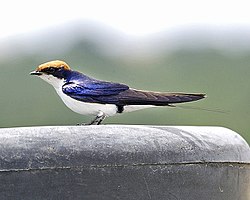
The wire-tailed swallow is a small passerine bird in the swallow family. It has two subspecies: H. s. smithii, which occurs throughout Africa, and H. s. filifera, which is found in southern and southeastern Asia. It is mainly resident, but populations in Pakistan and northern India migrate further south in winter. The genus name Hirundo is the Latin word for swallow. The species name smithii commemorates Christen Smith, a Norwegian botanist and geologist.
Region
Sub-Saharan Africa; South and Southeast Asia
Typical Environment
Common along rivers, lakes, reservoirs, and wetlands, as well as open countryside near water. Frequently uses human-made structures such as bridges, culverts, and buildings for nesting and perching. Forages over open water and adjacent fields, often flying low with swift, precise maneuvers. Occurs from rural landscapes to towns where suitable water bodies and nesting substrates exist.
Altitude Range
Sea level to 2400 m
Climate Zone
Tropical
Ease of Keeping
Beginner friendly: 1/5
Wire-tailed swallows are named for their very thin, wire-like outer tail feathers, which are longest in males. They build neat mud cup nests, often under bridges or overhanging structures above water, and will reuse and refurbish them. Two subspecies occur: H. s. smithii in Africa and H. s. filifera in South and Southeast Asia. They are agile aerial hunters specialized for catching small flying insects over open water.




Temperament
social and active
Flight Pattern
short rapid wingbeats with agile, low passes over water; occasional glides
Social Behavior
Usually seen in pairs or small groups, sometimes loosely associating with other swallows. Nests are mud cups placed on vertical surfaces, often under bridges or eaves above water. Generally monogamous and may defend nest sites vigorously; colonies are typically small or scattered.
Migratory Pattern
Partial migrant
Song Description
High, thin twitters and sharp chip notes delivered in quick series. Calls are bright and metallic, often given in flight and around nest sites.
Plumage
Glossy steel-blue upperparts with clean white underparts and a rich chestnut cap. Tail is square with extremely long, filament-like outer feathers in adults. Sleek, compact swallow profile with pointed wings and a short, wide-gaped bill.
Diet
Feeds almost entirely on small flying insects such as flies, midges, mosquitoes, termites, and beetles. Hunts on the wing, making tight turns and swift sallies to intercept prey. Often exploits emergences of aquatic insects and termite swarms. Rarely takes prey off the water surface.
Preferred Environment
Forages over open water bodies, river corridors, and nearby open fields or pastures. Frequently hunts near bridges, embankments, and along shorelines where insect activity is concentrated.