
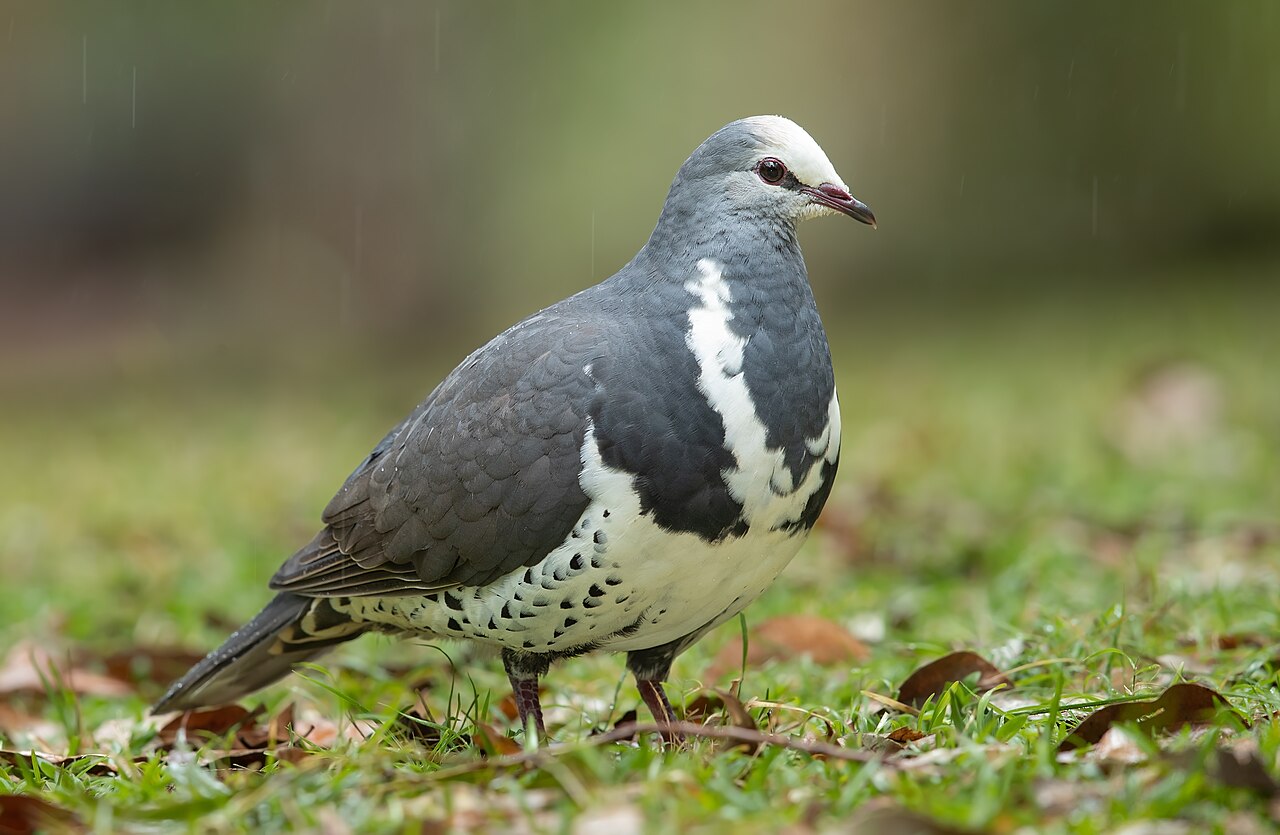
The wonga pigeon or wonga wonga is a pigeon that inhabits areas in eastern Australia with its range being from Central Queensland to Gippsland, eastern Victoria, Australia.
Region
Eastern Australia
Typical Environment
Occurs from central Queensland south through coastal and subcoastal New South Wales to Gippsland in eastern Victoria. It favors dense habitats including subtropical and temperate rainforests, wet sclerophyll forests, and thickly vegetated gullies. Often found near forest edges, clearings, and along creeks where fallen fruit accumulates. It forages mainly on the ground but retreats to low perches when disturbed. Adaptable to regrowth and some semi-urban fringes with suitable cover.
Altitude Range
Sea level to 1200 m
Climate Zone
Subtropical
Ease of Keeping
Beginner friendly: 2/5
The wonga pigeon is a large, ground-dwelling pigeon endemic to eastern Australia, often heard before it is seen. Its name echoes its resonant, repetitive “wong-ga” call that carries through forests. By swallowing fruits whole, it helps disperse seeds of many native rainforest plants.

Temperament
shy and secretive
Flight Pattern
short rapid wingbeats with explosive takeoffs
Social Behavior
Usually solitary or found in pairs, occasionally small loose groups at abundant food. Forms long-term monogamous pairs. Nests are simple stick platforms placed low to mid-level in dense shrubs or small trees. Both sexes share incubation and chick-rearing.
Migratory Pattern
Resident
Song Description
A deep, resonant, repetitive ‘wong-ga’ or ‘whoom’ series delivered at measured intervals, often carrying far through forest. Also gives soft coos and clattering wing noise when flushed.
Plumage
Upperparts smooth grey-brown; head and breast grey; underparts predominantly white with bold dark slate to blackish spotting and scalloping along the sides and flanks. Wings plain with subtle pale edging; tail dark with a paler tip.
Diet
Primarily consumes fallen rainforest fruits and berries, as well as seeds from native and sometimes introduced plants. Will take figs, laurels, wattles, and other fleshy fruits. Supplements diet with tender shoots, leaves, and occasionally small invertebrates or snails. Swallows items whole and later regurgitates seeds, aiding plant dispersal.
Preferred Environment
Feeds mostly on the forest floor in leaf litter, especially along tracks, edges, and beneath fruiting trees. Frequently uses dense cover near gullies and creeks, retreating to low perches when disturbed.


