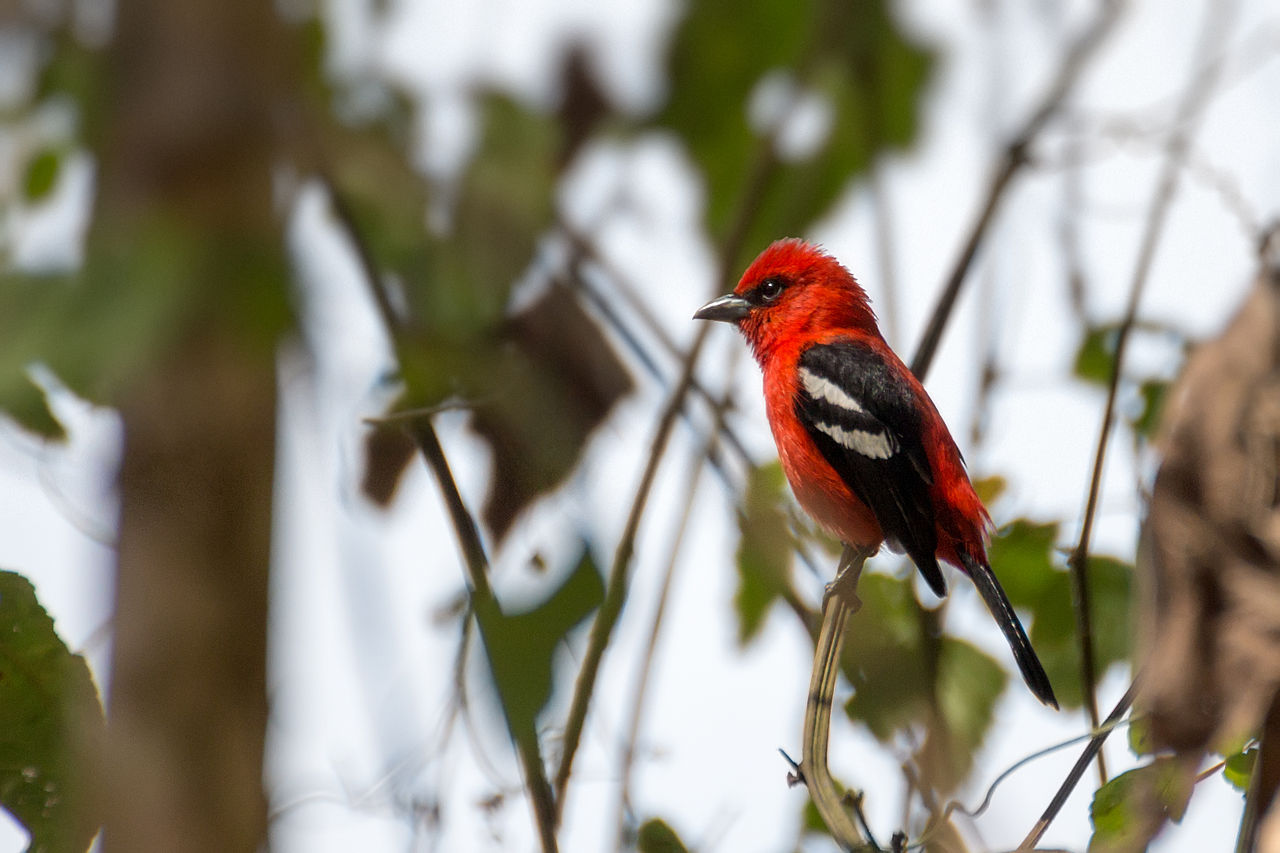
The white-winged shrike-tanager is a species of bird in the family Thraupidae. It is found in Bolivia, Brazil, and Peru in subtropical or tropical moist lowland forests. Two subspecies are recognised, L. v. versicolor from eastern Peru, western Brazil and northern Bolivia, and L. v. parvus from eastern and central Brazil and northeastern Bolivia.
Region
Amazon Basin
Typical Environment
Occurs in subtropical and tropical moist lowland forests of Bolivia, Brazil, and Peru. It occupies terra firme and seasonally flooded forest (várzea), favoring interior forest as well as edges and treefall gaps. Most foraging takes place from the midstory to the canopy, where it joins mixed-species flocks. It tolerates some secondary growth but is most frequent in mature forest.
Altitude Range
Sea level to 900 m
Climate Zone
Tropical
Ease of Keeping
Beginner friendly: 1/5
This shrike-tanager often travels with mixed-species flocks in the midstory to canopy, where its sharp calls help maintain contact among flock members. The striking white wing panel that flashes in flight gives the species its name and is most prominent in males. Sexes are strongly dimorphic, with females much duller than males.


L. versicolor, 1847
Temperament
social and active
Flight Pattern
short rapid wingbeats
Social Behavior
Often found in pairs or small groups embedded within mixed-species flocks. Nests are likely cup-shaped and placed in shrubs or small trees, with both sexes participating in territory defense. Displays include wing-flicking that accentuates the white wing patch.
Migratory Pattern
Resident
Song Description
Song consists of clear, piercing whistles delivered in short sequences. Calls include sharp chips and scolding notes used to keep contact within flocks and to signal alarm.
Plumage
Male largely dark with a bold, contrasting white wing panel; female drab olive-brown with paler underparts and faint wing markings. Plumage is smooth with minimal streaking, appearing sleek in the canopy. The white wing patch is conspicuous at rest and especially in flight.
Diet
Feeds mainly on arthropods such as insects and spiders, gleaned from foliage and small branches. Will occasionally take small fruits and berries, especially when insect availability is lower. Forages methodically in the midstory and canopy and may sally short distances to seize prey.
Preferred Environment
Most often forages within mature humid forest, along edges, and in natural light gaps. Frequently accompanies mixed-species flocks where it exploits disturbed foliage and branch clusters for hidden prey.