The white-winged tern or white-winged black tern is a species of tern in the family Laridae. It is a small species generally found in or near bodies of fresh water across much of the world, including Europe, Africa, Asia, and Australia. The genus name is from Ancient Greek khelidonios, "swallow-like", from khelidon, "swallow".
Region
Europe, Asia, Africa, and Australia
Typical Environment
Breeds across temperate Eurasia in freshwater marshes, lakes, and slow rivers with abundant emergent vegetation. During non-breeding it disperses to sub-Saharan Africa, South and Southeast Asia, and northern Australia. It favors shallow, productive wetlands, flooded meadows, rice paddies, and occasionally coastal lagoons and estuaries. Often roosts communally on mudflats or floating debris and follows insect swarms over open water.
Altitude Range
Sea level to 2000 m
Climate Zone
Temperate
Ease of Keeping
Beginner friendly: 1/5
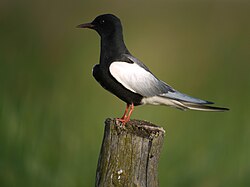
The white-winged tern, also called the white-winged black tern, is a small marsh tern that breeds in temperate Eurasia and winters widely across Africa, southern Asia, and Australia. In breeding plumage it shows striking black underparts with contrasting pale, silvery wings. It nests colonially on floating vegetation in shallow freshwater wetlands. Outside the breeding season it becomes much paler and often gathers in large flocks over lakes, flooded fields, and coastal lagoons.




Temperament
social and active
Flight Pattern
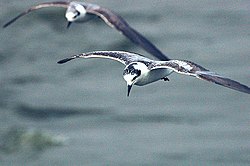
buoyant with short rapid wingbeats and agile swoops over water
Social Behavior
Breeds in loose to dense colonies, often alongside other marsh terns, building flimsy floating nests anchored to emergent plants. Pairs perform aerial displays and courtship feeding. Clutches typically contain 2–3 eggs, and both parents share incubation and chick-rearing. Outside the breeding season it forms sizable flocks that forage and roost together.
Migratory Pattern
Seasonal migrant
Song Description
Vocalizations are sharp, high-pitched kip and kree calls, especially around colonies and in flight. Alarm notes become harsher and more chattering near the nest.
Plumage
In breeding plumage, body and head mostly black with contrasting pale grey to white upperwings, white rump and tail; non-breeding birds are mostly white below with grey back and a dark ear patch and shoulder smudge.
Diet
Feeds mainly on insects such as dragonflies, mayflies, caddisflies, and beetles, which it snatches in flight or picks from the water surface. It also takes small crustaceans and occasionally tiny fish or tadpoles when available. Foraging is often over open water, flooded fields, and along reedbeds, frequently following insect emergences.
Preferred Environment
Forages over calm freshwater bodies, marsh edges, and inundated grasslands. In the non-breeding season it also uses estuaries, tidal flats, and coastal lagoons, especially where insect swarms concentrate.