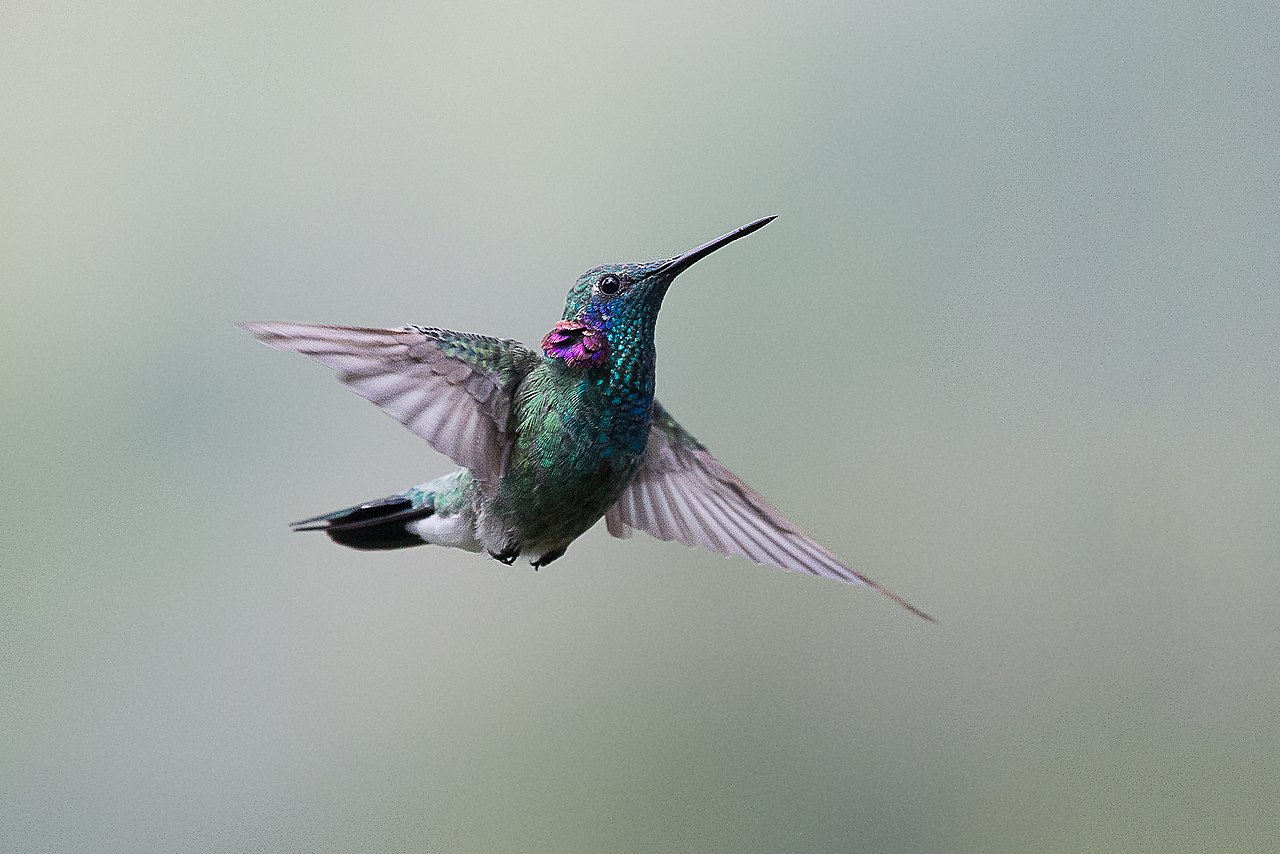
The white-vented plumeleteer is a species of hummingbird in the "emeralds", tribe Trochilini of subfamily Trochilinae. It is found in Colombia, Ecuador, Panama, Peru, and Venezuela.
Region
Northern South America and southern Central America
Typical Environment
Occurs from eastern Panama through much of Colombia and Venezuela to western Ecuador and into northern Peru. It favors humid lowland and foothill forests, forest edges, second growth, and shade plantations, and often ventures into parks and gardens. The species forages from the understory to midstory, frequently visiting flowering shrubs such as Heliconia and Inga. It adapts well to semi-open habitats as long as nectar sources and some cover are present.
Altitude Range
0–1600 m
Climate Zone
Tropical
Ease of Keeping
Beginner friendly: 1/5
A medium-sized hummingbird of the 'emeralds' group, the white-vented plumeleteer is named for its conspicuous white undertail coverts that flash as it hovers. It readily visits gardens and feeders but is often quite aggressive, with males defending rich flower patches. Several subspecies vary slightly in shade and size across its range.


Temperament
territorial and active
Flight Pattern
short rapid wingbeats with precise hovering
Social Behavior
Usually solitary while feeding and notably territorial around rich nectar sources. Courtship involves males displaying and chasing; pairs do not form long-term bonds. The nest is a small cup of plant fibers and spider silk placed on low branches; typical clutch is two eggs.
Migratory Pattern
Resident
Song Description
Vocalizations are a series of thin, high chips and buzzy twitters delivered from a perch between foraging bouts. Calls can accelerate into brief, scratchy trills during aggressive encounters.
Plumage
Males are mostly glittering green to bronze-green above with darker tail and striking white undertail coverts; females have green upperparts, grayish underparts, and the same bright white vent. Tail appears dusky blue-black, slightly notched, often with subtle pale edging on female tail feathers.
Diet
Primarily consumes nectar from a wide variety of tubular flowers, including Heliconia, Inga, and Psychotria. Supplements its diet with small arthropods, which provide essential protein, taken by hawking or gleaning from foliage. It often follows a circuit of favored blossoms and may dominate feeders.
Preferred Environment
Feeds along forest edges, clearings, riparian thickets, and in semi-open habitats such as gardens and shade coffee or cacao plantations. Frequently forages in the understory and midstory where dense flowering shrubs are available.