

The white-throated treecreeper is an Australian treecreeper found in the forests of eastern Australia. It is also called Dilmun in the Gathang language of the Worimi people, who reside in eastern Port Stephens and Great Lakes regions of coastal New South Wales, Australia. The Dilmun is the totem of Worimi women. It is unrelated to the northern hemisphere treecreepers. It is a small passerine bird with predominantly brown and white plumage and measuring some 15 cm (6 in) long on average. It is insectivorous, eating mainly ants. Unlike treecreepers of the genus Climacteris, the white-throated treecreeper does not engage in cooperative breeding, and wherever it overlaps with species of that genus, it feeds upon much looser bark besides typically using different trees.
Region
Eastern Australia
Typical Environment
Occurs from southeastern Queensland through eastern New South Wales into eastern Victoria and the far southeast of South Australia, with isolated populations in Tasmania. It inhabits eucalypt forests and woodlands, especially those with rough or stringy bark that harbors ants and other prey. It also uses wet sclerophyll forests, forest edges, and riparian corridors, and may visit suburban parks with mature eucalypts. It generally avoids very arid interiors and dense closed-canopy rainforest. Where it overlaps with Climacteris species, it typically uses trees with looser bark and different micro-foraging sites.
Altitude Range
Sea level to 1500 m
Climate Zone
Temperate
Ease of Keeping
Beginner friendly: 1/5
Endemic to eastern Australia, this species is the only treecreeper in the genus Cormobates and is unrelated to the northern hemisphere treecreepers. It forages by climbing trunks and prying at loose bark for ants and other small invertebrates. In Gathang (Worimi) it is called Dilmun and is a women’s totem. Unlike many Australian treecreepers (Climacteris), it does not engage in cooperative breeding.


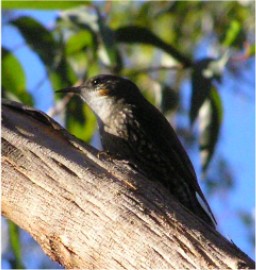
female, showing orange cheeks
Temperament
solitary to paired and territorial
Flight Pattern
short rapid wingbeats between trees; climbs and spirals up trunks
Social Behavior
Usually forages alone or in pairs and may join mixed-species feeding flocks. Nests in natural tree cavities or behind loose bark, lining the nest with bark fibres. Clutch size is small, and both parents participate in care; cooperative breeding is not typical.
Migratory Pattern
Resident
Song Description
Song is a series of clear, ringing, high-pitched whistles that often descend in pitch. Calls include sharp, high chips and repeated piping notes used to keep contact while foraging on trunks.
Plumage
Brown upperparts with fine pale scalloping, white throat and upper breast, and buffy to whitish underparts lightly streaked or mottled. Tail is brown with darker barring and often shows rufous tones. Plumage is sleek and adapted for close contact with bark.
Diet
Primarily eats ants, supplemented by beetles, spiders, and other small arthropods taken from crevices under bark. Uses its fine, decurved bill to pry and probe beneath loose or stringy bark. Occasionally gleans from small branches and twigs and may take insect eggs and larvae.
Preferred Environment
Feeds on the trunks and main branches of rough-barked eucalypts and other mature trees. Often works methodically up a trunk, moving to another tree with a short flight.


