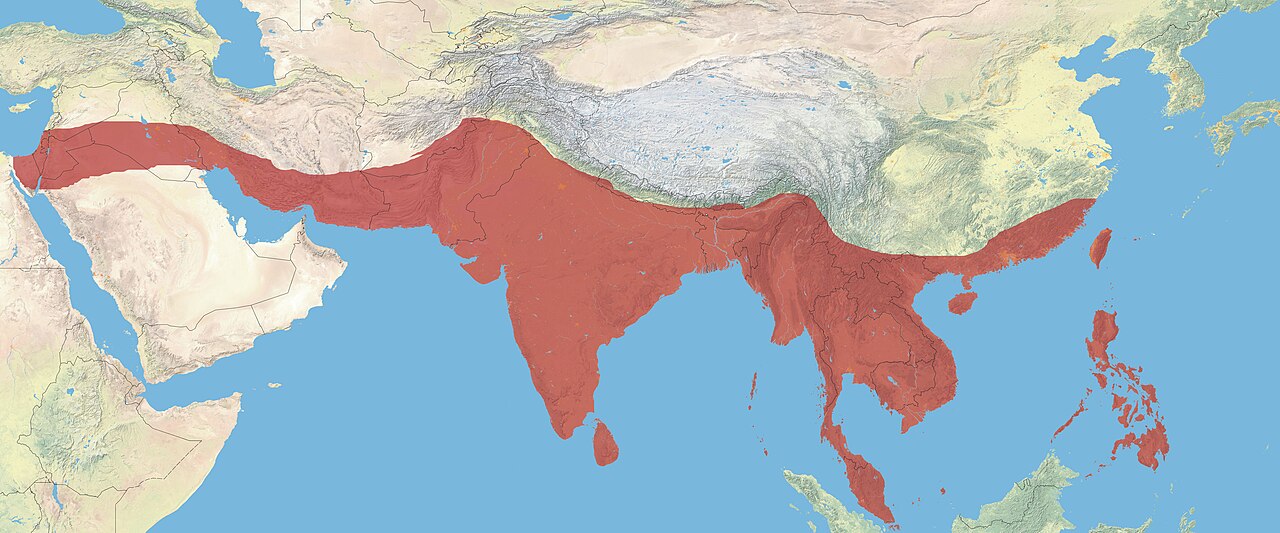
The white-throated kingfisher also known as the white-breasted kingfisher is a tree kingfisher, widely distributed in Asia from the Sinai east through the Indian subcontinent to China and Indonesia. This kingfisher is a resident over much of its range, although some populations may make short distance movements. It can often be found well away from water where it feeds on a wide range of prey that includes small reptiles, amphibians, crabs, small rodents and even birds. During the breeding season they call loudly in the mornings from prominent perches including the tops of buildings in urban areas or on wires.
Region
South Asia and Southeast Asia
Typical Environment
Occurs from the Sinai and parts of the Middle East across the Indian subcontinent to southern China and Indonesia. It occupies a variety of open and semi-open habitats including farmlands, scrub, forest edge, wetlands, and urban areas. Frequently seen along canals, rice paddies, mangroves, and ponds, but also well away from water in fields and gardens. Often perches on wires, poles, and exposed branches for hunting.
Altitude Range
Sea level to 1800 m
Climate Zone
Tropical
Ease of Keeping
Beginner friendly: 1/5
Despite being a kingfisher, it is frequently found far from water, hunting from wires and rooftops in towns and farmland. It takes a wide variety of prey from insects to small vertebrates and will boldly defend territories with loud, cackling calls. During breeding, it excavates nest burrows in banks or earthen walls. Its adaptability has helped it thrive in many human-altered landscapes.


At Singapore Botanic Gardens

At Kaziranga National Park, Assam, India

Couple of White-throated-Kingfisher


Temperament
solitary and territorial
Flight Pattern
strong flier with rapid, direct wingbeats
Social Behavior
Usually encountered alone or in pairs, especially during the breeding season. Nests are burrows excavated in earthen banks, termite mounds, or cuttings; both sexes help dig and feed young. Courtship involves calling, display flights, and food offerings.
Migratory Pattern
Resident
Song Description
A loud, raucous, cackling series of notes, often delivered from prominent perches at dawn. Calls can be far-carrying and repetitive, including rattles and sharp chacks.
Plumage
Glossy blue upperparts with contrasting rich chestnut head and underparts, and a clean white throat and breast patch.
Diet
Takes large insects (beetles, grasshoppers), earthworms, and crustaceans, as well as small reptiles, amphibians, rodents, and occasionally small birds and fish. Hunts from an exposed perch, dropping to the ground or water to seize prey. Often beats larger prey against a perch before swallowing. Opportunistic and adaptable in food choice.
Preferred Environment
Edges of water bodies, rice fields, canals, and mangroves, but also dry fields, roadsides, and urban gardens. Prefers open sightlines with scattered perches such as wires, posts, and bare branches.