
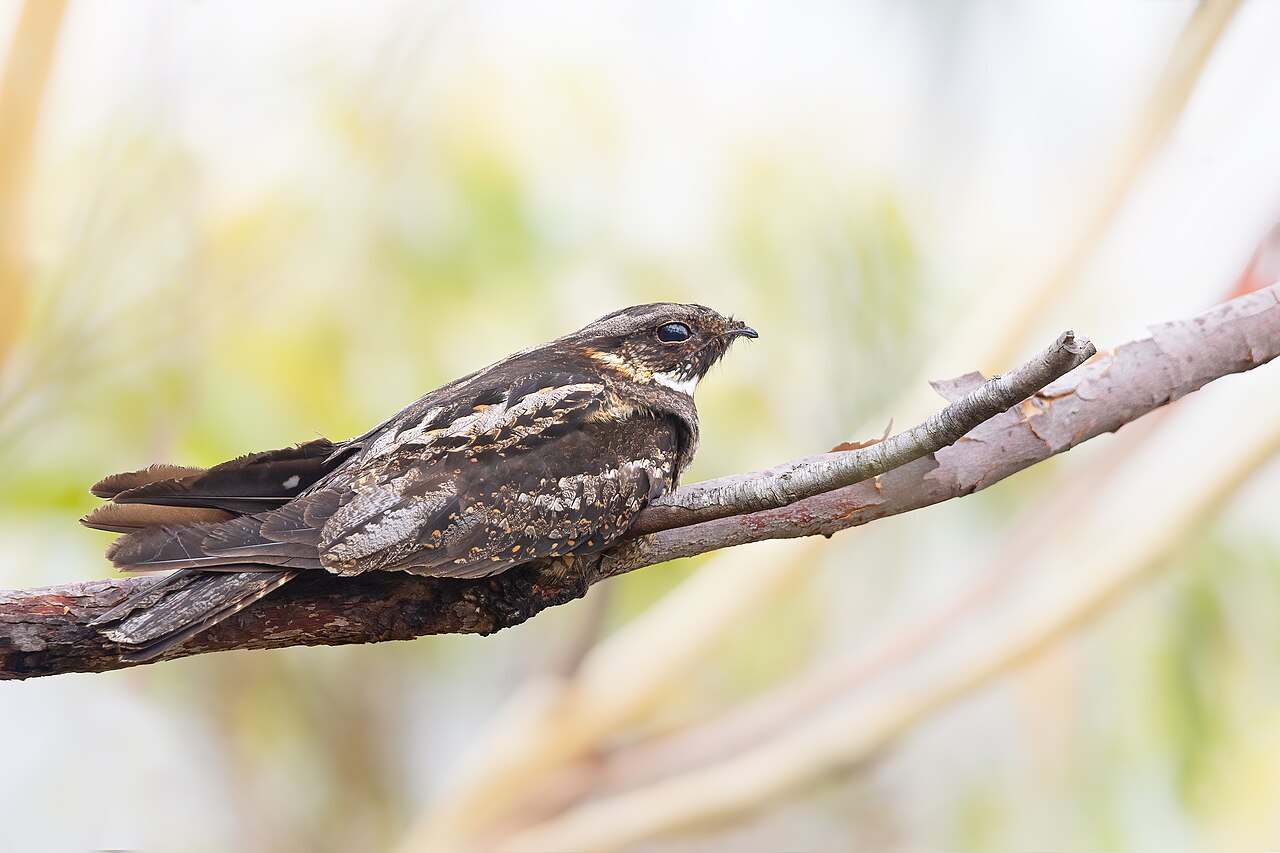
The white-throated nightjar or white-throated eared-nightjar is a species of nightjar in the family Caprimulgidae. It is endemic to eastern Australia; it is a non-breeding winter visitor in Papua New Guinea. Its natural habitat is subtropical or tropical dry forests.
Region
Eastern Australia and southern Papua New Guinea
Typical Environment
Found from eastern Queensland through New South Wales into northeastern Victoria, with non-breeding visitors in southern Papua New Guinea. It favors open eucalypt woodlands, dry sclerophyll forests, heaths, and forest edges, especially areas with sparse ground cover. It often uses ridgelines, clearings, and recently burned patches that concentrate flying insects. By day it roosts on the ground among leaf litter or low, open sites with good camouflage.
Altitude Range
Sea level to 1200 m
Climate Zone
Subtropical
Ease of Keeping
Beginner friendly: 1/5
This large nightjar is superbly camouflaged, roosting by day on leaf litter where its mottled plumage mimics bark and shadows. It breeds in eastern Australia and undertakes seasonal movements, with some birds wintering in southern Papua New Guinea. Like other nightjars, it lays a single egg directly on the ground and relies on stillness and camouflage rather than elaborate nests.


Drawing of white-throated nightjar

Temperament
solitary and secretive
Flight Pattern
buoyant flier with quick, shallow wingbeats interspersed with glides; agile aerial hunter
Social Behavior
Usually solitary or in pairs, roosting on the ground by day. Breeding involves a simple ground scrape where a single egg is laid; both parents share incubation and chick care. Displays and song are most frequent at dusk and night, with males performing aerial circuits over territories.
Migratory Pattern
Seasonal migrant
Song Description
The call is a rhythmic, far-carrying series of mellow, resonant notes that can build into a rolling trill. Soft clucking or churring contact calls are also given during foraging and at roost sites.
Plumage
Densely mottled brown, grey, and rufous with fine barring that creates a bark-like, cryptic pattern. The throat shows a bold white patch bordered by darker feathers. In flight, pale patches on the wings and tail corners may be visible, especially in males.
Diet
Primarily hunts large nocturnal insects such as moths, beetles, and other flying invertebrates. It forages on the wing, using a wide gape to capture prey in aerial sallies. Occasionally it hawks low over tracks or ridges where insects concentrate and may make brief ground sallies to pick up prey.
Preferred Environment
Feeds along forest edges, clearings, ridgelines, and above roads or recently burned areas where insect activity is high. It also patrols over open woodland canopies and near water bodies that attract swarming insects.


