

The white stork is a large bird in the stork family, Ciconiidae. Its plumage is mainly white, with black on the bird's wings. Adults have long red legs and long pointed red beaks, and measure on average 100–115 cm (39–45 in) from beak tip to end of tail, with a 155–215 cm (61–85 in) wingspan. The two subspecies, which differ slightly in size, breed in Europe north to Finland, northwestern Africa, Palearctic east to southern Kazakhstan and southern Africa. The white stork is a long-distance migrant, wintering in Africa from tropical Sub-Saharan Africa to as far south as South Africa, or on the Indian subcontinent. When migrating between Europe and Africa, it avoids crossing the Mediterranean Sea and detours via the Levant in the east or the Strait of Gibraltar in the west, because the air thermals on which it depends for soaring do not form over water.
Region
Europe, North Africa, and Western Asia
Typical Environment
Breeds widely across temperate Europe into western and central Asia and northwest Africa, favoring open lowland landscapes. It frequents wetlands, river floodplains, meadows, pastures, and agricultural fields with short vegetation. During nonbreeding it winters largely in sub-Saharan Africa and parts of the Indian subcontinent. It often nests near human settlements and uses man-made structures such as buildings and utility poles. Migrants concentrate along the Strait of Gibraltar and the Levant to exploit rising air thermals and avoid long sea crossings.
Altitude Range
Sea level to 2000 m
Climate Zone
Other
Ease of Keeping
Beginner friendly: 1/5
White storks are famous for their loud bill-clattering display, as they lack a true song. They often nest on rooftops, chimneys, and poles, reusing and enlarging the same massive stick nest for many years. In folklore across Europe they are symbols of good luck and fertility, and modern tracking shows they use distinct western and eastern flyways to avoid crossing large bodies of water.


Skeleton

A juvenile feeding on an insect

In flight. White storks fly with their necks outstretched.

An older juvenile at Vogelpark Avifauna, Netherlands. Beaks turn red starting at the base.

A flock foraging in Turkey. White storks avoid areas overgrown with tall grass and shrubs.

In 1822, the Rostocker Pfeilstorch provided early evidence of long-distance stork migration.

A flock in migration over Israel. Migrating white storks use the uplift of air thermals to reduce the effort of long-distance flying.
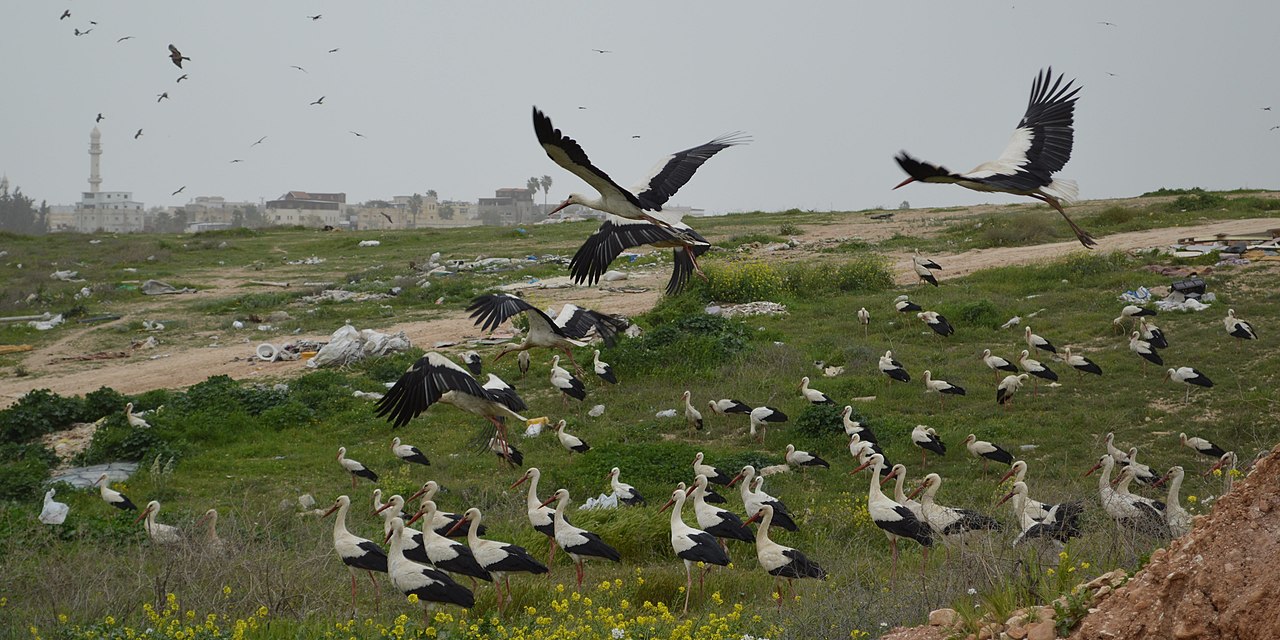
Eastern route: storks resting in Rahat (spring 2017)

Otto Lilienthal studied the flight of storks in 1889 while designing his glider. Sketches by his brother Gustav Lilienthal.

An adult in Tsavo East National Park, Kenya. The lower parts of its legs are covered with its whitish droppings—an example of thermoregulation by urohidrosis.
![Ottomar Anschütz's images of white storks, taken in 1884—the earliest known photographs of any wild birds[78]](https://upload.wikimedia.org/wikipedia/commons/thumb/0/09/Ansch%C3%BCtz_Vol_cigogne_%C3%A9tude_1884.png/500px-Ansch%C3%BCtz_Vol_cigogne_%C3%A9tude_1884.png)
Ottomar Anschütz's images of white storks, taken in 1884—the earliest known photographs of any wild birds[78]

Nests on a belfry in Spain. White storks often form small nesting colonies.

Mating

Egg
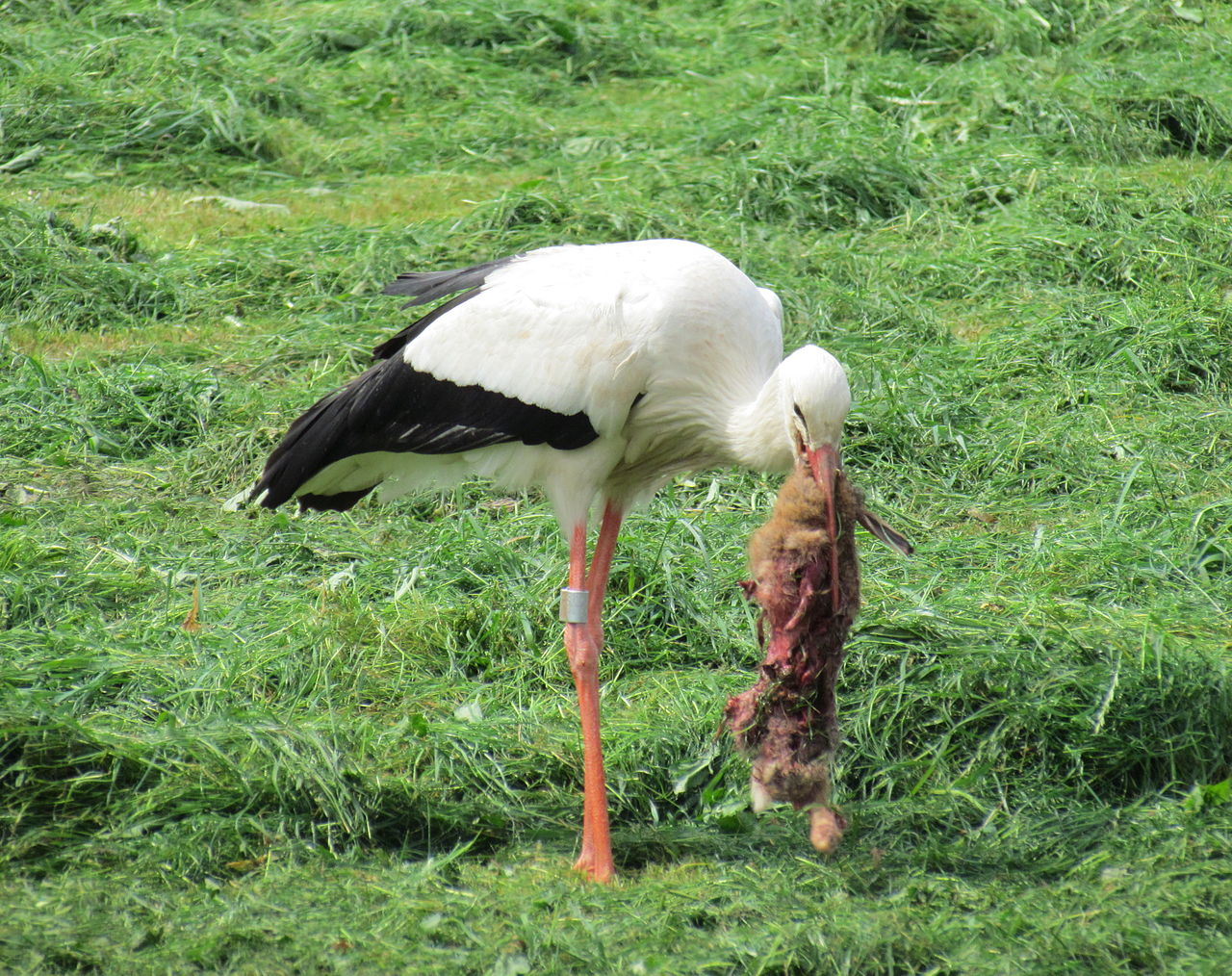
White stork picking at a dead young European rabbit (Oryctolagus cuniculus)

Results of the 2004/05 white stork census in Europe (numbers of breeding pairs)

A nest on a man-made platform in Poland. The platform was built as a conservation measure and to prevent storks disrupting electricity supplies through nesting on pylons. Three young white storks are on the nest, and two Eurasian tree sparrows are perching on the side of the nest.

The first known pair in Finland (2015), representing a northward expansion compared to the species' historical breeding range

Bociany (Storks), an oil painting of 1900, 150×198 cm, by Józef Chełmoński (1849–1914), National Museum in Warsaw
![Supposed filial virtues of the stork in a children's moral education text from 1831[147]](https://upload.wikimedia.org/wikipedia/commons/thumb/6/62/Stork_moral_education.jpg/500px-Stork_moral_education.jpg)
Supposed filial virtues of the stork in a children's moral education text from 1831[147]
![The Fieseler Fi 156 Storch received its nickname from its landing gear, resembling two long legs, and its flight style.[165]](https://upload.wikimedia.org/wikipedia/commons/thumb/3/34/Fieseler_Fi_156_Storch_D-IKVN.jpg/1280px-Fieseler_Fi_156_Storch_D-IKVN.jpg)
The Fieseler Fi 156 Storch received its nickname from its landing gear, resembling two long legs, and its flight style.[165]

Der Klapperstorch (The Stork), a painting by Carl Spitzweg (1808–1885)
Temperament
social and active
Flight Pattern
soaring glider
Social Behavior
Typically monogamous within a breeding season, pairs build large stick nests on trees, rooftops, or pylons and may reuse them for decades. They form loose colonies in suitable habitat and gather in large flocks during migration and at roosts. Both parents incubate and feed the young by regurgitation.
Migratory Pattern
Seasonal migrant
Song Description
Mostly silent; primary display is rapid, resonant bill-clattering during courtship and at the nest. Occasional hisses and soft calls may be given at close range, especially by chicks.
Plumage
Mostly white with contrasting black flight feathers; sleek, smooth plumage with broad wings.
Diet
An opportunistic predator that takes large insects, earthworms, amphibians, reptiles, small mammals, and fish. It hunts by walking slowly and striking at visible prey on the ground or in shallow water. In some regions it also forages at ploughed fields and landfills, but natural prey from wetlands and grasslands dominates the diet.
Preferred Environment
Feeds in open habitats with short vegetation such as meadows, grazed pastures, fallow fields, rice paddies, and marsh edges. Shallow wetlands and river margins are important for amphibians and fish. Often follows agricultural activity that exposes invertebrates and small vertebrates.


