

The white-backed duck is a waterbird of the family Anatidae. It is distinct from all other ducks, but most closely related to the whistling ducks in the subfamily Dendrocygninae, though also showing some similarities to the stiff-tailed ducks in the subfamily Oxyurinae. It is the only member of the genus Thalassornis.
Region
Sub-Saharan Africa
Typical Environment
Occurs widely across sub-Saharan Africa and on Madagascar in quiet freshwater habitats. It favors shallow lakes, ponds, marshes, and dams with dense emergent vegetation and abundant floating plants such as water lilies. The species avoids large expanses of open water, preferring sheltered coves and reedbeds. It is largely sedentary but may move locally in response to water levels and seasonal drying.
Altitude Range
0–2500 m
Climate Zone
Tropical
Ease of Keeping
Beginner friendly: 2/5
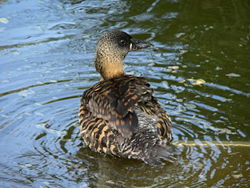
The white-backed duck is the sole member of its genus and is most closely related to the whistling ducks. It is an adept diver that often sinks quietly to avoid danger, making it surprisingly hard to flush into flight. The eponymous pale back patch is most obvious when the bird is preening or fluffed. It favors lily-covered waters and is often overlooked due to its secretive habits.




Temperament
solitary and secretive
Flight Pattern
short rapid wingbeats; reluctant to fly, prefers to dive
Social Behavior
Often found alone or in small loose groups, especially where cover is dense. Pairs form in the breeding season, and the nest is a floating or semi-floating platform hidden in emergent vegetation. Clutch size is moderate, and downy young are precocial and leave the nest soon after hatching. Parental care is shared, with adults guiding ducklings through cover-rich waters.
Migratory Pattern
Resident
Song Description
Generally quiet; vocalizations include soft whistles and low grunts. Calls are most often heard at night or around dawn and dusk, especially during the breeding season.
Plumage
Densely mottled dark brown plumage with fine buff spotting; overall appearance is dark and cryptic. A pale to whitish patch across the upper back can show when feathers are raised or during preening. Underparts are similarly mottled, and the tail is short. Plumage is adapted for camouflage among floating vegetation.
Diet
Feeds mainly on aquatic plants, especially leaves, buds, and seeds of water lilies and other floating vegetation. It also takes stems and seeds of submerged and emergent plants. Occasional small aquatic invertebrates may be consumed incidentally while foraging. Foraging involves diving, dabbling, and upending among dense lily pads.
Preferred Environment
Usually feeds in sheltered, still waters with abundant floating vegetation and thick reedbeds. It keeps close to cover, working along edges of lily beds and within narrow channels.


