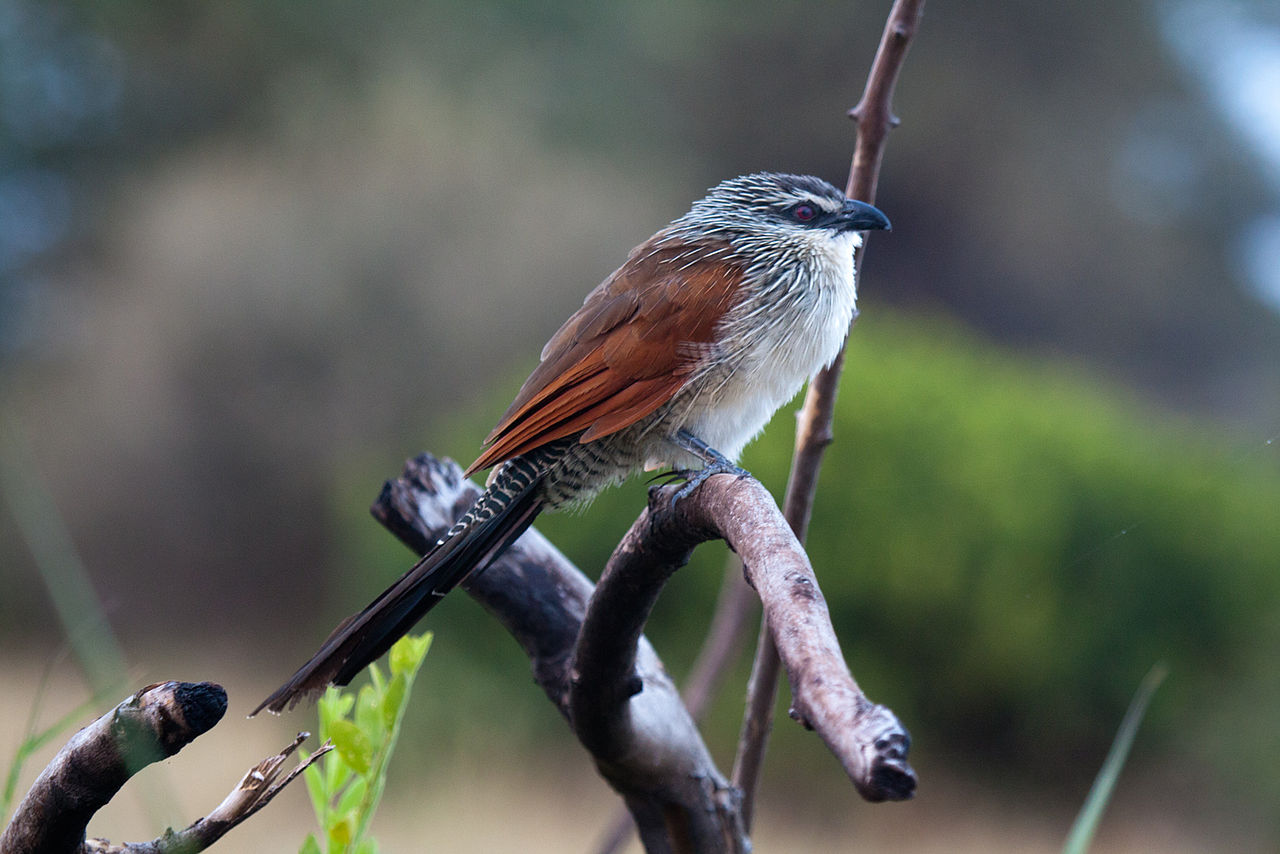
The white-browed coucal or lark-heeled cuckoo, is a species of cuckoo in the family Cuculidae. It is found in sub-Saharan Africa. It inhabits areas with thick cover afforded by rank undergrowth and scrub, including in suitable coastal regions. Burchell's coucal is sometimes considered a subspecies.
Region
Sub-Saharan Africa
Typical Environment
It occurs widely from East to southern Africa in habitats with dense cover, including rank grass, reedbeds, riparian thickets, thorn scrub, and coastal bush. It favors ecotones and overgrown edges near wetlands, drainage lines, and cultivated areas. It generally avoids closed forest and very open, arid plains. Often found near water but can persist in dry scrub where undergrowth is tall and tangled.
Altitude Range
0–2300 m
Climate Zone
Tropical
Ease of Keeping
Beginner friendly: 1/5
Also known as the lark-heeled cuckoo, this species is one of the few cuckoos that builds its own nest and rears its own young. Its rich, bubbling calls often increase before or after rain, earning coucals the nickname “rain birds” in many parts of Africa. It skulks through dense cover more than it flies, often sunning with wings spread after cool nights.


Juvenile

White-browed Coucal Adult
Temperament
secretive and skulking
Flight Pattern
short rapid wingbeats with low, gliding hops between cover
Social Behavior
Usually seen singly or in pairs, maintaining small territories year-round. It is monogamous, and both sexes build a domed nest of grasses hidden in dense vegetation. Both parents incubate and feed the chicks. Unlike many cuckoos, it is not a brood parasite.
Migratory Pattern
Resident
Song Description
The call is a series of rich, bubbling hoots and descending ‘doo-doo-doo’ phrases, often given in duet at dawn and dusk. Calls carry far in still air and are common after rain or during humid weather. Alarm notes are harsher, with clucks and churring sounds from within cover.
Plumage
Coarse, streaked brown upperparts with pale buff streaking; warm rufous wings; long blackish tail with pale tips; underparts creamy-white to buff. A bold white supercilium contrasts with a darker crown and face. Plumage is loose and slightly shaggy, especially on the flanks and mantle.
Diet
Primarily hunts large insects such as grasshoppers, beetles, caterpillars, and mantises. Also takes spiders, small reptiles, frogs, and occasionally small birds or eggs. It may supplement its diet with small snails and other invertebrates, seizing prey with a strong, hooked bill.
Preferred Environment
Forages low in dense scrub, rank grass, and reedbeds, often moving along the ground or clambering through vegetation. Frequently hunts along wetland margins, drainage ditches, and overgrown field edges where prey is abundant.