

The western rockhopper penguin, traditionally known as the southern rockhopper penguin, is a species of rockhopper penguin that is sometimes considered distinct from the northern rockhopper penguin. It occurs in subantarctic waters of the western Pacific and Indian Oceans, as well as around the southern coasts of South America. It was formerly considered to be conspecific with one or both of eastern rockhopper penguin and northern rockhopper penguin.
Region
Subantarctic South Atlantic and southern South America
Typical Environment
Breeds mainly around the Falkland/Malvinas Islands and off the southern coasts of Chile and Argentina, including nearby offshore island groups. Outside the breeding season, birds range widely over the subantarctic and temperate South Atlantic, foraging over continental shelf and shelf-break waters. Colonies are placed on steep, rocky coasts and tussock-covered headlands with access to the sea. At sea they occupy cold, productive waters influenced by upwellings and fronts.
Altitude Range
Sea level to 200 m
Climate Zone
Temperate
Ease of Keeping
Beginner friendly: 1/5
Western rockhopper penguins are the spiky-crested, red-eyed penguins famous for bounding over rocks rather than sliding on ice. They lay two eggs of very different sizes, with the first-laid smaller egg usually failing—an unusual strategy among birds. Colonies can be extremely noisy during breeding, and adults undertake long post-breeding dispersals at sea. Major threats include climate-driven prey shifts, fisheries interactions, and oil pollution.


Adult E. c. chrysocome in the New Island (Falkland Islands) rookery

Eudyptes chrysocome colony on Saunders Island, Falkland Islands

Western rockhopper penguin (Eudyptes chrysocome) displaying its distinctive crest
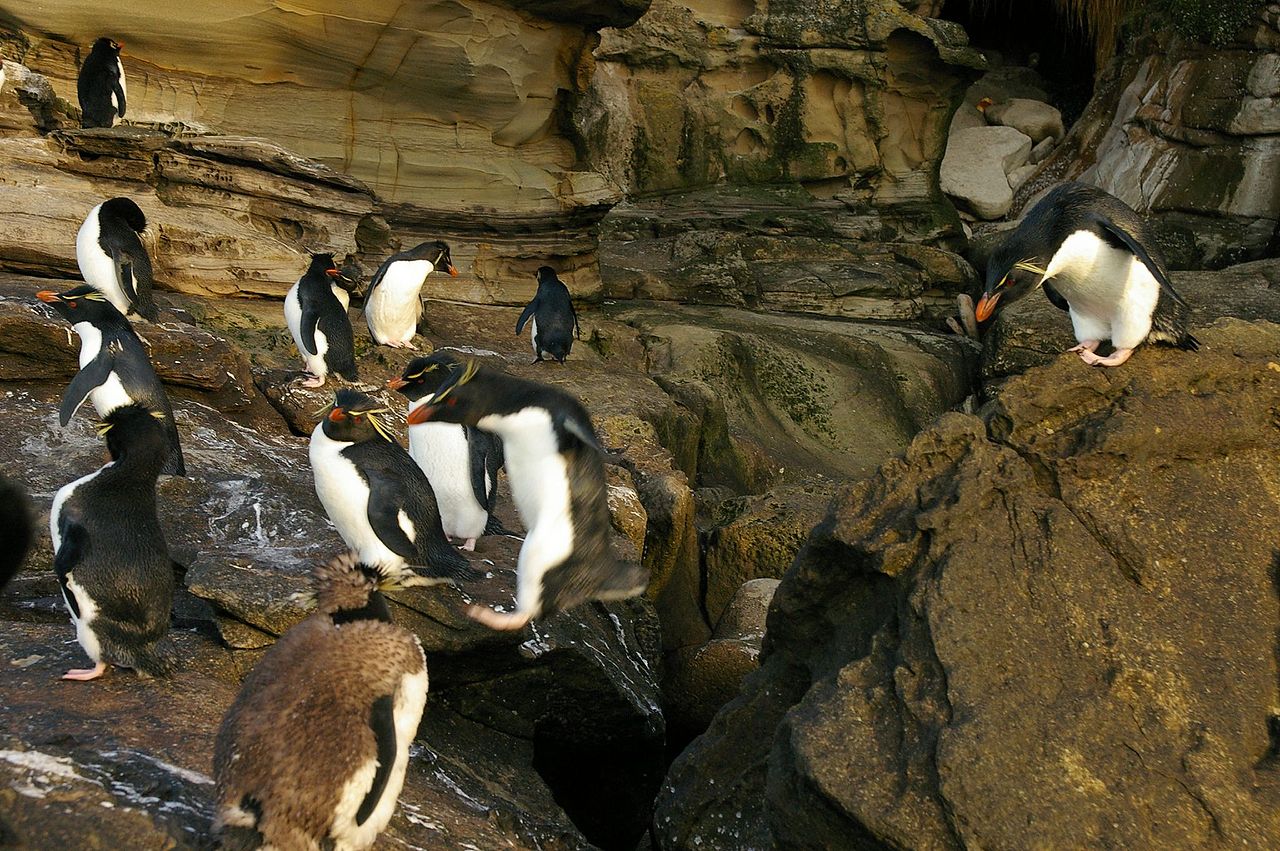
E. chrysocome on Saunders Island, Falkland Islands hopping over a crack

Egg

A chick on the Saunders Island in the Falkland Islands

Rockhopper penguin skeleton in Manchester Museum
Temperament
social and assertive
Flight Pattern
flightless; powerful underwater swimmer using rapid flipper strokes
Social Behavior
Breeds in dense colonies on cliffs and rocky slopes, often under tussock grass. Pairs are generally monogamous within seasons and perform elaborate mutual displays. Nests are shallow scrapes lined with pebbles or vegetation, and two eggs are laid with strong size dimorphism. Adults show high site fidelity, returning to the same nesting areas annually.
Migratory Pattern
Partial migrant
Song Description
Vocalizations include loud brays, barks, and gruff calls used in pair bonding and territorial defense. At colonies, individuals give rhythmic, trumpeting display calls accompanied by head-shaking and crest-raising.
Plumage
Sharp contrast of black upperparts and white underparts with a shaggy, spiky crest; sleek, waterproof feathers adapted for diving.
Diet
Feeds mainly on krill and other crustaceans, small schooling fishes, and cephalopods. Forages by pursuit-diving, typically to tens of meters but capable of deeper dives when prey is scarce. Diet composition varies seasonally and regionally with oceanographic conditions. They may forage singly or in loose groups when prey is abundant.
Preferred Environment
Cold, productive shelf and shelf-break waters near oceanic fronts and upwellings. During chick-rearing they often forage closer to the colony; post-breeding they range more widely offshore.


