

The western rosella, or moyadong, is a species of parrot endemic to southwestern Australia. The head and underparts are bright red, and the back is mottled black; a yellow patch at the cheek distinguishes it from others of the genus Platycercus. Adults of the species exhibit sexual dimorphism with the females duller overall; juveniles lack the striking colours of mature birds and the characteristic patterning is not as easily distinguished. Their communication call is a softly delivered pink-pink sound, and much of their behaviour is comparatively unobtrusive. Their habitat is in eucalypt forests and woodlands, where they often remain unobserved until they appear to feed on seeds at nearby cleared areas.
Region
Southwest Australia
Typical Environment
Occurs in eucalypt forests and woodlands dominated by jarrah, marri, and karri. Uses riparian belts, sheoak groves, and timbered farmland with scattered mature trees. Frequently forages on the ground in cleared pastures, road verges, and orchards, retreating to the canopy when disturbed. Also appears in parks and large gardens within its range where suitable tree hollows and food are available.
Altitude Range
Sea level to 800 m
Climate Zone
Temperate
Ease of Keeping
Beginner friendly: 3/5
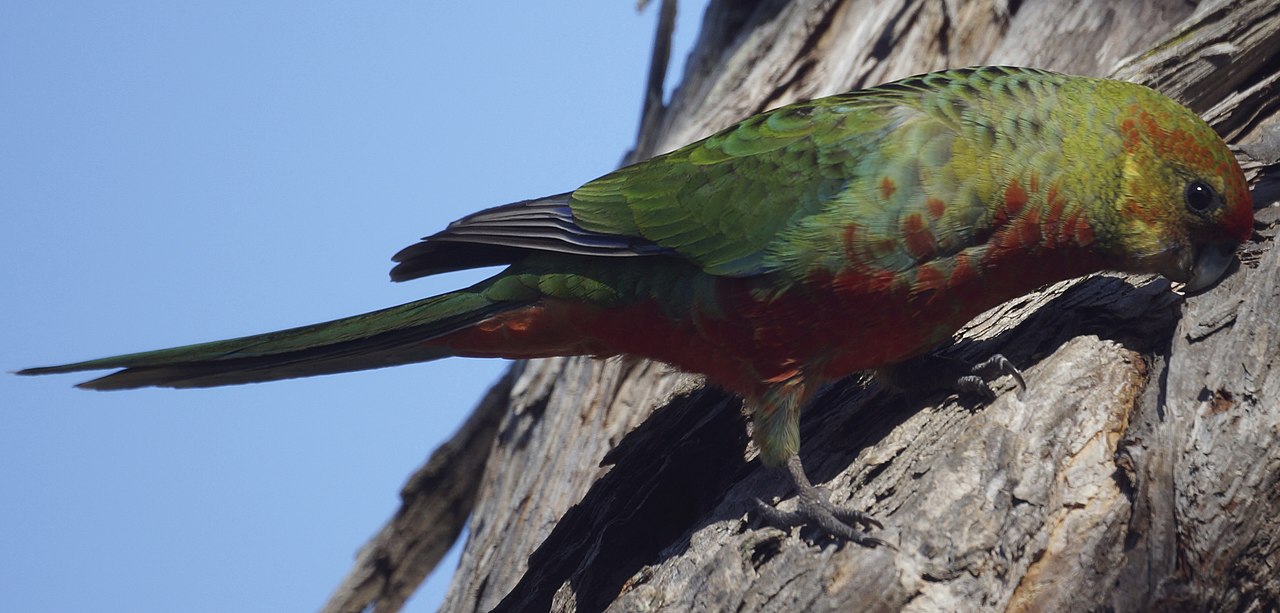
The western rosella (moyadong) is the smallest rosella and is confined to the southwest of Western Australia. Males are strikingly red-faced with yellow cheek patches, while females and juveniles are duller and more heavily mottled, helping them remain inconspicuous. They are quiet, unobtrusive parrots that often feed on the ground along woodland edges and farmland. Their soft, tinkling pink-pink calls can be heard as they move between feeding sites and tall eucalypts.


"Platycercus xanthogenys" Keulemans, 1891. This is an illustration of the type specimen of subspecies Platycercus icterotis xanthogenys.

Henry Constantine Richter's Platycercus icterotis, rechristened the "Earl of Derby Parrakeet", 1848

Male adult walking through leaf litter

Plate 23 of Illustrations of the Family of Psittacidae, or Parrots, first depiction of the species by Edward Lear, November to December 1830, entitled "Platycercus Stanleyii / Stanley Parrakeet", named for the patron Lord Stanley

Immature birds at a picnic area in karri forest
![Plate 24 of Lear's Illustrations (1830), depicting a captive specimen in England.[4]](https://upload.wikimedia.org/wikipedia/commons/thumb/a/a1/Lear_plate_24_Platycercus_stanleyii_juv.jpg/1280px-Lear_plate_24_Platycercus_stanleyii_juv.jpg)
Plate 24 of Lear's Illustrations (1830), depicting a captive specimen in England.[4]
Temperament
shy and unobtrusive
Flight Pattern
short rapid wingbeats with swift, direct flight
Social Behavior
Often seen in pairs or small family groups; larger loose flocks may form at rich food sources outside the breeding season. Nests in deep tree hollows of mature eucalypts, with strong site fidelity. Pairs maintain quiet contact calls while foraging on the ground and retreat to cover when alarmed.
Migratory Pattern
Resident
Song Description
A soft, tinkling series of notes and the characteristic pink-pink contact call. Vocalizations are subdued compared with other rosellas, becoming more insistent near the nest or when regrouping.
Plumage
Male with bright red head and underparts; upperparts green with black scalloping; blue-green wings and long tail. Female and juvenile birds are duller olive-red below with heavier green mottling above. Feathers show fine scalloped patterning across the back and mantle.
Diet
Takes seeds of grasses and herbs, eucalypts, and acacias, along with blossoms, fruits, and leaf buds. Consumes nectar when available and occasionally supplements the diet with insects and their larvae. Will feed on spilled grain and fallen orchard fruit in agricultural areas.
Preferred Environment
Forages mainly on the ground along woodland edges, in lightly timbered farmland, and open clearings near dense cover. Also feeds in orchards, road verges, and parklands, moving to trees to preen and rest.


